Be Loving

When I was a little girl I wrote on a slip of paper, “When I grow up I want to be a writer or a dancer.” I know this because a relative of mine saved it all these years. Written in extra large letters, it was less of a wish and more of a declaration.

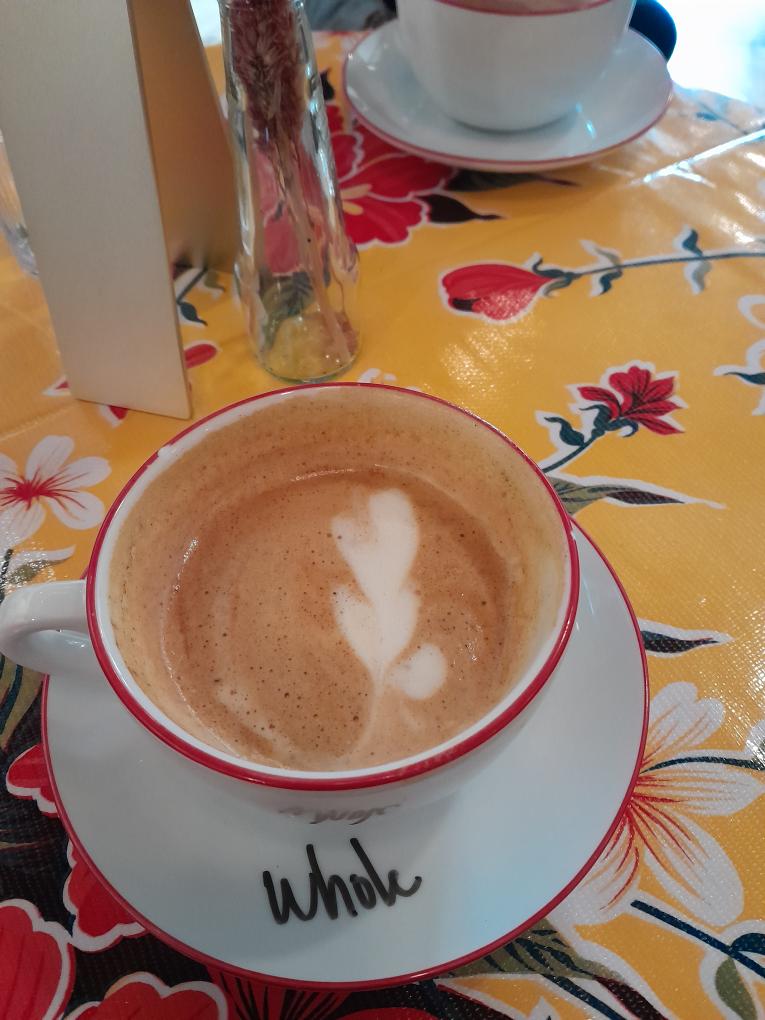
I am a water sign, born in autumn of 1985. Last week, to celebrate my birthday, a friend of many years accompanied me to a hot spring in the woods east of Eugene. We tried to get as close to the source as possible (literally and figuratively), tended to our senses, and bathed in the forest together. As with most my birthdays there was a delicate balancing act going on inside me—was my birthday meaningful or meaningless? (Is there such a thing as a meaningless day?) Ever the meaning-seeker, I leaned into the moments that felt extra special: a barista penning “whole” on my golden spice latte order (in case I’d forgotten), a bill totaling my exact angel number, cold raindrops on my bareface, the earthy-eggy scent of natural mineral water, a park ranger telling me “Don’t listen to what they say about forty, you’ve still got plenty of time and lots of living ahead of you,” and feeling like he really meant it; then, when I got home, finding an itty bitty perfectly formed diamond (fake, obviously) stuck in the mud in the crevasse of my hiking shoe. I held it up to the sunlight and thought it must be a gift from Dad.

Despite my best efforts not to, I found myself reflecting on my life’s trajectory on my birthday. Taking stock. Thinking of that note of mine, the one I’d penned as a child, I have just one edit for little girl me: Don’t be a writer, be writing. Don’t be a dancer, be dancing.

Perhaps with that shift in perspective, I can feel good about where I’m at today. I write, creatively mostly, professionally some. And I recently took up a Dance Fitness class at my local gym. (I’m loving it!) Maybe I am living the life I once dreamed of. I must be, only it’s slightly off-center. Something like it. Close enough. As the tides keep changing and the pages keep turning, I hope to remember that I am the author of my journey. And always remember to be writing, and be dancing. And, all we really came here to earth school to do: be loving.

My Greatest Teacher

It’s been going on four years now, Dad. You’d be turning 63 years old in November. Now that I am turning 40 myself, I’m growing wiser (and more disillusioned) with every day. I’ve never been more aware of this stupid human suit I’m wearing. It’s incredible what a difference a few years makes. I wish I could tell you all I’ve learned since you departed. I would ask your forgiveness for the times I articulated your faults on the page, just trying to understand. I would tell you that I understand now. I get it more, Dad.

These are the words rattling around in my mind this afternoon: poverty is a systemic failure, not a personal one. After you died, I discovered that it was a measly ten thousand dollars standing between us and our dreams. I learned that if you hadn’t been literally robbed of your cash, we would have had a home–those sturdy walls and saloon doors we’d sketched out so carefully. Why didn’t you ever tell me that? About the time you got robbed of ten thousand dollars and everything changed?

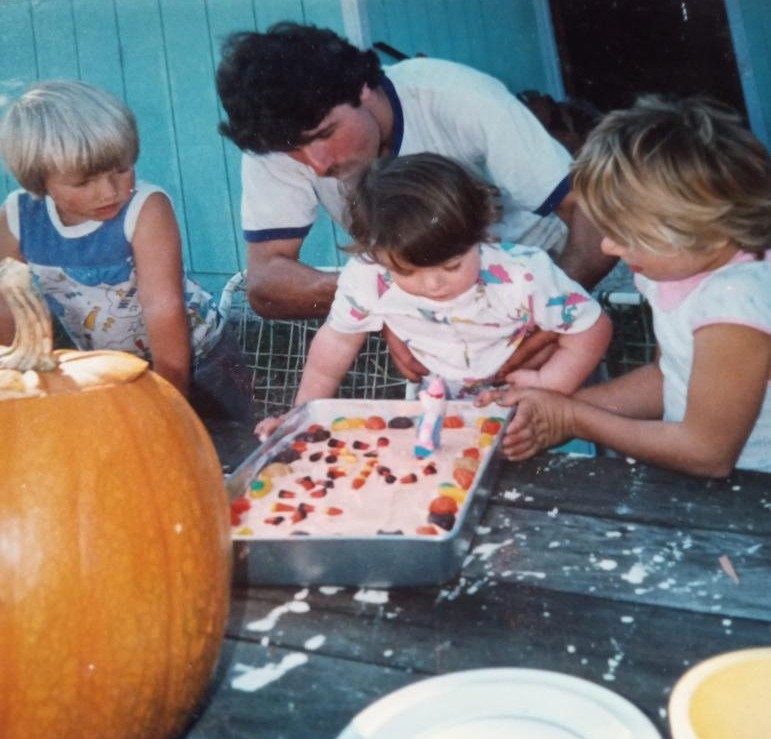
Today, Aunt Julie shared a picture of us that I’d never seen. It was taken on my second birthday, outside the house on Glenn Street. Someone (was it you?) made me a sheet cake and spelled out my name in candy corn. What I love about the picture is that as I am blowing out my birthday candles, so are you. You were ever encouraging, attuned, a gentle wind at my back from day one. God, I look like Autumn in the photo. A few years ago, unwittingly, I also decorated her birthday cake with candy corn. October babies.

You don’t want to be forgotten, do you? I know this because every now and again you pop up. A photo I’ve never seen. Your song playing on the radio. Your initials emblazoned on a barn along the interstate. But most incredible are the thirty-some-odd handwritten pages I recently received from a relative, your descriptions of our early days together. How did it take me all this time to realize that it was you all along? That it was you, legally disabled but spiritually sophisticated, who inspired my love of writing? I wish I could tell you all I’ve learned since you’ve departed, because one thing I know for sure is that you’d be listening.

What I wouldn’t give to scramble up a hillside with you today, sit at the top, overlooking some vista, laughing at the absurdity of it all. Someday I’ll get to reading those pages you sent me from the great beyond. But honestly, it kind of hurts to do so. I opened it once and a line jumped out at me. It read, “I believe in simple living and high thinking.” What more do you have to teach me, Dad? Are you still the wind at my back? What can I do to not be robbed of ten thousand dollars? Anything?

Storytime: Reading the Waves by Lidia Yuknavitch

I don’t do book reviews or ratings. If I loved a book, you’ll likely hear about it from me eventually. Rarely, my book hype might even venture into some different form, maybe even a story, which is exactly what happened here.

I was mostly finished reading Lidia Yuknavitch’s Reading the Waves when I spontaneously suggested to my family that we scratch our original Mother’s Day brunch plans in Eugene and drive to Heceta Beach instead. Spontaneity–a mother’s antidote to monotony. The decision was a full body knowing. Something you don’t question. Like when the month before Dad died, I suddenly announced that we’d be making an impromptu trip to see him. Quality time with Autumn’s grandpa. An overdue visit. We didn’t know it yet but—that would be our goodbye. Now I try to always follow my intuition.

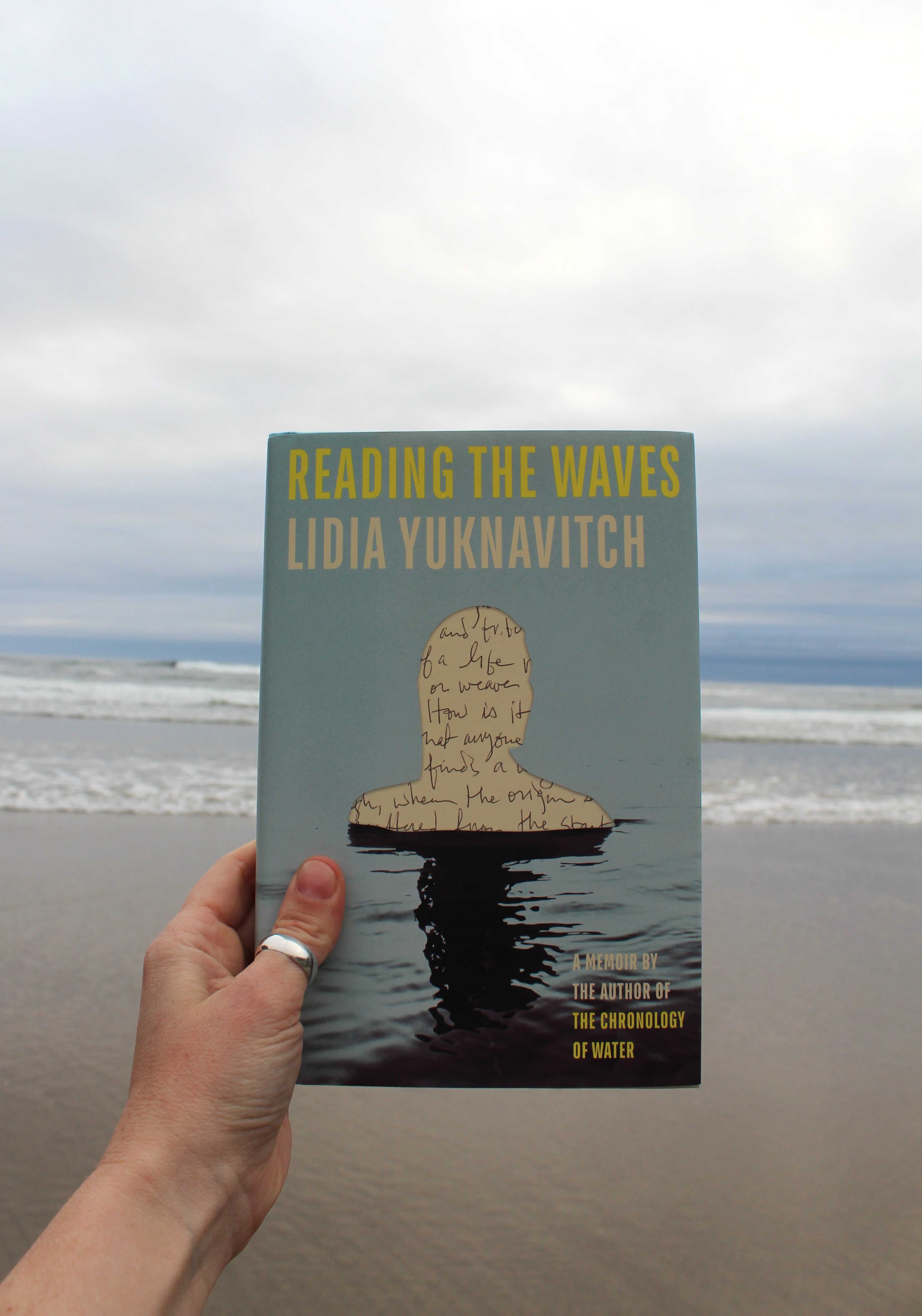
Before driving forty miles northwest to Heceta Beach, I grabbed Lidia’s book, wrapped it in a silk scarf, and placed it in our picnic basket. Once there, Autumn and I began skipping rocks on the creek that spills into the Pacific. The rocks were black, round and flat. They were the perfect skipping rocks! Steve built a campfire in the sand, and we all ran barefoot on the beach. We explored the grottos underneath the lighthouse, examined the tidal pools for starfish, then sat around the fire making s’mores. Eventually I took out Lidia’s beautiful book to photograph it against the moody backdrop of sky, waves and sea. I figured that later, when I’d finished the remaining few pages, I’d have an image to share alongside my words about how much I loved the book. I took a couple photographs then walked back to the campfire.

Back at the farm, a nearly full flower moon in Scorpio shone through the bedroom window. I opened Reading the Waves, reading only for a page or two before the following words jumped out at me: The historic Cape Creek Bridge arches over the place where a creek and the ocean meet. If you are at the lip of the ocean and the arm of the creek, the bridge feels like it has your back.

At the lip of the ocean and the arm of the creek…In her new book, Lidia had written a whole page about the exact place we’d built our campfire and skipped rocks at the beach. The next day, I wrote her a letter and sent it to her PO box. Something about cosmic nudges, kinship, inner knowing, invisible threads, art, motherhood, and awe. Something about Heceta Beach.

Beautiful coincidences aside, first with The Chronology of Water and now with Reading the Waves, Lidia has breathed life into me through her work. It feels as if by writing her truths, she’s writing my truths, too. There are even parallels within parallels, stacked like little nesting dolls: our connection to Eugene, Oregon; our obsession with the underwater world and how it is one of the only places on earth we feel safe; our complicated family stories; our inherited misfittedness; our need for peace, for space, for quiet. But this isn’t about me, it isn’t personal…It’s just that every time I read a book that resonates with me on that level, it feels that way: personal. It makes me wonder if things aren’t connected on a mostly invisible realm existing just beyond our field of vision. Just beyond our willingness to believe in such magic.

The moment I began Reading the Waves, I got swept away. She writes of geographies lodged in our psyches, in our bones, even in our gait. She reminds me that although certain memories may be unforgettable, we can transform the rough ones into something smoother. Like with all the rocks she collects along the shore, stories too are destined to go through their own metamorphosis. Each one with a different history, color, and composite—best witnessed when illuminated underwater. This book feels to me, at least in part, about all the great loves in her life. About the wild forms intimacy takes. They are Lidia’s love stories, right when I needed them most. This book may feel like a return to The Chronology of Water for fans of Lidia’s early work. (Her unforgettable memoir was adapted into a film directed by Kristen Stewart which recently premiered at the Cannes Film Festival.) You can find Lidia’s latest book, Reading the Waves, at Powells Books and other national and local booksellers. She currently teaches writing workshops on the Oregon coast.

Reading the Waves by Lidia Yuknavitch
Heceta Beach, Oregon, May 2025

Back Home Before You Know It

Driving past the massive redwood peanut carving meant that we were halfway to Eureka, California. The redwood peanut was also a marker of the town where my mother, Moonbeam, lived. Every other weekend, Dad drove me to Orick for our mandatory visit. Mandatory just meant that the law was involved. The law being involved was practically a law of the universe for people like us.

But the law had little to do with why we were driving past the redwood peanut that day. Except that after my scheduled ear surgery, I was mandated to remain with Moonbeam in Orick–in civilization–until my eardrums fully recovered. It would likely take the rest of summer. My earaches had become regular enough that a physician recommended I get tubes put in to help drain out all the gunk. I would also be getting my tonsils and adenoids removed. The plan was that after leaving the hospital in Eureka–the same hospital where I’d been born nine years earlier–Dad would drop me off at Moonbeam’s before heading back upriver to our home off grid. It would be the longest I’d ever stayed with Moonbeam, my stepdad, and my two younger brothers. I stared out the window as we drove past the huge redwood peanut, anticipating the story I knew was coming.

“That peanut,” Dad began, “was trucked all the way to the White House in Washington D.C. as a gift for President Jimmy Carter. But because Carter was an environmentalist, he shipped it back. He saw it as an insult. Here Carter was, trying to save the redwoods—or what was left of them—and some loggers from Orick send him a redwood tree carved into peanut! What a joke. I mean, can you imagine?”

I didn’t say anything in response. Didn’t need to. Sometimes Dad talked to keep himself awake while driving. Despite that it wasn’t nighttime, I knew Dad was probably tired. He’d worked at the road department all week, helped get my belongings together for the trip, then driven from near the border of Oregon in a car we’d borrowed from a friend of his. I didn’t really know why we were in the car, and not in Dad’s pick-up truck. Maybe the truck got a flat tire or needed a repair. Or maybe driving the car had been mandated. For whatever reason, I was riding in the backseat: precious cargo.

The car smelled horrible and was making my stomach turn. I never got car sickness on windy roads, but I suddenly felt queasy. It was as if invisible cigar smoke was emanating from the maroon velvet seats. Dad didn’t smoke, but whoever owned the car sure did. I was getting nauseous. I tried to lie down, the seat belt digging into my waist. I didn’t know what was worse: watching the tops of the redwood trees zoom by out the window, green morphing to white given all the movement, or closing my eyes. Both felt impossible. The pain in my ears faded to the background as my nausea took centerstage. I heard Dad mumble something about the time. My ear surgery was scheduled to start in one hour, so we’d be cutting it close. I gripped the car seat with one hand and held my other hand to my forehead, trying to remain steady. One more hour to go, and then the hard part would begin.

Naturally, I didn’t remember a thing from my first visit to Humboldt General Hospital–the day I’d been born there. This time though, I’d remember every detail. Starting with how enraged Dad was when I finally puked as he whipped the car into the parking lot.

“Couldn’t you have at least waited until I parked?” Dad yelled at me, swinging my door open.

Dad rarely yelled and never hit me, but in that moment, he looked like he wanted to rip my head off. Now that I am a parent myself, I know the look. It was stress. It was fear of failure. It had little to do with me. Fucking up created shame. Dad couldn’t win. We were late and I’d puked in the car he’d borrowed. This would all make him look bad. It would take time that we just didn’t have. Dad quickly shook out the floor mat, tossing the vomit into some nearby bushes, and then we raced into the hospital.

Before long, the hospital staff were preparing me for surgery. Dad may or may not have told them about the vomiting. It was all happening so quickly. They said I wouldn’t feel a thing during the operation, no pain and no nausea, because they planned on putting me to sleep. I was intrigued, then confused. Instead of reading me a bedtime story, a nurse placed a large, rubber mask over my mouth and nose. Because I’d never worn anything like the mask, I was frightened—and then I was out.

I remember a few details from right before they put the mask on. After being wheeled into the room, they positioned me with my feet pointed toward the door we’d entered through. There were three people: one doctor and two nurses. They were all wearing masks too, but a different kind.

Then things changed. The doctor began counting back from ten. By the time he got to four, I did indeed fall asleep. But I also rose up out of my body. Suddenly, my feet were no longer pointing at the door from which we’d entered, but my back was. And instead of laying horizontally, I was standing vertically. I was technically floating and there were two of me: the “me me” and the “hospital bed me.”

Me me observed the doctor and one nurse performing the operation, and a second nurse standing off to my right.

I woke up as I was being wheeled down a short hallway. Never mind that I was getting too old for stuffed animals, I was downright giddy when someone handed me a small teddy bear wearing a white t-shirt with the name of the hospital printed on it. Maybe they’d known they almost killed me back there, and the teddy bear was my consolation prize. I didn’t care. The deal was made even sweeter when I was given a popsicle in the recovery room. I was instructed to eat lots of popsicles in the days to come. Maybe it will be okay after all, I thought.

Driving back to Orick, I sat in the backseat again. I told Dad about the strange occurrence when they’d “put me out” at the hospital.

“Hey, that’ll happen,” Dad said reassuringly, looking at me in the rearview mirror.

Dad was nonchalant. He knew his stuff. This was child’s play. Dad was the one who had spent weeks on the other side after a drowning accident when he was a kid. They’d dubbed him Miracle Boy in the local newspaper. After the accident, our family felt Dad got touched by an angel, because from then on, he was so different. Not just his voice, which had been scarred in the accident, but his whole way-of-being. He was spiritual and special. What I’d experienced was only a blip. I didn’t get so much as a glimpse of heaven. It was practically nothing. I needed to focus on my future, on getting better, on summer.

Today I understand why I didn’t go to the great beyond. Had things ended differently that day, Dad would never have forgiven himself for how he’d left things, for yelling at me like he had in the parking lot. We drove past the redwood peanut again and I sighed audibly.

“You’ll be back home before you know it,” Dad said, empathetically.

I wasn’t entirely sure if Dad meant our cabin by the river, or our home up in the sky.

Journaling Prompts for Trauma Healing

Writing heals. Through the act of writing, we begin to understand ourselves more deeply. This is especially true for writers of memoir, personal essays, and poetry. We discover what matters to us. We learn what’s impacted us, and in what ways. The self-awareness gained through writing becomes a gift to oneself and others. Our journals becoming a place to lay down whatever worries we carry, large or small–with the option of sharing what we’ve written with others, or not. In my experience the act of writing is inherently healing, and the act of sharing our writing is inherently empowering. We discover that people can witness our darkest expressions and still accept us, maybe even love and respect us more knowing what makes us us.

In Spring 2023 I began guiding a weekly journaling workshop “Releasing With Writing” at the Trauma Healing Project in Eugene, Oregon. Since then I’ve witnessed how the process of putting words down on the page, and sharing those words aloud, peels back layers of the heart, generating more compassion for oneself and others. Throughout this journey I have relied primarily on my own creativity generating our journaling prompts (which I am sharing below). Because my own trauma healing was aided by writing memoir, many, though not all, of the writing prompts align with the memoir genre:

Write about your scars
Think about place you’ve lived and describe it in immense detail
Write about an object that holds special meaning for you
Write about a cherished photograph
Write about a time you were bullied/bullied someone else
Write about a time you gave/received love
Write what’s on your heart today
Write about the good old days
Make a list of the turning points in your life
Introduce us to your inner child
A mess you made
A blessing in disguise
A celebration
Survival mode
A reality check
A stranger angel
A beginning/An ending
A trip
Dirt
Fire
Hunger
Companionship
Something you regret
Something you didn’t think you’d survive
A recent adventure
A time you felt filled with hope
A date you’d like to remember/forget
A love letter to the town you live in
Describe a meal that holds special meaning for you
Write about your birthplace
Write about standing in another person’s shoes
Write about a time you were selfless/selfish
Write about a time you had to ask for forgiveness
Write about a time you spread/hid your light
Write about a time you felt free/trapped
Write a love letter to summer
Write a letter to your kid self
Describe your childhood hopes and dreams
Use color as the central point of meaning in your story
Something someone said that you’ll never forget
What’s your inner weather?
What is a big challenge you’re facing right now?
How can you be kinder to yourself this week? This year?
What is a personal belief you held in the past that has since changed?
What do you need more of right now, solitude or companionship?
What is your astrological sign? Do you relate to it? Why or why not?
What is something new you would like to try?
What would you do with unlimited resources?
What’s your superpower?
Where do you go to find yourself?
How do you prioritize self-care?
What do you want more of?
What matters most?
What are you afraid of?
What are you calling in/letting go of?
How do you balance your needs with the needs of others?
How has your definition of love evolved?
What can you let go of today?
What have you learned from your elders?
What advice would you give someone going through a hard time?
Write about a person you are grateful for. What do you admire about them? Why have they had such an impact on your life?
What is broken and needs fixing?
If this time in your life were a chapter, what would it be called and why?
What I remember was…
In this moment I am…

Feel free to use these journaling prompts yourself or in a group setting, and don’t forget to share your prompts with me in the comments section below!

Love and mysterious blessings,

Mama Bird

Sign Sign Everywhere a Sign

I spend a lot of time with the dead people in my family. Typing that line, I must pause and stare at the word. Dead. It doesn’t jive with how it really is. With how alive they really are. Right now, for example, seated at my maternal great grandmother Glady’s oak stationary desk, it is her short fingers, not mine, I can imagine reaching out to place a paper clip in a small ceramic dish. The ornate, antique desk came into my life unexpectedly when my great aunt recently moved into assisted living, and it is now the most valuable thing that I own. My mind is blown when I consider that I was just five years old when my great grandmother passed away and, shortly before, said she wanted me to have the desk. That was, of course, long before I was a writer.

I didn’t used to believe in the supernatural or in superstitions. Though I have always accepted that dreams hold significant meaning. But since Dad’s passing, and in the months leading up to it, my previous beliefs were challenged. They softened under the weight of the unexpected. I’d have been a fool not to notice the signs.

In my notebooks, I’ve written down countless instances that point to a storyline larger than us, one just beyond reach. I’ve experienced things that felt more like serendipity than happenstance. Objects arriving in my life like gifts from the universe. A spectacular and rare seashell washed up on Rockaway Beach, during a week away working on my memoir. A brass bell sitting in the rain. An antique desk.

Not long ago, I awoke from a dream along with a message from my late second cousins, Kathy and Carla, who were more like aunts to me. It was one of the few dreams where I’ve been delivered a very specific message. Such dreams are rare. That’s how I know they’re special. In my dream, I stumbled upon heaven. I intuited that I was in heaven by the fact that Kathy and Carla, who had both died of cancer within five years of each other, where there. In dreamland they signaled it was them because they both wore no hair, a reminder of the cancer that had taken them in this form.

I was surprised to find that heaven was less like a place in the sky where you frolic around, and more like Santa’s workshop. Kathy and Carla weren’t idly hanging out on a cloud, sipping earl grey tea, and catching up with Jesus. No, they were both hunched over some sort of creative project. They were working with their hands. They almost seemed annoyed when I interrupted them. I was surprised to see that actual work was being done in heaven. Upon realizing where I was, I wanted to know things. The pressing question that came to mind was, “How can I accomplish my goal of publishing a book?”

They both looked at me, looked at one another, and then communicated these words: Take the actual steps needed to get there.

When I woke, I thought about their words. Take the actual steps needed to get there. I loved that. The actual steps. Not the fake steps. I wrote it down. Carried it with me. Scheduled another writing retreat. Doubled down on my creative writing projects.

There were more serendipities:

Driving to pick up my wedding dress alone on the day before our ceremony the first song that played when I turned on the radio was “My Sweet Lord” by George Harrison. It was the same song I played in the ICU seventeen days earlier when releasing Dad’s spirit back into the wild.

A few weeks after the ceremony, I’d been bawling my eyes out in the kitchen, and my electric teakettle turned itself on, gently. It was as if Dad was saying “I see you” and “It’s all going to be okay.”

One Monday after returning from California with a trunk full of Dad’s belongings, I stumbled upon a piece of a brass altar set, sitting out in the pouring rain, at work near the bench where I always eat lunch. The brass hand bell was identical in color and detail to the rest of Dad’s altar set, which I had just unpacked and polished the night before. I knew the bell belonged with me, though it felt strange putting it in my pocket and carrying it home. I placed the bell on a shelf with the rest of Dad’s set and it was a perfect match.

Months before Dad’s fatal accident, on a dark winter night, I was at home with my daughter. It was just the two of us. My husband (then fiancé) was out. We live a quarter mile from the highway, nine miles from the nearest general store, and we have one neighbor within earshot. We don’t get a lot of visitors. But when we heard three loud knocks on the front door, I still didn’t think much of it. Sometimes a dog gets lost on our stretch of highway and the owner goes knocking on doors asking if you’ve seen them. Or it could have been the UPS or FedEx man. But when I swung open the front door, no one was there. Autumn and I immediately looked at one another, stunned. I locked both doors and put Autumn to bed. I couldn’t quite get the three knocks out of my mind, so I googled “three knocks ghost.” I read reports from different places across the world about a phenomenon called the “three knocks of death” signaling that someone you know has or soon will die. Some believers went far enough to claim that the death will happen in three days, three weeks, or three months.

I spoke with my cousin Crystal the following week. A vehicle had crashed into our lower pasture at dawn, resulting in a fatality. The family affixed a steel cross on a tree trunk on the opposite side of the highway. I ran across the road to study it. It was a young man who’d died. Just nineteen years old. I told my cousin, “I feel like death is all around me.” Only I whispered it, as if by keeping my worst fears quiet enough, they couldn’t possibly come true. By my estimate it was no more than six months later when I got the call about Dad falling off a ladder at a job site.

Autumn, now five years old, recently approached me with a question. She asked if her and Grandpa Rob ever played with toys together on a rocky beach. I told her that they’d played with toys on a sandy beach at the river. She said this wasn’t at the river, it was at the ocean. She reiterated that it was on a rocky, not a sandy beach. She paused for a moment, then said, smiling, “It must’ve been a dream. But wow, it felt so real.”

I smiled knowing Dad had a hand in that. All Autumn ever did was ask me to play with her. So here he was stepping in when I couldn’t. Maybe our ancestors have the birds-eye view. They can be everywhere all at once. They can see into the future. They can understand the past. My ancestors have always known that I need all the help I can get. Today, I am wide open to receiving their signals.

My great grandmother’s desk came into my life in perfect timing. Just when fear managed to unsettle the well of my creativity, doubts churning in the dark waters. Negative self-talk—and just plain laziness—had manifested itself in the form of my stagnant memoir project. There was the penetrating thought that maybe it all doesn’t matter, anyway. My story. My pile of pain. My gift to the world. But now, this desk. Ancient wood capturing afternoon sunlight, illuminating a blank page. Beckoning. Reminding me that there is enough space in this world for one more story. I only need to be willing to take the actual steps needed to get there.   

Love and mysterious blessings,

Mama Bird

Field Notes

Wild irises spring up after the daffodils line the city streets, after the trillium dot the animal paths in the forest. Wild irises, tiny, delicate, purple, and white, are no match for the beasty ornamental varieties, of which three flowers can fill out a vase. But still, I prefer them wild. Wild irises hint that summer is coming. Naturally, irises have always reminded me of Dad. All my life they reminded me of the time of year that signaled our outdoor quality time together. Hiking, foraging, and when the snow melt eased up, swimming. In early May 2022, I got a call from a doctor in the intensive care unit in my hometown in California. “Come,” he said. “Quickly.” Dad had an accident and he wasn’t going to make it. Four days later, pulling up the long gravel drive to the farm after having returned from California, I glanced out the open car window to see that the wild irises had pushed up through the earth while I was gone. They’d emerged and made themselves known while I was releasing Dad’s spirit back into the wild. How could they? It felt like either some kind of cruel joke or, on the other hand, a symbol of peace and the natural order of things. It was the first of many signs and synchronicities to come. Most of them I would make note of in my journal, the messages too compelling to ignore. The irises have arrived again, right on time, to greet me.

Thank You for Funding Our Anthology!

Freeing Our Frozen Songs: Transmuting Pain to Power contributors
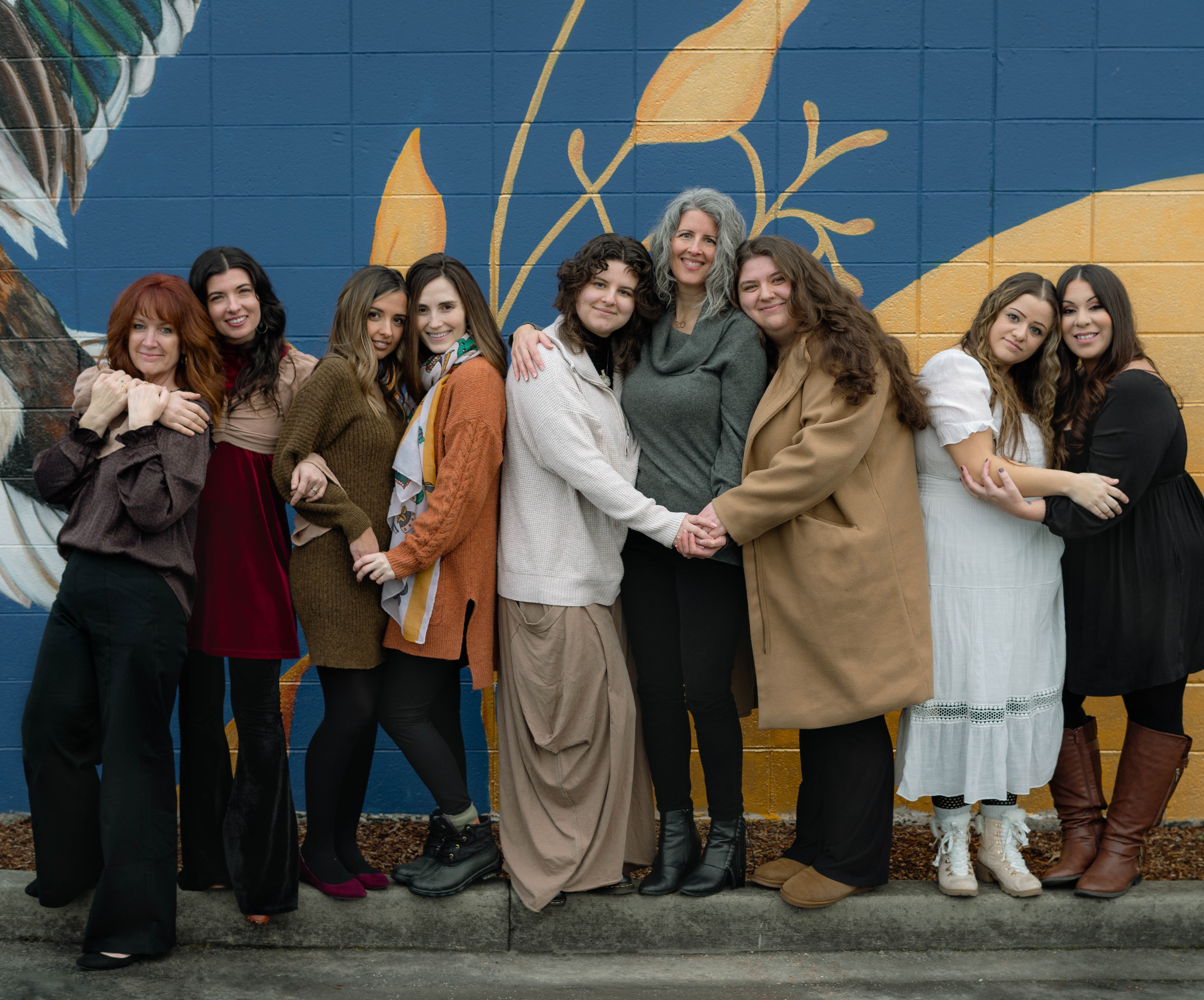
Left to right: Mikell, Terah, Crystal, McKenzie, Kaid, Kirsten, Kaya, Meg and Abigail; Not pictured: JC Smith

We did…together! In November, 87 backers pledged a total of $6,201 to support our independently published anthology Freeing Our Frozen Songs: Transmuting Pain to Power. We want to sincerely thank those who contributed to our Kickstarter campaign! Whether it was by pre-ordering your copy of Freeing Our Frozen Songs, donating any amount, sharing, talking about the book, thinking about the book, whatever you did to move this project forward, thank you! We achieved momentum, ultimately exceeding our fundraising goal!

This will allow us to recover our initial investments, fund the printing and shipping of our book, put the finishing touches on our companion workbook’s offerings, including recording guided meditations, and fund our local book release events. 

Thank you so much. Truly. We hope you appreciate all the intention and love we put into this offering!

Mama Bird

Book Reveal! Freeing Our Frozen Songs: Transmuting Pain to Power

Hello faithful readers,

I trust the seasonal changes, wherever you may be, are inspiring you to slow down, go inward, and savor the feeling of autumn’s presence. Those things are certainly true for me. On top of it being a very special time of year, the time of year that my daughter and I both celebrate our birthdays, I am also celebrating another milestone: The upcoming release of our anthology “Freeing Our Frozen Songs: Transmuting Pain to Power.” I, along with nine other artists, collectively and intentionally created a book with the mission of generating more healing and acceptance in a sometimes harsh and apathetic world. Because I have yet to find a better way to reduce the shame and stigma of surviving, well, anything, than through storytelling.

Freeing Our Frozen Songs: Transmuting Pain To Power

Ten Oregon storytellers and visual artists are featured in this anthology. Our curator, Kirsten Fountain, believed in us, valued our individual stories, and honored us as the true experts in our lives. I am so proud to be revealing eighteen poems that I have never before shared. Poems that explore my own personal journey from pain to power.

I believe in not only witnessing, but honoring, celebrating even, the full spectrum of this human experience. That is why I am preordering, in addition to my complimentary contributor’s copy, the book Freeing Our Frozen Songs to place in the library at the Trauma Healing Project in Eugene, Oregon.

I invite you to preorder our collection via Kickstarter and consider sharing it with a loved one in your life, particularly one who has endured trauma of any kind, at any time. Or you might consider donating it to a community library. Or keeping the book just for yourself.

If that feels like too much of a commitment at this time, I completely understand. You instead might consider a “sneak peek” of our anthology on our website https://freeingourfrozensongs.com/. There, you can preview samples of our work, and get to know each contributor more intimately by reading our biographies and artist statements. Of course, you also might consider a simple share on social media or an email forward as a way to show our contributors and curator some love.

Regardless, know that your story is always worthy. Always. And autumn time is a wonderful reminder of the sweet release of letting go of that which no longer serves us. Like the leaves on the tree, we too reach our peak, change colors, and transform into something brand new, sometimes unrecognizable, but always with a thread of the familiar still hanging on.

Please be blessed on your journey, and I will too.

With thanks,

Mama Bird

Killing My Darlings at the Colonyhouse

Late August brought with it my long anticipated road trip north to the historic Oregon Writers Colony Colonyhouse in Rockaway Beach, Oregon. A trip I’d been planning for a year. The time to “kill my darlings” had finally come. I’m quoting William Faulkner there. He was speaking to the act of “letting go of the bits of your writing you are holding onto selfishly.”

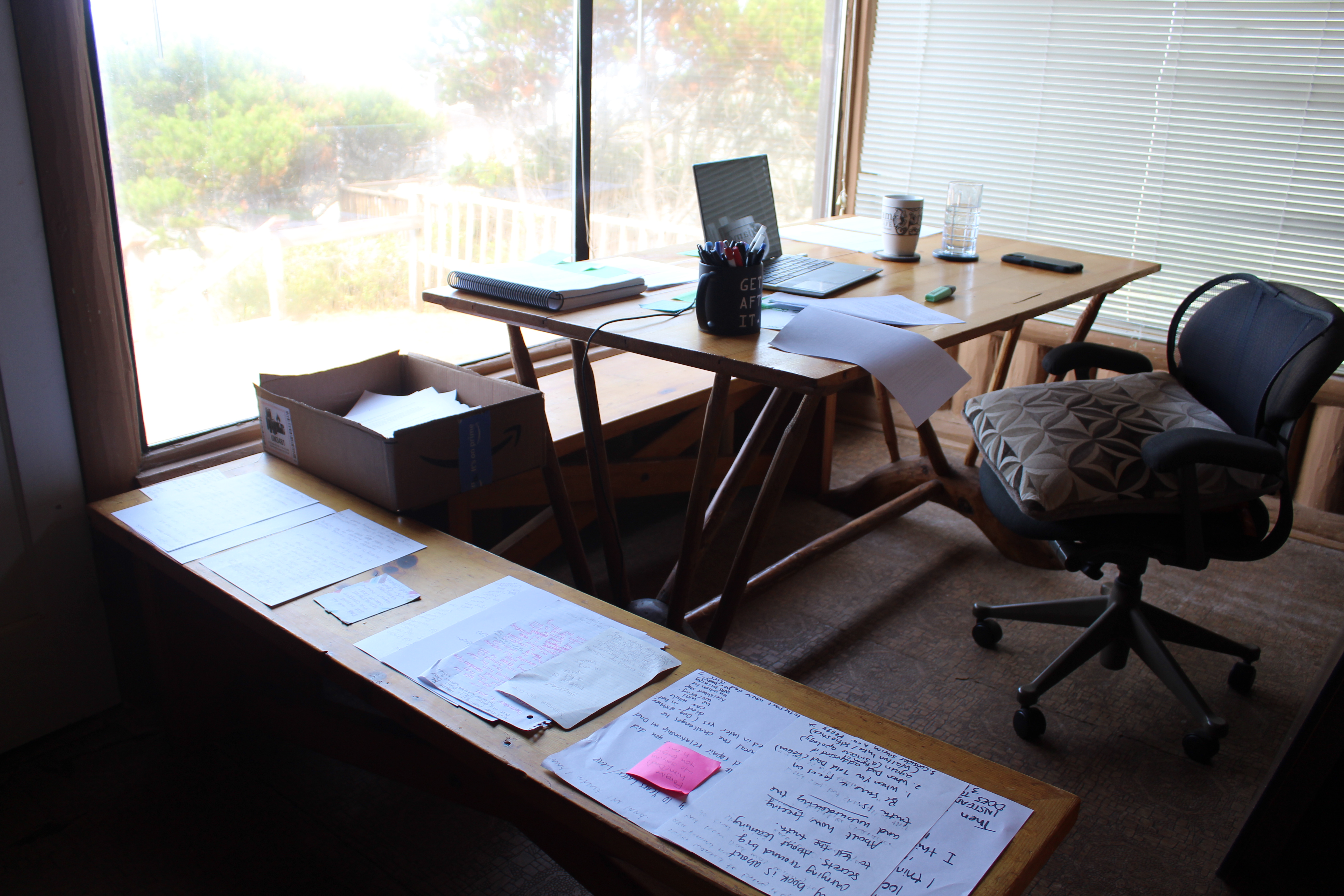
Looking down into the dining room where my darlings, or rather, scraps of paper and Post-It notes still needing to be “merged” into my memoir manuscript cover the table. I kept about half the ideas. “Killed” or recycled the rest.

A semi-unexpected surprise was the hominess of the Colonyhouse itself. I knew that the writers’ house (more like a lodge) was established back in 1988, when I was three years old. So I expected the writing desks strewn throughout every room and the impressive collection of coffee mugs hanging in the kitchen. But what caught me by pleasant surprise was how much it smelled like my great aunt’s house and the moment when I stumbled upon a signed copy of my favorite author’s memoir. It was the epitome of homey. Like, I didn’t want to leave.

The Colonyhouse was designed by the same architect who created Oregon’s Timberline Lodge at Mt. Hood. All the little details, down to the doorknobs, were a wonder.

My writing goals for the five day stay at the Colonyhouse were mammoth. I was going to incorporate into my manuscript all the feedback I had received from my critique group, all the changes I had outlined for myself into my manuscript in red pen, all the “notes” you saw earlier, and write an ending. Endings are hard. Writing is hard. Editing is hard! All of it is just plain hard. I had to take deep breaths and remind myself of two things. Number one, Anne Lamott’s well-earned advice: Bird by bird. Number two, it’s all about the journey!

Mid week. Notes. Office supplies. Coffee. Water. And a view of the ocean.

Once I got over the initial shock of all that I was trying to accomplish, I started setting goals. Attainable goals. I incorporated all the feedback needed make my manuscript shine (or rather, stand up on two shaky legs). I wrote an ending and accepted that it will need more work. (First drafts of chapters typically aren’t ready for publication!) I embraced what I would be leaving with: a completed fourth draft. And let go of what I would not be leaving with: a draft that’s ready for querying. Most importantly, I took moments to be grateful, experience joy, and celebrate in my own sacred little ways.

Something else happened, too. Existing inside of my story all day every day for five days was quite emotional. There were tears and reflection and ruminating. I realized that telling my story is a lot like holding up a massively heavy thing for everyone to see. It is deeply emotional work, especially the ground that I delicately try to cover in The Poetry of Place.

I am superstitious when it comes to the craft of writing. I have to have certain objects that invoke inspiration, such as certain books, Dad’s Spirit Path cards, and my satchel of crystals, pictured here.

Wrapping up the five day writing retreat was bittersweet. My writing spells, interspersed with walks on the beach, and sleeping to the sound of ocean waves, would be missed. My only solace was that ever other writer I know would likely have also found the retreat too short to cover the creative distance they wanted. So I leaned on my old, trusted way of thinking, and reminded myself that my manuscript is 100% better than it was.

I also left with the understanding that my story is getting too heavy to lift. And although it is not there yet, it is getting ready to take flight. I can feel it.

Love,

Mama Bird

Sunset at Rockaway Beach, Oregon