When we moved in, in late November, the tree had no leaves. Just a massive trunk with deep grooves, roots pushing up through the concrete. In the springtime, it took longer to show itself than the other trees in the neighborhood. Rather than leafing out completely, it rained sap on my car, as if a warning to keep my distance. I was here first, it seemed to be saying. Didn’t I know that?
By summer, I was so preoccupied I barely stopped to notice the tree in its fullness. I only appreciated the way it blocked our dining room window, making it harder for passersby to see through the panes.
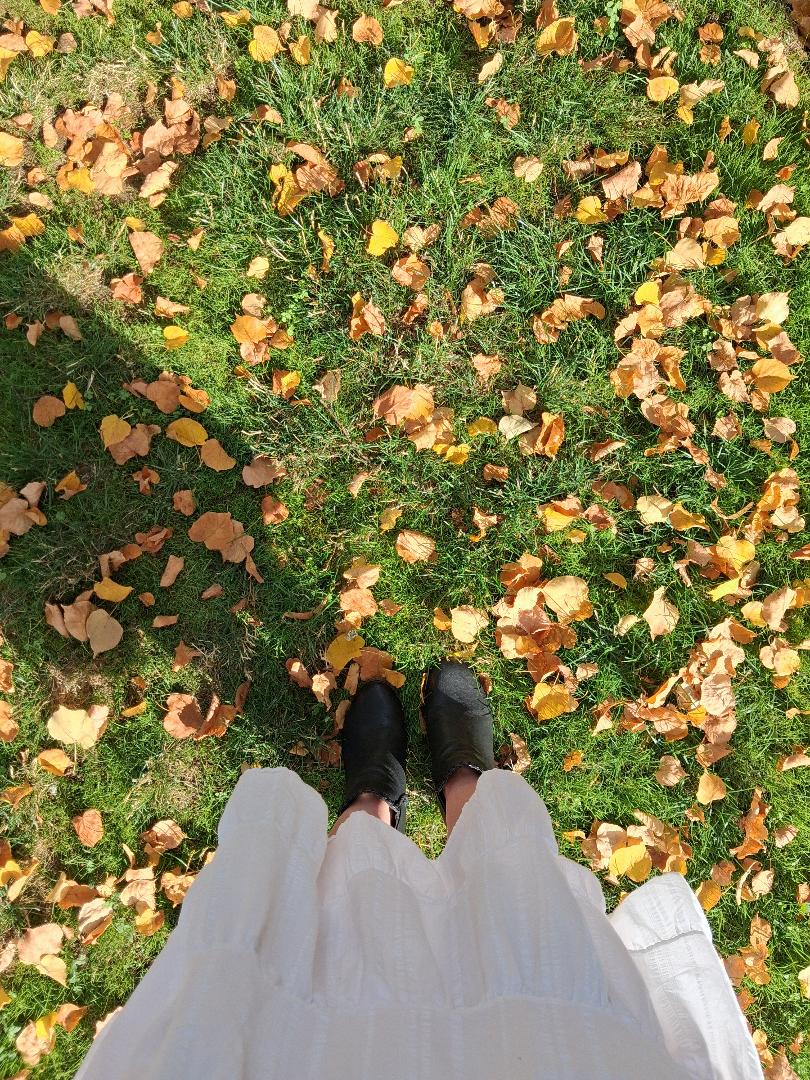
Then in late August it started shedding leaves. Not all at the same time, like a maple in an autumn windstorm, but one-by-one, almost undetectable. Yet every time a yellow leaf drifted outside my window, landing on the porch of our modest apartment, my post-breakup rental, I noticed.
And the leaves weren’t just any leaves, they were shaped like hearts with serrated edges. They were sweet but seemed to be saying, Don’t you dare get too close to me. I understood. When I finally ID’d the tree, I discovered a new kind I’d never heard of before: a Littleleaf Linden tree. The mature one growing outside my apartment, the tiny two bedroom I’d secured in the worst possible economic conditions, on the heels of a difficult separation, appeared much larger than most Linden trees grew. It produced an abundance of heart shaped leaves that, as the month of October marched on, began falling heavier and heavier on the front lawn, on the back lawn, and in the street, covering not just my car, but all my neighbors’ cars, too. Naturally, I took note. Life doesn’t uproot you then transplant you beside a heart leaf producing tree just because. Most everything has meaning, has hope.
I got to thinking, if the Littleleaf Linden tree could put down roots and thrive here, despite everything, like being far away from other Linden trees, and being surrounded by artificial concrete, maybe I could, too. Maybe I could even spread some love along the way, little yellow hearts covering everything.
It was September 6, 2020. The sun appeared like an eraser tip in the sky – gray, muted and small. Usually in September the sun was a bright yellow beach ball shining down over our homestead halfway between Eugene and the Oregon coast. There were high winds. We never got high winds. Smoke appeared to be coming over the mountainside and our sheep were hunkered down in a huge heap out in the pasture. Within days, record wildfires would burn more acres of national forest land than had been burned in all the previous 36 years combined. They’d even give it a special name, the 2020 Labor Day Fires. But we didn’t know any of that yet.
When the smoke settled in and the electricity companies turned off the power, I closed and locked every single window and door in our manufactured home. I didn’t know if locking the windows made a difference, but our home wasn’t that airtight. It was something we struggled with in the winter. If we didn’t have a fire going in the woodstove, we woke up to temperatures near what it was outside.
Wildfires were burning on the other side of the valley. Flames licked up and down the McKenzie River corridor, people’s lives were in danger and farm animals were being transported to the fairgrounds.
“Why, mama?” Our child, who was barely verbal, asked me of the locked windows and doors. She wanted to run and play outside, like she had done during other moments of daylight in the summertime.
“Smoke,” was all I could respond.
Reading the news headlines was making me anxious, but I kept scrolling anyway.
“The Oregon Health Authority warned Saturday that wildfire smoke can exacerbate respiratory diseases, including Covid-19.” September 6, 2020 OPB.org
I retrieved two kerosene lanterns, wicks, and oil that I kept stashed for when the power went out, then set out to make a dinner of lemon and chicken on top of our woodstove. Years ago, a friend of ours had jokingly said that we were the couple he’d want to pair up with in an apocalypse. It was a nice thought, and far from the truth. How many millennials would actually fare well in a real, live apocalypse? That was the word that kept coming up, apocalypse.
On top of feeding, entertaining, and caring for our toddler, I was wondering how I would accomplish a Zoom conference the next day, type and submit an article for the paper, and how the helk we were going to care for all the farm animals given the current conditions.
If the smoke persisted, what would happen to the hundreds of chickens in our care? I stared out the window and feared the worst. I’d been working on a pastured poultry farm two summers prior and we’d suffered a few fatalities during a particularly smoky season. The smoke we were experiencing was already preceding that summer. The sky had been a strange shade of sepia for more than twenty-four hours. It was as if we were all stuck in a vintage photograph. But no one was using words like unprecedented or hazardous to describe the smoke just yet…that would come later.
In the morning, when the water ran out completely, I opened the cupboard where we kept roughly 10 gallons of emergency water in plastic jugs. My soon-to-be husband was working at another farm, his day job at that time, and Autumn was still asleep, so I carried three jugs of water out to our farm animals. Because there was no electricity, there was no pumping water into the water lines.
I watered the flock of sheep and quickly fixed up our chicken brooder, placing blankets over the top to replace their heat lamps. It was probably eighty degrees out, but little chicks need it to be closer to 95 degrees. I was relieved to see that the baby chicks still had one full waterer. I felt like crumbling under the stress, but instead I stepped outside the brooder and took a deep breath, with my hands cupped over my mouth to avoid the smoke.
I craned my neck looking at all the Douglas fir trees surrounding our property. They were towering over me. Dense forest everywhere. Suddenly, it was as if we were living in a matchbox, and all it would take was one spark. I’d lived in the forest for most of my life, but up until then I’d never feared it.
When my fiancé came home from work I was on edge, despite all the deep breathing. He gave me a quick, dry peck on the lips. We were running out of water from our “apocalypse” stash, I told him. He said he didn’t think watering the farm animals with water from our home stash had been such a good idea.
“You take care of the farm, and I’ll take care of Autumn,” I told him through gritted teeth.
Monday
On Monday, Labor Day, I’d been scheduled to pick up twenty 50lb bags of chicken feed from a mill fifty miles north of us, but on route in our minivan with Autumn in tow, the smoke, high winds and impending fires had me feeling unsafe. I explained all of that to the mill’s owner over the phone when I turned around halfway. It was clear he was less than impressed that I’d been unable to follow through. Tensions were high. What kind of farm wife was I?
After returning from work, my fiancé promptly left to purchase a generator. He was also going to pick up the chicken feed: my failed mission. He didn’t mention the massive water shortage issue. I knew he was dealing the best he could. It wasn’t his fault he’d been asked to pick vegetables all day in the smoke. He had a job to do. More than one. Same as me.
I paced around the house, looking out all the windows into the sepia haze. It was day two of no power, no water, and lots and lots of smoke. The sheep were grazing out in the pasture, though they didn’t appear to be eating. I felt horrible for them.
The week before, my biggest concern was catching the Coronavirus. This week I was mentally packing our go-bag. I wondered what other families were doing right then: fashioning air filters out of box fans, purchasing brand-new air filtration systems, watering their lawns and roofs. I felt like a sitting duck and I didn’t like the feeling. I was resentful that farming was demanding so much of my fiancé’s energy and time. I had Autumn to care for…and my own work deadlines to meet!
Thick, mucusy smoke was seeping in through the floorboards and flimsy doors. Our shared objective became to open and close the door as quickly as possible. There was our border collie, Cedar, who was coping with all of this as well.
I ran into our neighbor, an avid outdoorsman, out near the water pump. “I’ve been preparing for this my whole life,” he said to me, cloaked in camo. It was true, he had a generator, and other fancy, survivalist-things. He pulled 5-gallon water containers out of the back of his full-sized truck while his four-year-old ran circles in the thick smoke.
I kept mentally packing my go-bag. Although our neighbor offered me one of his 5-gallon water jugs, my pride, or something, wouldn’t allow me to take it. Probably a stupid decision on my part. Had I taken it, it may have changed the trajectory of our next few days. It might have allowed our family to stay together.
It felt as if the disaster was throwing people into camps: Survivor. Dependent. First Responder. We were all reacting so differently to the stress of the wildfires–which were colliding with our already fragile psyches, beaten down after a year of pandemic isolation and political and social discord. The clock appeared to be ticking slower and slower. Of course it was just the numbers displayed on my cellphone screen that I was going by. I had to run my vehicle in order to charge it. My one source of information and communication never displayed more than two bars of charge at any given time.
I tried not to let my fear show as I nursed Autumn. I didn’t cry. I didn’t complain. At this stage I was still nursing up to forty hours per week. I silently scrolled the news on my phone, hoping my eyes didn’t reveal the anxiety building within me. I couldn’t yet admit that I felt abandoned by my partner due to his lack of communication. I couldn’t yet recognize that rooted deep down inside me was a resistance to trusting anyone for anything. Maybe if he knew all of that then he would have acted differently and communicated more. The lack of control I felt over the situation led me to spiral. Somewhere inside me the reaction to take flight began stirring.
“More than 120,000 people lose power across the Portland Metro area due to a rare and powerful windstorm.” September 7, 2020 KPTV.org
I thought of my college friends in Portland. Pictured them with all their scented candles lit in their apartments, their fur babies and houseplants. This was affecting all of us, I knew. Due to the refrigerator losing power, I’d dragged a large cooler into the kitchen that I’d filled with ice packs. Inside was a half-gallon of milk, yogurt, and some leftovers in glass Pyrex dishes. I looked out at the sepia haze, longing for the electricity it would take to power our two box fans. I knew when Autumn’s dad returned with the generator, it would be used primarily to power the freezers in the shop, containing all the meat he’d raised through his pastured poultry business.
It didn’t take long before I got to thinking about myself and Autumn independent of him. I thought about that quick, dry peck on the lips. I wasn’t crazy when I’d said, “You take care of the farm, and I’ll take care of Autumn.” Was I?
When I suggested packing a go-bag, I’d been met with an eye roll. I shook the image from my mind and retrieved a large plastic tote from the closet. I tipped it over on its side, letting gift bags and wrapping tissue fall to the floor. Autumn gleefully played with them while I placed the items inside the plastic tote from my mental go-bag list: diapers, wipes, three pairs of pants for each of us, three clean shirts for each of us, my laptop and charger, the lock box with our important family documents, a framed photo of my Grandma Peggy, a couple children’s books, and my memoir manuscript. Operating on instinct, I put our go-bag inside my Dodge Caravan, snug behind the driver’s seat. I placed half a dozen apples, a bunch of bananas, and a frozen jug of water from the freezer into the cooler with the other food and hoisted that out to the van, too.
Desperate for information, and though I didn’t recognize it at the time, for connection, I pulled up the news on my cellphone as it charged in my van. A headline from KATU 2 News in Eugene jumped out at me: We should expect loss of life from this fire.
I started the van several minutes before our departure, windows rolled up, cool air circulating throughout. Then I retrieved Autumn from the house. Because she wasn’t speaking much yet, I wasn’t entirely sure how she felt. But I tried to maintain my ordinary cheerfulness and act like everything was normal. My initial plan was to fill up eight of our 2-gallon water containers and then return to the farm. But a part of me just wasn’t committed to coming back. As we drove away, images of flickering flames on the other side of the valley filled my brain. I could see our neighbor and his son in the rearview mirror, but barely.
I had everything we needed if we took refuge some other place. Some place with water and power, I was thinking. Some place kind of wet. Driving west toward the town of Mapleton, away from the fire up the McKenzie River corridor, I realized I didn’t really want to go back to the farm. I just didn’t feel completely safe there. With my history of trauma, it was likely I’d been suffering from PTSD my entire life. Safety, mine and my child’s, came above all else. I’d learned there was no one I could really rely on but myself. I hated to think that my soon-to-be-husband might be unintentionally reinforcing that belief.
I remembered what I’d told him, “You take care of the farm, and I’ll take care of Autumn.”
I hoped he would understand, but naturally I was afraid he wouldn’t. I couldn’t quite identify what was happening inside of me—a combination of fear and hope. Fear of wildfires, hope for safety. It was fight or flight, and I was flying. My cooing, burbling baby girl came first. Somebody, somewhere, had to understand. I didn’t know if we were in real danger at the farm or not, but I wasn’t going to stick around, managing the oil lanterns and the meals single handedly, while missing out on work, to find out. And the smoke. It was all coming down to how airtight your home was. I suddenly thought of Dad in his modest cabin near the redwoods.
I appeared calm but was acutely aware of the coniferous forest waving in the high winds all around us as I drove. Just one spark to ignite a spot fire. Maybe we’d head to northern California to ride out the storm, I was thinking. Shit, the Coronavirus. Not even family would want us showing up on their doorstep at a time like this. I kept driving toward Hwy 101 anyway, stopping in Mapleton to fill up the water, and call my closest cousin, Crystal, while Autumn napped in her car seat.
“No, girl, there’s fires down here, too,” Crystal informed me. “Interstate-5 is closed and it’s burning all between here and Medford.”
“What? Oh my god. But we’re coming down the coast,” I told her. “Do you think it’s any better in Crescent City?”
“The smoke isn’t any better in the Illinois Valley, but you can try Crescent City. I don’t even know if I could get to Crescent City if I wanted to. Hwy 199 might be closed, too,” she said, sounding as frightened as I was.
“What. The. Fuck. Do you guys have power at your house?”
“For now, but there’s talk of them shutting it off here in Grants Pass, too.”
“What are we going to do?”
“I don’t know.”
“What about the smoke there? Is it bad?”
“It’s so bad. It’s been like a thick, hazy and orange for a couple of days. And it’s getting worse.”
“Yeah, here too. I just left the farm. We have no power and no water.”
“What? Where are you going? Are you all together?”
“No, we’re not. It’s just me and Autumn. I was thinking of driving to Crescent City, but now I’m not so sure.”
Ashes were falling on the windshield. My headlights were pointed toward the coast, and even in broad daylight, the ash looked like snow lightly falling. If I squinted my eyes, I could pretend it was Christmastime in Montana, where we went every winter to visit my in-laws. I just wanted to breathe, and I felt unanchored, so we drove toward the ocean, fifteen miles away. Before I started driving, my phone vibrated and lit up. A quick glance told me it was an email reminder of my upcoming Zoom conference for work. Knowing I was going to miss it, the best I could do was laugh out loud at the absurdity of it all.
Tuesday September 9, 2020 “Thousands evacuated as ‘once in a generation’ wildfires burn through Oregon” -Washington Post
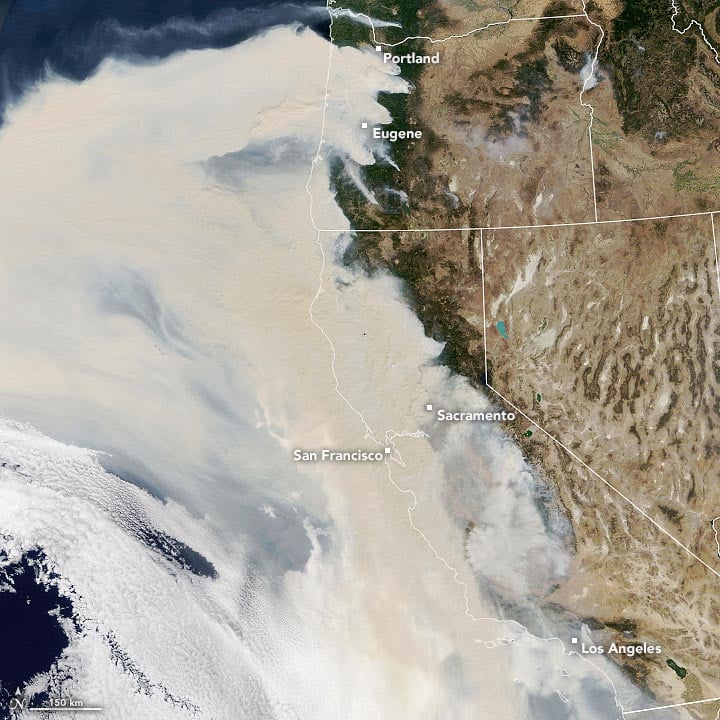
Aerial image of west coast wildfire smoke on September 9, 2020. Credit: SciTechDaily
Finding a hotel room had been a beast. There were no rooms available in Florence or Coos Bay, and there was a wildfire up north in Lincoln City, preventing us from driving anywhere but south. I’d called the Best Western Inn in Bandon and, fortunately, they had a room. It cost $200 before taxes but since I had no other options, I said we’d take it. I got a dog-friendly room, in case the rest of the family needed to take refuge there as well. The hotel was on the south end of town near a beach called Face Rock.
After dragging the cooler upstairs and settling into our hotel room, I opened my cell phone to check the wildfire news. A wildfire had ignited near us in Bandon (on the coast of all places!). They name it the North Bank Lane Fire. Fire officials were currently working to put out the blaze, which was 20% contained. The fire had started from a downed power line and had burned over 300 acres.
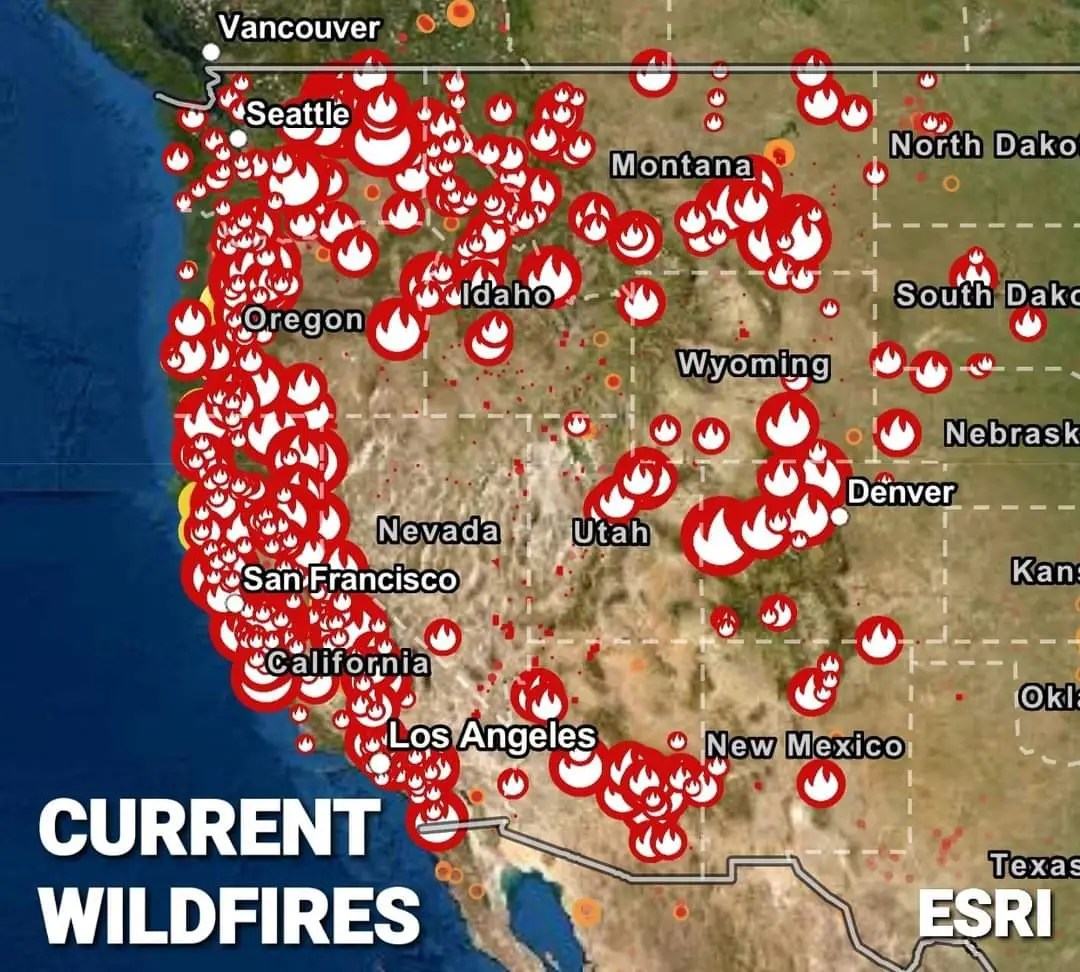
Meanwhile, the Holiday Farm Fire up the McKenzie River corridor was 0% contained and already 37,000 acres. The hazardous smoke had caused an air quality index of over 300 and rising in the Willamette Valley. On the coast, the AQI was 150, which is still considered unhealthy. One headline read that the air quality in western Oregon was worse than in Beijing. Aerial footage showed astounding images of plumes of wildfire smoke blanketing the west coast. I was shocked to see wildfires dotting entire mountain ranges in northern California and Oregon. The west was on fire and it was unprecedented in my lifetime.
Even though I knew there was a wildfire burning just a few short miles away, I felt safer than I had in days. Autumn and I quickly fell into a deep, exhausted sleep. Guilt tugged at my eyelids as I drifted off, and I tried to ignore it. I knew if it weren’t for my postal service union settlement money, none of this would have been possible. I thought I’d made the right decision coming to the coast and escaping the smoke, but I still wasn’t sure. My fiancé had been distant ever since I’d told him where we were.
Wednesday
To comfort and reassure myself, I analyzed the AQI information over my morning drip coffee. Children and the elderly were not supposed to be out in the hazardous air. I thought of my grandmother, who’d always been my closest confidant. I called her in Arizona to tell her about the craziness happening in Oregon. I let her know where we were and that we were safe.
“Yee-gads!” She responded. “That sounds absolutely awful. What about all those farm animals? Are they going to be okay?”
“I don’t know. I can’t think about that, honestly. I’m on a deadline.”
I told her what I said about him taking care of the farm, and me taking care of Autumn. To my surprise, at the end of our conversation, she said she was proud of me. Something about my maternal instincts.
The things my grandmother was proud of sometimes came as a surprise to me. Like the time I got suspended for punching a girl in the nose during math class. That time, she was proud of me for standing up to a bully. The world wasn’t so black and white. It felt good to have someone on my side.
After the conversation with Grandma Peggy, Autumn and I ventured outside willingly for the first time in days. In the lobby, during check in, I’d learned that some people staying there had been misplaced due to wildfires. They were meant to be there. It was a last resort for them. For us, not so much. I didn’t want to let on that a wildfire hadn’t actually made it to our town. That we were just escaping the smoke.
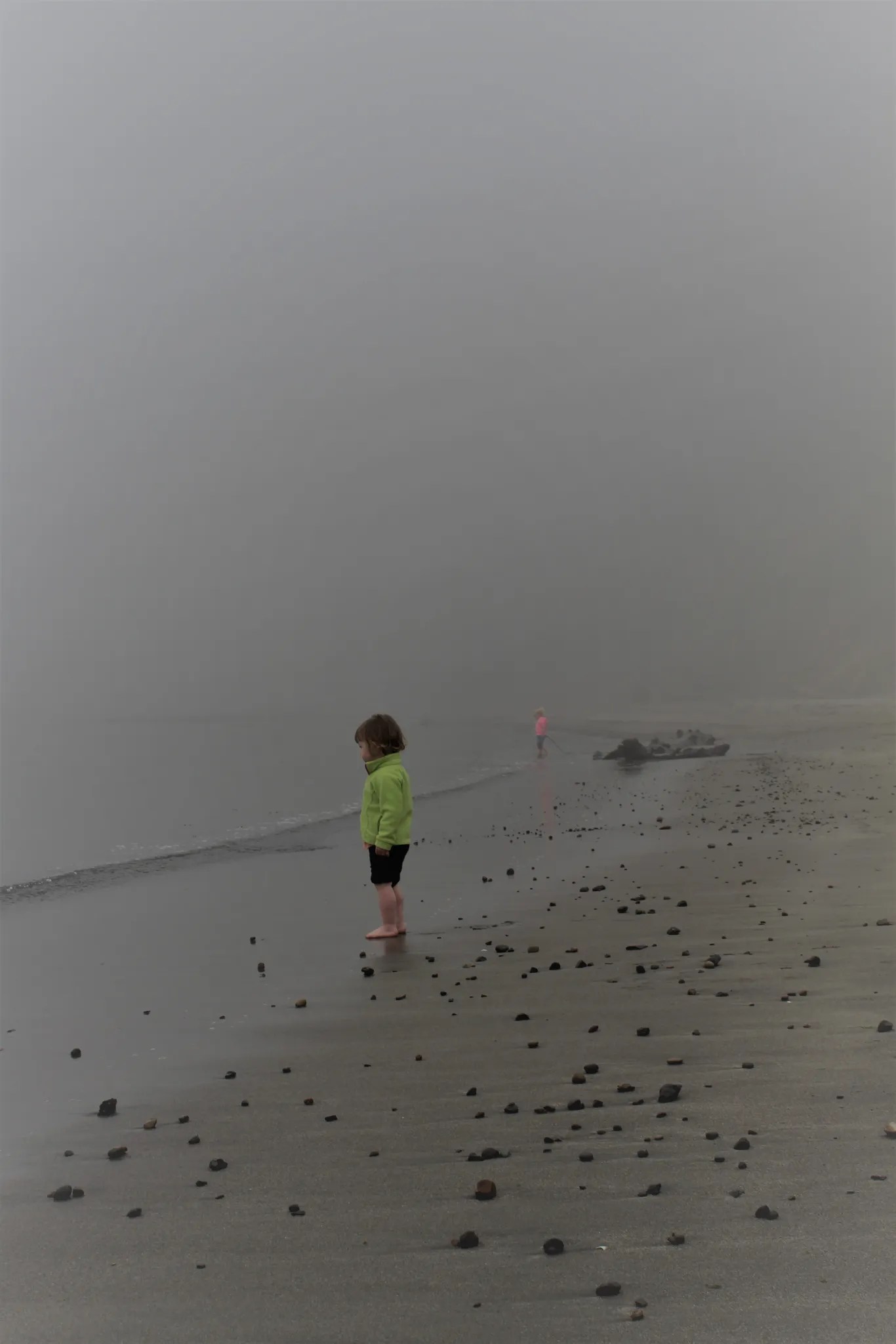
We walked a narrow sandy path down to the shore. Above the sea, the sky wasn’t clear but the salty air was so satisfying that I ate it in gulps. It was like the ocean produced an atmosphere all its own. The freshness was a gift. Autumn didn’t act like she knew what was going on with the wildfires, but as she ran up and down the beach and for nearly an hour, I felt like maybe I had done something right. I felt like I had done something that made sense to me, even if it was a little privileged.
Autumn and another child social distancing amidst record wildfires and hazardous air.
That night I stayed up and wrote my article that was due at midnight. The writing came naturally. I wished I could sit there with my fingers pounding on the keys for days. Not only was writing a welcome distraction, it was also completely necessary. It simply had to happen, especially since I’d bounced on Monday’s Zoom meeting.
Thursday
Every day I called my fiancé to ask if we had any water on the farm yet. That would indicate whether we would go home or not. Even if there was no electricity and even if the AQI was still 500, I said we’d return if there was water. Despite a good friend of mine quipping “Well, have fun,” over the phone, I knew we weren’t on vacation. We needed a fair amount of water to cover the basic washing, cleaning, food prep, and cooking back home. I needed something to work with. A couple five gallon jugs, something.
The whir of helicopters outside became a constant, no matter where you were in western Oregon. A good sound or a bad sound, I couldn’t decide. There were still bone dry weather conditions and gusty winds. Dad had been evacuated. The Red Cross put him and others up in a hotel in Crescent City.
September 10, 2020 “Wildfires have burned over 800 square miles in Oregon” –Wildfire Today
Being from northern California, wildfires weren’t foreign to me. But they weren’t commonplace, either. I remember as a kid the first night I got a glimpse into the terror that fires can present. Late at night at my grandmother’s house, we were watching a program that detailed the 1991 fires in Oakland, California. My grandmother fell asleep and I, scared straight, pulled my covers up to my chin. I was obsessively envisioning orange embers tapping at the windows. I was terrified.
Naturally, I’d already come up with an escape plan from our Bandon hotel room. I knew that from our hotel room to the beach was approximately 264 steps. One step equated to roughly one second. So in four minutes, with Autumn strapped snug in her Ergopack, we could escape to the beach via the trail. Half the time if we were running instead of walking. The beach, where there were lots of rocks and sand. The beach, where there were no trees. Going down this rabbit hole in my mind led me to envision the National Guard rescuing people off the coast of Oregon. They would take us all out on boats, where we would see our former homes, our former habitat, aflame. A scenario, I later learned, that was not far removed from what played out on the coast of Australia during their unprecedented brush fires just one year prior.
Friday
September 11, 2020 “At least six people dead, more missing in Oregon wildfires” –OPB.org
Because of the high cost of the hotel room I was in, after a few days, I called around and found a cheaper room at the Red Lion Inn in Coos Bay.
Coos Bay was closer to the farm, where there was still no water, and where the AQI was still off the fucking charts. Moving hotel rooms was an almost shocking thing to do during the pandemic, as the goal was to prevent as much contact with others as humanely possible. I wiped down all the surfaces myself when we entered the hotel room.
The truth was, at this point I was probably more likely to bring harm to us by catching the Coronavirus, stepping on a jellyfish on our daily excursions to the beach, or getting t-boned coming out of a coffee hut. I vowed to start paying more attention to things other than the smoking woodlands all around us. I didn’t want to put us in unnecessary danger. I needed to get a grip, but all I could do was grip my cellphone and consume whatever I could online about the unprecedented wildfires. I couldn’t spell out “wildfires” in my journal without putting the word “unprecedented” before it.
If you know anything about Paradise, California, you know that in the span of forty-five minutes the town was in a grid lock of bumper-to-bumper traffic with about 30,000 residents trying to flee and the police department hanging up on people due to the volume of calls.
“If you fear for your safety, even if you’ve not been evacuated, you can leave, ma’am,” a police officer reportedly said.
One minute it was falling ash, the next minute it was all up in flames. School children were reporting falling, flaming branches on the playground. People had underestimated mother nature’s fiery roar.
No one could believe it, except maybe the climate scientists.
Credit: ESRI.com
Saturday
Most other farm families couldn’t afford what I was doing. Did that make it inherently bad? A girlfriend, who I’d spoken with on the phone, the one who’d said, “have fun,” was under the thumb of her long-term partner. She was scared too, I knew, and her kids would have really benefited from being able to run around on the beach like Autumn was. I invited them to stay in our room, but deep down I knew her partner wouldn’t “let” them. I also knew that domestic violence starts with being provided just enough to live by, but not enough to leave by.
Our world was quickly becoming divided by those who were going towards the flame, and those who were running from it. Me? I was clinging to a wet seashore. But I knew deep down that I was one who was built to go towards the flame, and that my newish role of mother was setting me apart. Whenever I could, I splayed my memoir pages out on the hotel room desk, revising furiously, as if the world were on fire. The guilt had me feeling like I should be “doing something.”
While she was sleeping, I stepped outside the hotel room door. I’d brought along my cannabis vape pen. I took a long drag, exhaled. The sky was still sepia-tinged. How strange it will look when it finally goes back to normal. Which it will, I assured myself. A blue heeler dog gulped at the air as he leaped and charged at birds in the parking lot. A cop car raced down the highway, sirens blaring. My body quickly reminded me how fragile my nerves were, jumping at the sound, which was so loud and so close. A single plastic bag floated in an algae-filled swimming pool below. I stared at it and thought of how void our current existence is of celebration. About how alive it is with fear. Then I stepped inside and logged onto Instagram, forgetting about the apocalypse for an hour or more, before calling the farm again to ask about the water status. I was wondering when we would return home. Wondering if it could ever be like it was before. If we could ever really go back.
When I was a little girl I wrote on a slip of paper, “When I grow up I want to be a writer or a dancer.” I know this because a relative of mine saved it all these years. Written in extra large letters, it was less of a wish and more of a declaration.
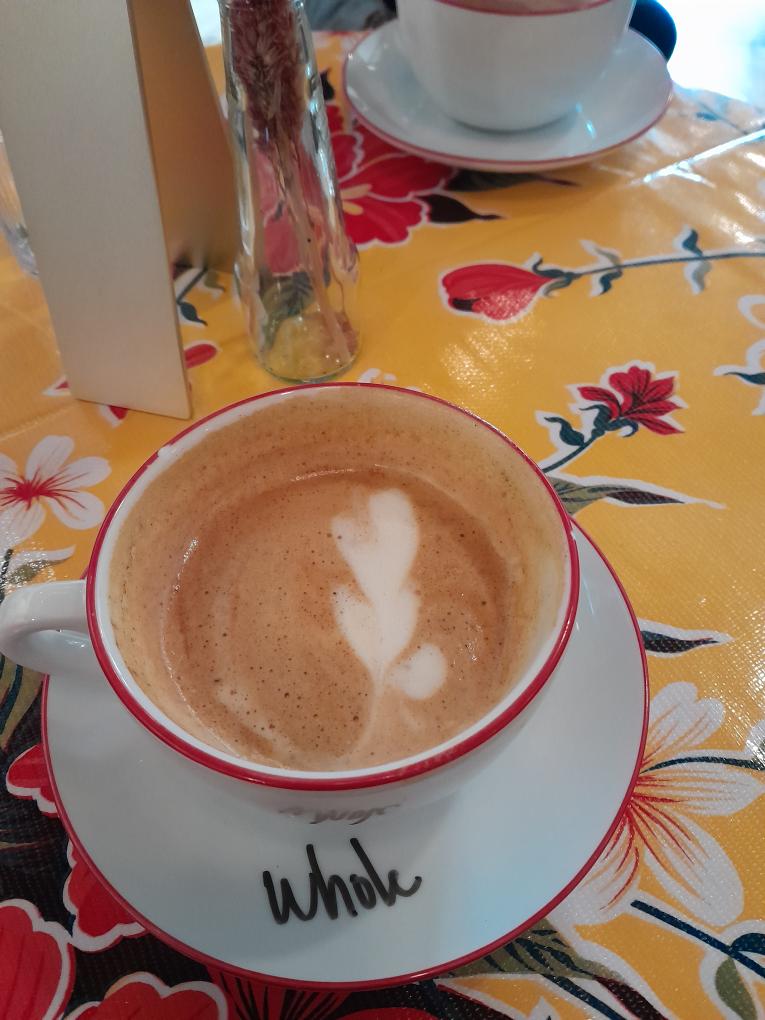
I am a water sign, born in autumn of 1985. Last week, to celebrate my birthday, a friend of many years accompanied me to a hot spring in the woods east of Eugene. We tried to get as close to the source as possible (literally and figuratively), tended to our senses, and bathed in the forest together. As with most my birthdays there was a delicate balancing act going on inside me—was my birthday meaningful or meaningless? (Is there such a thing as a meaningless day?) Ever the meaning-seeker, I leaned into the moments that felt extra special: a barista penning “whole” on my golden spice latte order (in case I’d forgotten), a bill totaling my exact angel number, cold raindrops on my bareface, the earthy-eggy scent of natural mineral water, a park ranger telling me “Don’t listen to what they say about forty, you’ve still got plenty of time and lots of living ahead of you,” and feeling like he really meant it; then, when I got home, finding an itty bitty perfectly formed diamond (fake, obviously) stuck in the mud in the crevasse of my hiking shoe. I held it up to the sunlight and thought it must be a gift from Dad.
Despite my best efforts not to, I found myself reflecting on my life’s trajectory on my birthday. Taking stock. Thinking of that note of mine, the one I’d penned as a child, I have just one edit for little girl me: Don’t be a writer, be writing. Don’t be a dancer, be dancing.
Perhaps with that shift in perspective, I can feel good about where I’m at today. I write, creatively mostly, professionally some. And I recently took up a Dance Fitness class at my local gym. (I’m loving it!) Maybe I am living the life I once dreamed of. I must be, only it’s slightly off-center. Something like it. Close enough. As the tides keep changing and the pages keep turning, I hope to remember that I am the author of my journey. And always remember to be writing, and be dancing. And, all we really came here to earth school to do: be loving.
It’s been going on four years now, Dad. You’d be turning 63 years old in November. Now that I am turning 40 myself, I’m growing wiser (and more disillusioned) with every day. I’ve never been more aware of this stupid human suit I’m wearing. It’s incredible what a difference a few years makes. I wish I could tell you all I’ve learned since you departed. I would ask your forgiveness for the times I articulated your faults on the page, just trying to understand. I would tell you that I understand now. I get it more, Dad.
These are the words rattling around in my mind this afternoon: poverty is a systemic failure, not a personal one. After you died, I discovered that it was a measly ten thousand dollars standing between us and our dreams. I learned that if you hadn’t been literally robbed of your cash, we would have had a home–those sturdy walls and saloon doors we’d sketched out so carefully. Why didn’t you ever tell me that? About the time you got robbed of ten thousand dollars and everything changed?
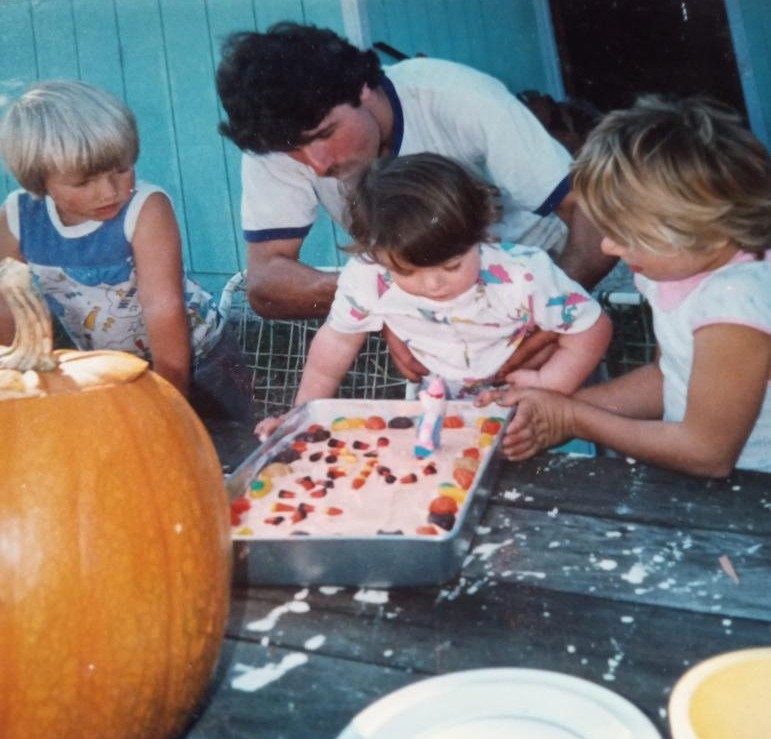
Today, Aunt Julie shared a picture of us that I’d never seen. It was taken on my second birthday, outside the house on Glenn Street. Someone (was it you?) made me a sheet cake and spelled out my name in candy corn. What I love about the picture is that as I am blowing out my birthday candles, so are you. You were ever encouraging, attuned, a gentle wind at my back from day one. God, I look like Autumn in the photo. A few years ago, unwittingly, I also decorated her birthday cake with candy corn. October babies.
You don’t want to be forgotten, do you? I know this because every now and again you pop up. A photo I’ve never seen. Your song playing on the radio. Your initials emblazoned on a barn along the interstate. But most incredible are the thirty-some-odd handwritten pages I recently received from a relative, your descriptions of our early days together. How did it take me all this time to realize that it was you all along? That it was you, legally disabled but spiritually sophisticated, who inspired my love of writing? I wish I could tell you all I’ve learned since you’ve departed, because one thing I know for sure is that you’d be listening.
What I wouldn’t give to scramble up a hillside with you today, sit at the top, overlooking some vista, laughing at the absurdity of it all. Someday I’ll get to reading those pages you sent me from the great beyond. But honestly, it kind of hurts to do so. I opened it once and a line jumped out at me. It read, “I believe in simple living and high thinking.” What more do you have to teach me, Dad? Are you still the wind at my back? What can I do to not be robbed of ten thousand dollars? Anything?
I don’t do book reviews or ratings. If I loved a book, you’ll likely hear about it from me eventually. Rarely, my book hype might even venture into some different form, maybe even a story, which is exactly what happened here.
I was mostly finished reading Lidia Yuknavitch’s Reading the Waves when I spontaneously suggested to my family that we scratch our original Mother’s Day brunch plans in Eugene and drive to Heceta Beach instead. Spontaneity–a mother’s antidote to monotony. The decision was a full body knowing. Something you don’t question. Like when the month before Dad died, I suddenly announced that we’d be making an impromptu trip to see him. Quality time with Autumn’s grandpa. An overdue visit. We didn’t know it yet but—that would be our goodbye. Now I try to always follow my intuition.
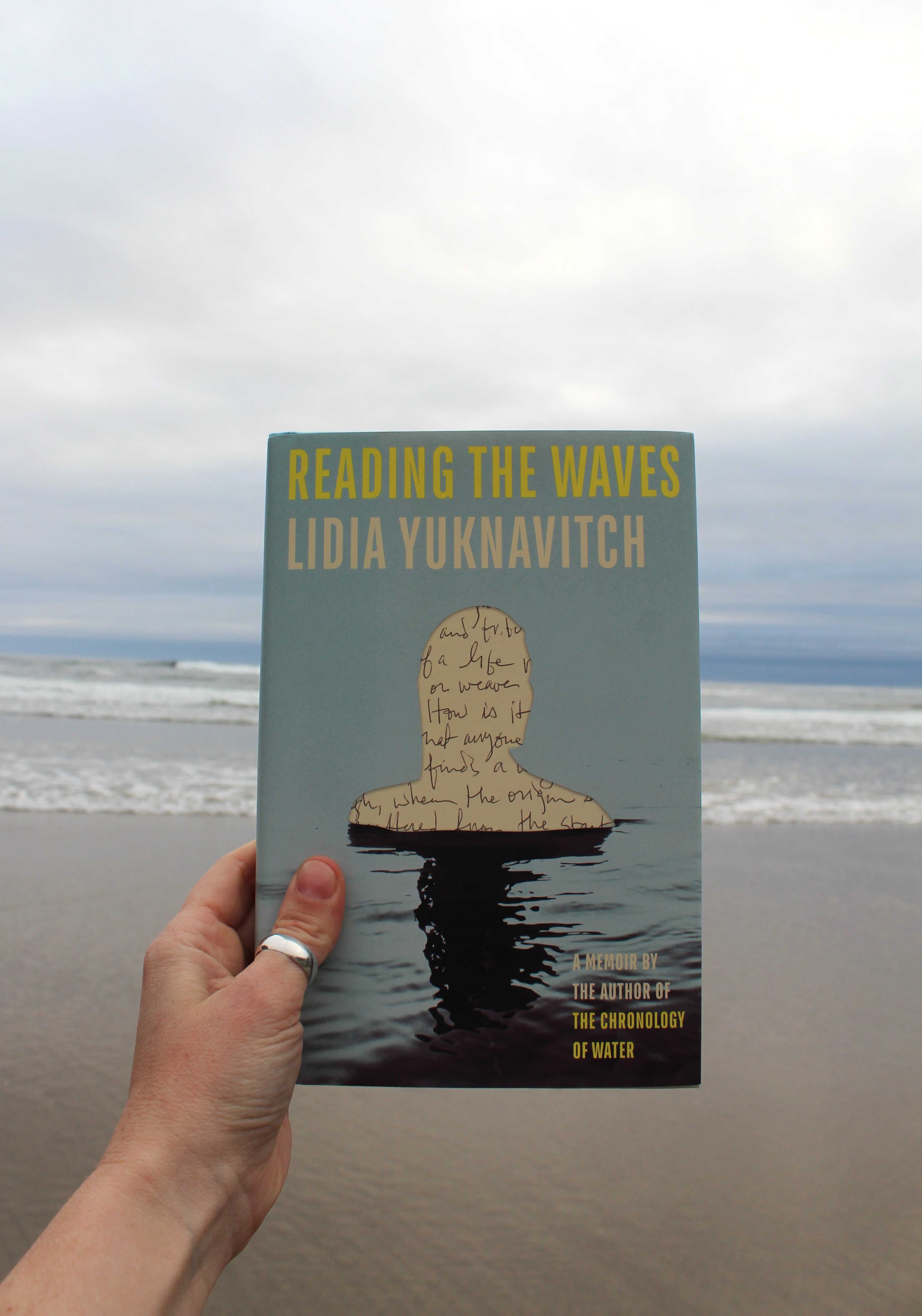
Before driving forty miles northwest to Heceta Beach, I grabbed Lidia’s book, wrapped it in a silk scarf, and placed it in our picnic basket. Once there, Autumn and I began skipping rocks on the creek that spills into the Pacific. The rocks were black, round and flat. They were the perfect skipping rocks! Steve built a campfire in the sand, and we all ran barefoot on the beach. We explored the grottos underneath the lighthouse, examined the tidal pools for starfish, then sat around the fire making s’mores. Eventually I took out Lidia’s beautiful book to photograph it against the moody backdrop of sky, waves and sea. I figured that later, when I’d finished the remaining few pages, I’d have an image to share alongside my words about how much I loved the book. I took a couple photographs then walked back to the campfire.
Back at the farm, a nearly full flower moon in Scorpio shone through the bedroom window. I opened Reading the Waves, reading only for a page or two before the following words jumped out at me: The historic Cape Creek Bridge arches over the place where a creek and the ocean meet. If you are at the lip of the ocean and the arm of the creek, the bridge feels like it has your back.
At the lip of the ocean and the arm of the creek…In her new book, Lidia had written a whole page about the exact place we’d built our campfire and skipped rocks at the beach. The next day, I wrote her a letter and sent it to her PO box. Something about cosmic nudges, kinship, inner knowing, invisible threads, art, motherhood, and awe. Something about Heceta Beach.
Beautiful coincidences aside, first with The Chronology of Water and now with Reading the Waves, Lidia has breathed life into me through her work. It feels as if by writing her truths, she’s writing my truths, too. There are even parallels within parallels, stacked like little nesting dolls: our connection to Eugene, Oregon; our obsession with the underwater world and how it is one of the only places on earth we feel safe; our complicated family stories; our inherited misfittedness; our need for peace, for space, for quiet. But this isn’t about me, it isn’t personal…It’s just that every time I read a book that resonates with me on that level, it feels that way: personal. It makes me wonder if things aren’t connected on a mostly invisible realm existing just beyond our field of vision. Just beyond our willingness to believe in such magic.
The moment I began Reading the Waves, I got swept away. She writes of geographies lodged in our psyches, in our bones, even in our gait. She reminds me that although certain memories may be unforgettable, we can transform the rough ones into something smoother. Like with all the rocks she collects along the shore, stories too are destined to go through their own metamorphosis. Each one with a different history, color, and composite—best witnessed when illuminated underwater. This book feels to me, at least in part, about all the great loves in her life. About the wild forms intimacy takes. They are Lidia’s love stories, right when I needed them most. This book may feel like a return to The Chronology of Water for fans of Lidia’s early work. (Her unforgettable memoir was adapted into a film directed by Kristen Stewart which recently premiered at the Cannes Film Festival.) You can find Lidia’s latest book, Reading the Waves, at Powells Books and other national and local booksellers. She currently teaches writing workshops on the Oregon coast.
Reading the Waves by Lidia Yuknavitch Heceta Beach, Oregon, May 2025
Driving past the massive redwood peanut carving meant that we were halfway to Eureka, California. The redwood peanut was also a marker of the town where my mother, Moonbeam, lived. Every other weekend, Dad drove me to Orick for our mandatory visit. Mandatory just meant that the law was involved. The law being involved was practically a law of the universe for people like us.
But the law had little to do with why we were driving past the redwood peanut that day. Except that after my scheduled ear surgery, I was mandated to remain with Moonbeam in Orick–in civilization–until my eardrums fully recovered. It would likely take the rest of summer. My earaches had become regular enough that a physician recommended I get tubes put in to help drain out all the gunk. I would also be getting my tonsils and adenoids removed. The plan was that after leaving the hospital in Eureka–the same hospital where I’d been born nine years earlier–Dad would drop me off at Moonbeam’s before heading back upriver to our home off grid. It would be the longest I’d ever stayed with Moonbeam, my stepdad, and my two younger brothers. I stared out the window as we drove past the huge redwood peanut, anticipating the story I knew was coming.
“That peanut,” Dad began, “was trucked all the way to the White House in Washington D.C. as a gift for President Jimmy Carter. But because Carter was an environmentalist, he shipped it back. He saw it as an insult. Here Carter was, trying to save the redwoods—or what was left of them—and some loggers from Orick send him a redwood tree carved into peanut! What a joke. I mean, can you imagine?”
I didn’t say anything in response. Didn’t need to. Sometimes Dad talked to keep himself awake while driving. Despite that it wasn’t nighttime, I knew Dad was probably tired. He’d worked at the road department all week, helped get my belongings together for the trip, then driven from near the border of Oregon in a car we’d borrowed from a friend of his. I didn’t really know why we were in the car, and not in Dad’s pick-up truck. Maybe the truck got a flat tire or needed a repair. Or maybe driving the car had been mandated. For whatever reason, I was riding in the backseat: precious cargo.
The car smelled horrible and was making my stomach turn. I never got car sickness on windy roads, but I suddenly felt queasy. It was as if invisible cigar smoke was emanating from the maroon velvet seats. Dad didn’t smoke, but whoever owned the car sure did. I was getting nauseous. I tried to lie down, the seat belt digging into my waist. I didn’t know what was worse: watching the tops of the redwood trees zoom by out the window, green morphing to white given all the movement, or closing my eyes. Both felt impossible. The pain in my ears faded to the background as my nausea took centerstage. I heard Dad mumble something about the time. My ear surgery was scheduled to start in one hour, so we’d be cutting it close. I gripped the car seat with one hand and held my other hand to my forehead, trying to remain steady. One more hour to go, and then the hard part would begin.
Naturally, I didn’t remember a thing from my first visit to Humboldt General Hospital–the day I’d been born there. This time though, I’d remember every detail. Starting with how enraged Dad was when I finally puked as he whipped the car into the parking lot.
“Couldn’t you have at least waited until I parked?” Dad yelled at me, swinging my door open.
Dad rarely yelled and never hit me, but in that moment, he looked like he wanted to rip my head off. Now that I am a parent myself, I know the look. It was stress. It was fear of failure. It had little to do with me. Fucking up created shame. Dad couldn’t win. We were late and I’d puked in the car he’d borrowed. This would all make him look bad. It would take time that we just didn’t have. Dad quickly shook out the floor mat, tossing the vomit into some nearby bushes, and then we raced into the hospital.
Before long, the hospital staff were preparing me for surgery. Dad may or may not have told them about the vomiting. It was all happening so quickly. They said I wouldn’t feel a thing during the operation, no pain and no nausea, because they planned on putting me to sleep. I was intrigued, then confused. Instead of reading me a bedtime story, a nurse placed a large, rubber mask over my mouth and nose. Because I’d never worn anything like the mask, I was frightened—and then I was out.
I remember a few details from right before they put the mask on. After being wheeled into the room, they positioned me with my feet pointed toward the door we’d entered through. There were three people: one doctor and two nurses. They were all wearing masks too, but a different kind.
Then things changed. The doctor began counting back from ten. By the time he got to four, I did indeed fall asleep. But I also rose up out of my body. Suddenly, my feet were no longer pointing at the door from which we’d entered, but my back was. And instead of laying horizontally, I was standing vertically. I was technically floating and there were two of me: the “me me” and the “hospital bed me.”
Me me observed the doctor and one nurse performing the operation, and a second nurse standing off to my right.
I woke up as I was being wheeled down a short hallway. Never mind that I was getting too old for stuffed animals, I was downright giddy when someone handed me a small teddy bear wearing a white t-shirt with the name of the hospital printed on it. Maybe they’d known they almost killed me back there, and the teddy bear was my consolation prize. I didn’t care. The deal was made even sweeter when I was given a popsicle in the recovery room. I was instructed to eat lots of popsicles in the days to come. Maybe it will be okay after all, I thought.
Driving back to Orick, I sat in the backseat again. I told Dad about the strange occurrence when they’d “put me out” at the hospital.
“Hey, that’ll happen,” Dad said reassuringly, looking at me in the rearview mirror.
Dad was nonchalant. He knew his stuff. This was child’s play. Dad was the one who had spent weeks on the other side after a drowning accident when he was a kid. They’d dubbed him Miracle Boy in the local newspaper. After the accident, our family felt Dad got touched by an angel, because from then on, he was so different. Not just his voice, which had been scarred in the accident, but his whole way-of-being. He was spiritual and special. What I’d experienced was only a blip. I didn’t get so much as a glimpse of heaven. It was practically nothing. I needed to focus on my future, on getting better, on summer.
Today I understand why I didn’t go to the great beyond. Had things ended differently that day, Dad would never have forgiven himself for how he’d left things, for yelling at me like he had in the parking lot. We drove past the redwood peanut again and I sighed audibly.
“You’ll be back home before you know it,” Dad said, empathetically.
I wasn’t entirely sure if Dad meant our cabin by the river, or our home up in the sky.
Writing heals. Through the act of writing, we begin to understand ourselves more deeply. This is especially true for writers of memoir, personal essays, and poetry. We discover what matters to us. We learn what’s impacted us, and in what ways. The self-awareness gained through writing becomes a gift to oneself and others. Our journals becoming a place to lay down whatever worries we carry, large or small–with the option of sharing what we’ve written with others, or not. In my experience the act of writing is inherently healing, and the act of sharing our writing is inherently empowering. We discover that people can witness our darkest expressions and still accept us, maybe even love and respect us more knowing what makes us us.
In Spring 2023 I began guiding a weekly journaling workshop “Releasing With Writing” at the Trauma Healing Project in Eugene, Oregon. Since then I’ve witnessed how the process of putting words down on the page, and sharing those words aloud, peels back layers of the heart, generating more compassion for oneself and others. Throughout this journey I have relied primarily on my own creativity generating our journaling prompts (which I am sharing below). Because my own trauma healing was aided by writing memoir, many, though not all, of the writing prompts align with the memoir genre:
Write about your scars Think about place you’ve lived and describe it in immense detail Write about an object that holds special meaning for you Write about a cherished photograph Write about a time you were bullied/bullied someone else Write about a time you gave/received love Write what’s on your heart today Write about the good old days Make a list of the turning points in your life Introduce us to your inner child A mess you made A blessing in disguise A celebration Survival mode A reality check A stranger angel A beginning/An ending A trip Dirt Fire Hunger Companionship Something you regret Something you didn’t think you’d survive A recent adventure A time you felt filled with hope A date you’d like to remember/forget A love letter to the town you live in Describe a meal that holds special meaning for you Write about your birthplace Write about standing in another person’s shoes Write about a time you were selfless/selfish Write about a time you had to ask for forgiveness Write about a time you spread/hid your light Write about a time you felt free/trapped Write a love letter to summer Write a letter to your kid self Describe your childhood hopes and dreams Use color as the central point of meaning in your story Something someone said that you’ll never forget What’s your inner weather? What is a big challenge you’re facing right now? How can you be kinder to yourself this week? This year? What is a personal belief you held in the past that has since changed? What do you need more of right now, solitude or companionship? What is your astrological sign? Do you relate to it? Why or why not? What is something new you would like to try? What would you do with unlimited resources? What’s your superpower? Where do you go to find yourself? How do you prioritize self-care? What do you want more of? What matters most? What are you afraid of? What are you calling in/letting go of? How do you balance your needs with the needs of others? How has your definition of love evolved? What can you let go of today? What have you learned from your elders? What advice would you give someone going through a hard time? Write about a person you are grateful for. What do you admire about them? Why have they had such an impact on your life? What is broken and needs fixing? If this time in your life were a chapter, what would it be called and why? What I remember was… In this moment I am…
Feel free to use these journaling prompts yourself or in a group setting, and don’t forget to share your prompts with me in the comments section below!
I spend a lot of time with the dead people in my family. Typing that line, I must pause and stare at the word. Dead. It doesn’t jive with how it really is. With how alive they really are. Right now, for example, seated at my maternal great grandmother Glady’s oak stationary desk, it is her short fingers, not mine, I can imagine reaching out to place a paper clip in a small ceramic dish. The ornate, antique desk came into my life unexpectedly when my great aunt recently moved into assisted living, and it is now the most valuable thing that I own. My mind is blown when I consider that I was just five years old when my great grandmother passed away and, shortly before, said she wanted me to have the desk. That was, of course, long before I was a writer.
I didn’t used to believe in the supernatural or in superstitions. Though I have always accepted that dreams hold significant meaning. But since Dad’s passing, and in the months leading up to it, my previous beliefs were challenged. They softened under the weight of the unexpected. I’d have been a fool not to notice the signs.
In my notebooks, I’ve written down countless instances that point to a storyline larger than us, one just beyond reach. I’ve experienced things that felt more like serendipity than happenstance. Objects arriving in my life like gifts from the universe. A spectacular and rare seashell washed up on Rockaway Beach, during a week away working on my memoir. A brass bell sitting in the rain. An antique desk.
Not long ago, I awoke from a dream along with a message from my late second cousins, Kathy and Carla, who were more like aunts to me. It was one of the few dreams where I’ve been delivered a very specific message. Such dreams are rare. That’s how I know they’re special. In my dream, I stumbled upon heaven. I intuited that I was in heaven by the fact that Kathy and Carla, who had both died of cancer within five years of each other, where there. In dreamland they signaled it was them because they both wore no hair, a reminder of the cancer that had taken them in this form.
I was surprised to find that heaven was less like a place in the sky where you frolic around, and more like Santa’s workshop. Kathy and Carla weren’t idly hanging out on a cloud, sipping earl grey tea, and catching up with Jesus. No, they were both hunched over some sort of creative project. They were working with their hands. They almost seemed annoyed when I interrupted them. I was surprised to see that actual work was being done in heaven. Upon realizing where I was, I wanted to know things. The pressing question that came to mind was, “How can I accomplish my goal of publishing a book?”
They both looked at me, looked at one another, and then communicated these words: Take the actual steps needed to get there.
When I woke, I thought about their words. Take the actual steps needed to get there. I loved that. The actual steps. Not the fake steps. I wrote it down. Carried it with me. Scheduled another writing retreat. Doubled down on my creative writing projects.
There were more serendipities:
Driving to pick up my wedding dress alone on the day before our ceremony the first song that played when I turned on the radio was “My Sweet Lord” by George Harrison. It was the same song I played in the ICU seventeen days earlier when releasing Dad’s spirit back into the wild.
A few weeks after the ceremony, I’d been bawling my eyes out in the kitchen, and my electric teakettle turned itself on, gently. It was as if Dad was saying “I see you” and “It’s all going to be okay.”
One Monday after returning from California with a trunk full of Dad’s belongings, I stumbled upon a piece of a brass altar set, sitting out in the pouring rain, at work near the bench where I always eat lunch. The brass hand bell was identical in color and detail to the rest of Dad’s altar set, which I had just unpacked and polished the night before. I knew the bell belonged with me, though it felt strange putting it in my pocket and carrying it home. I placed the bell on a shelf with the rest of Dad’s set and it was a perfect match.
Months before Dad’s fatal accident, on a dark winter night, I was at home with my daughter. It was just the two of us. My husband (then fiancé) was out. We live a quarter mile from the highway, nine miles from the nearest general store, and we have one neighbor within earshot. We don’t get a lot of visitors. But when we heard three loud knocks on the front door, I still didn’t think much of it. Sometimes a dog gets lost on our stretch of highway and the owner goes knocking on doors asking if you’ve seen them. Or it could have been the UPS or FedEx man. But when I swung open the front door, no one was there. Autumn and I immediately looked at one another, stunned. I locked both doors and put Autumn to bed. I couldn’t quite get the three knocks out of my mind, so I googled “three knocks ghost.” I read reports from different places across the world about a phenomenon called the “three knocks of death” signaling that someone you know has or soon will die. Some believers went far enough to claim that the death will happen in three days, three weeks, or three months.
I spoke with my cousin Crystal the following week. A vehicle had crashed into our lower pasture at dawn, resulting in a fatality. The family affixed a steel cross on a tree trunk on the opposite side of the highway. I ran across the road to study it. It was a young man who’d died. Just nineteen years old. I told my cousin, “I feel like death is all around me.” Only I whispered it, as if by keeping my worst fears quiet enough, they couldn’t possibly come true. By my estimate it was no more than six months later when I got the call about Dad falling off a ladder at a job site.
Autumn, now five years old, recently approached me with a question. She asked if her and Grandpa Rob ever played with toys together on a rocky beach. I told her that they’d played with toys on a sandy beach at the river. She said this wasn’t at the river, it was at the ocean. She reiterated that it was on a rocky, not a sandy beach. She paused for a moment, then said, smiling, “It must’ve been a dream. But wow, it felt so real.”
I smiled knowing Dad had a hand in that. All Autumn ever did was ask me to play with her. So here he was stepping in when I couldn’t. Maybe our ancestors have the birds-eye view. They can be everywhere all at once. They can see into the future. They can understand the past. My ancestors have always known that I need all the help I can get. Today, I am wide open to receiving their signals.
My great grandmother’s desk came into my life in perfect timing. Just when fear managed to unsettle the well of my creativity, doubts churning in the dark waters. Negative self-talk—and just plain laziness—had manifested itself in the form of my stagnant memoir project. There was the penetrating thought that maybe it all doesn’t matter, anyway. My story. My pile of pain. My gift to the world. But now, this desk. Ancient wood capturing afternoon sunlight, illuminating a blank page. Beckoning. Reminding me that there is enough space in this world for one more story. I only need to be willing to take the actual steps needed to get there.
Wild irises spring up after the daffodils line the city streets, after the trillium dot the animal paths in the forest. Wild irises, tiny, delicate, purple, and white, are no match for the beasty ornamental varieties, of which three flowers can fill out a vase. But still, I prefer them wild. Wild irises hint that summer is coming. Naturally, irises have always reminded me of Dad. All my life they reminded me of the time of year that signaled our outdoor quality time together. Hiking, foraging, and when the snow melt eased up, swimming. In early May 2022, I got a call from a doctor in the intensive care unit in my hometown in California. “Come,” he said. “Quickly.” Dad had an accident and he wasn’t going to make it. Four days later, pulling up the long gravel drive to the farm after having returned from California, I glanced out the open car window to see that the wild irises had pushed up through the earth while I was gone. They’d emerged and made themselves known while I was releasing Dad’s spirit back into the wild. How could they? It felt like either some kind of cruel joke or, on the other hand, a symbol of peace and the natural order of things. It was the first of many signs and synchronicities to come. Most of them I would make note of in my journal, the messages too compelling to ignore. The irises have arrived again, right on time, to greet me.
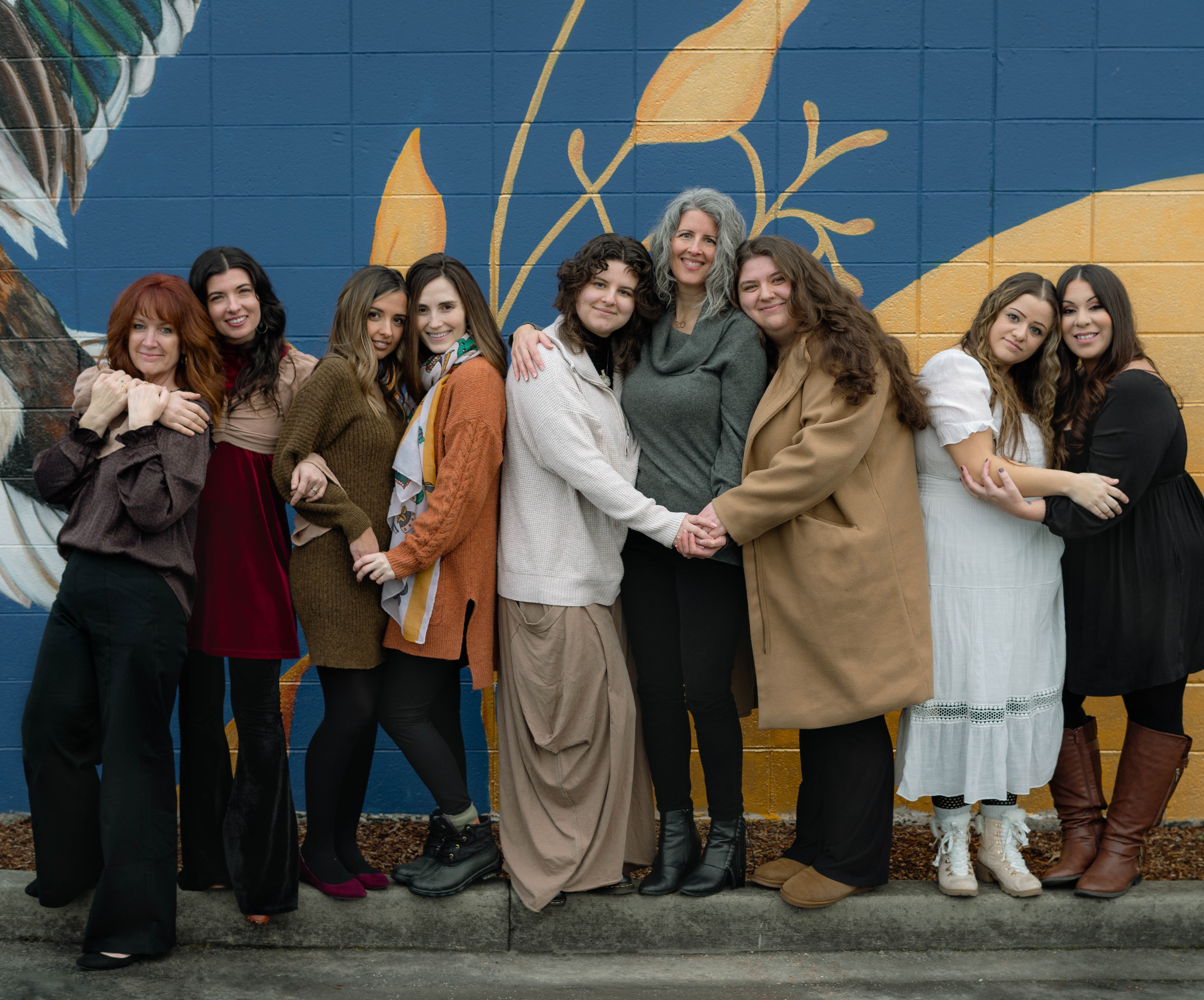
Freeing Our Frozen Songs: Transmuting Pain to Power contributors Left to right: Mikell, Terah, Crystal, McKenzie, Kaid, Kirsten, Kaya, Meg and Abigail; Not pictured: JC Smith
We did…together! In November, 87 backers pledged a total of $6,201 to support our independently published anthology Freeing Our Frozen Songs: Transmuting Pain to Power. We want to sincerely thank those who contributed to our Kickstarter campaign! Whether it was by pre-ordering your copy of Freeing Our Frozen Songs, donating any amount, sharing, talking about the book, thinking about the book, whatever you did to move this project forward, thank you! We achieved momentum, ultimately exceeding our fundraising goal!
This will allow us to recover our initial investments, fund the printing and shipping of our book, put the finishing touches on our companion workbook’s offerings, including recording guided meditations, and fund our local book release events.
Thank you so much. Truly. We hope you appreciate all the intention and love we put into this offering!