Be Loving

When I was a little girl I wrote on a slip of paper, “When I grow up I want to be a writer or a dancer.” I know this because a relative of mine saved it all these years. Written in extra large letters, it was less of a wish and more of a declaration.

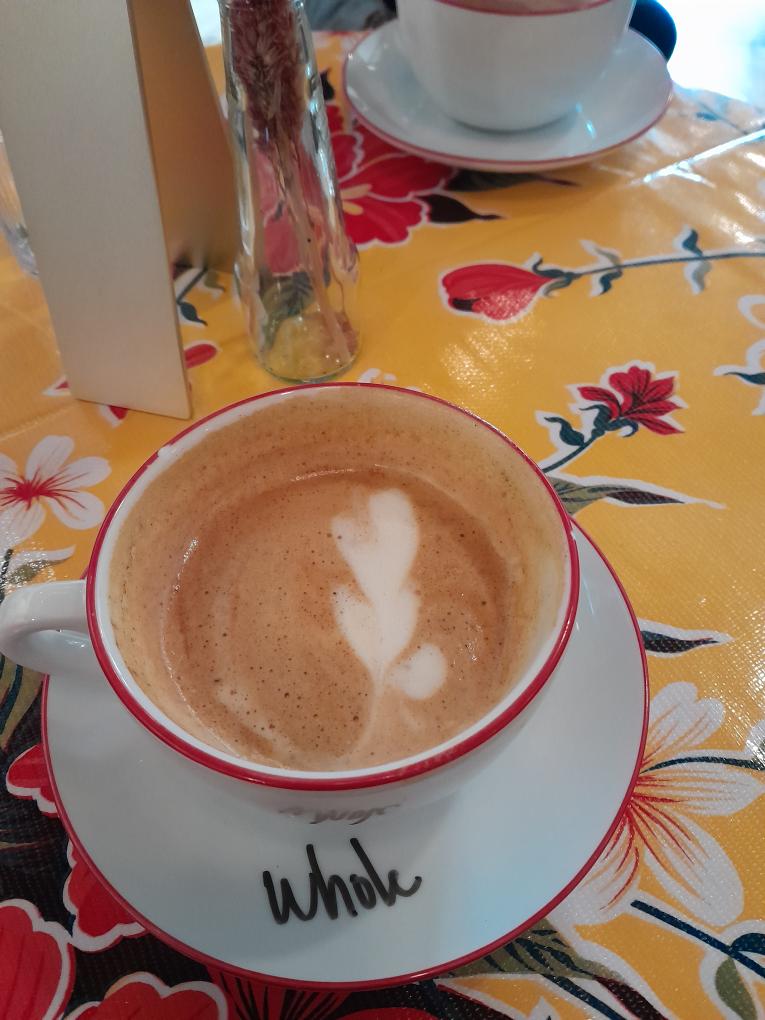
I am a water sign, born in autumn of 1985. Last week, to celebrate my birthday, a friend of many years accompanied me to a hot spring in the woods east of Eugene. We tried to get as close to the source as possible (literally and figuratively), tended to our senses, and bathed in the forest together. As with most my birthdays there was a delicate balancing act going on inside me—was my birthday meaningful or meaningless? (Is there such a thing as a meaningless day?) Ever the meaning-seeker, I leaned into the moments that felt extra special: a barista penning “whole” on my golden spice latte order (in case I’d forgotten), a bill totaling my exact angel number, cold raindrops on my bareface, the earthy-eggy scent of natural mineral water, a park ranger telling me “Don’t listen to what they say about forty, you’ve still got plenty of time and lots of living ahead of you,” and feeling like he really meant it; then, when I got home, finding an itty bitty perfectly formed diamond (fake, obviously) stuck in the mud in the crevasse of my hiking shoe. I held it up to the sunlight and thought it must be a gift from Dad.

Despite my best efforts not to, I found myself reflecting on my life’s trajectory on my birthday. Taking stock. Thinking of that note of mine, the one I’d penned as a child, I have just one edit for little girl me: Don’t be a writer, be writing. Don’t be a dancer, be dancing.

Perhaps with that shift in perspective, I can feel good about where I’m at today. I write, creatively mostly, professionally some. And I recently took up a Dance Fitness class at my local gym. (I’m loving it!) Maybe I am living the life I once dreamed of. I must be, only it’s slightly off-center. Something like it. Close enough. As the tides keep changing and the pages keep turning, I hope to remember that I am the author of my journey. And always remember to be writing, and be dancing. And, all we really came here to earth school to do: be loving.

Sign Sign Everywhere a Sign

I spend a lot of time with the dead people in my family. Typing that line, I must pause and stare at the word. Dead. It doesn’t jive with how it really is. With how alive they really are. Right now, for example, seated at my maternal great grandmother Glady’s oak stationary desk, it is her short fingers, not mine, I can imagine reaching out to place a paper clip in a small ceramic dish. The ornate, antique desk came into my life unexpectedly when my great aunt recently moved into assisted living, and it is now the most valuable thing that I own. My mind is blown when I consider that I was just five years old when my great grandmother passed away and, shortly before, said she wanted me to have the desk. That was, of course, long before I was a writer.

I didn’t used to believe in the supernatural or in superstitions. Though I have always accepted that dreams hold significant meaning. But since Dad’s passing, and in the months leading up to it, my previous beliefs were challenged. They softened under the weight of the unexpected. I’d have been a fool not to notice the signs.

In my notebooks, I’ve written down countless instances that point to a storyline larger than us, one just beyond reach. I’ve experienced things that felt more like serendipity than happenstance. Objects arriving in my life like gifts from the universe. A spectacular and rare seashell washed up on Rockaway Beach, during a week away working on my memoir. A brass bell sitting in the rain. An antique desk.

Not long ago, I awoke from a dream along with a message from my late second cousins, Kathy and Carla, who were more like aunts to me. It was one of the few dreams where I’ve been delivered a very specific message. Such dreams are rare. That’s how I know they’re special. In my dream, I stumbled upon heaven. I intuited that I was in heaven by the fact that Kathy and Carla, who had both died of cancer within five years of each other, where there. In dreamland they signaled it was them because they both wore no hair, a reminder of the cancer that had taken them in this form.

I was surprised to find that heaven was less like a place in the sky where you frolic around, and more like Santa’s workshop. Kathy and Carla weren’t idly hanging out on a cloud, sipping earl grey tea, and catching up with Jesus. No, they were both hunched over some sort of creative project. They were working with their hands. They almost seemed annoyed when I interrupted them. I was surprised to see that actual work was being done in heaven. Upon realizing where I was, I wanted to know things. The pressing question that came to mind was, “How can I accomplish my goal of publishing a book?”

They both looked at me, looked at one another, and then communicated these words: Take the actual steps needed to get there.

When I woke, I thought about their words. Take the actual steps needed to get there. I loved that. The actual steps. Not the fake steps. I wrote it down. Carried it with me. Scheduled another writing retreat. Doubled down on my creative writing projects.

There were more serendipities:

Driving to pick up my wedding dress alone on the day before our ceremony the first song that played when I turned on the radio was “My Sweet Lord” by George Harrison. It was the same song I played in the ICU seventeen days earlier when releasing Dad’s spirit back into the wild.

A few weeks after the ceremony, I’d been bawling my eyes out in the kitchen, and my electric teakettle turned itself on, gently. It was as if Dad was saying “I see you” and “It’s all going to be okay.”

One Monday after returning from California with a trunk full of Dad’s belongings, I stumbled upon a piece of a brass altar set, sitting out in the pouring rain, at work near the bench where I always eat lunch. The brass hand bell was identical in color and detail to the rest of Dad’s altar set, which I had just unpacked and polished the night before. I knew the bell belonged with me, though it felt strange putting it in my pocket and carrying it home. I placed the bell on a shelf with the rest of Dad’s set and it was a perfect match.

Months before Dad’s fatal accident, on a dark winter night, I was at home with my daughter. It was just the two of us. My husband (then fiancé) was out. We live a quarter mile from the highway, nine miles from the nearest general store, and we have one neighbor within earshot. We don’t get a lot of visitors. But when we heard three loud knocks on the front door, I still didn’t think much of it. Sometimes a dog gets lost on our stretch of highway and the owner goes knocking on doors asking if you’ve seen them. Or it could have been the UPS or FedEx man. But when I swung open the front door, no one was there. Autumn and I immediately looked at one another, stunned. I locked both doors and put Autumn to bed. I couldn’t quite get the three knocks out of my mind, so I googled “three knocks ghost.” I read reports from different places across the world about a phenomenon called the “three knocks of death” signaling that someone you know has or soon will die. Some believers went far enough to claim that the death will happen in three days, three weeks, or three months.

I spoke with my cousin Crystal the following week. A vehicle had crashed into our lower pasture at dawn, resulting in a fatality. The family affixed a steel cross on a tree trunk on the opposite side of the highway. I ran across the road to study it. It was a young man who’d died. Just nineteen years old. I told my cousin, “I feel like death is all around me.” Only I whispered it, as if by keeping my worst fears quiet enough, they couldn’t possibly come true. By my estimate it was no more than six months later when I got the call about Dad falling off a ladder at a job site.

Autumn, now five years old, recently approached me with a question. She asked if her and Grandpa Rob ever played with toys together on a rocky beach. I told her that they’d played with toys on a sandy beach at the river. She said this wasn’t at the river, it was at the ocean. She reiterated that it was on a rocky, not a sandy beach. She paused for a moment, then said, smiling, “It must’ve been a dream. But wow, it felt so real.”

I smiled knowing Dad had a hand in that. All Autumn ever did was ask me to play with her. So here he was stepping in when I couldn’t. Maybe our ancestors have the birds-eye view. They can be everywhere all at once. They can see into the future. They can understand the past. My ancestors have always known that I need all the help I can get. Today, I am wide open to receiving their signals.

My great grandmother’s desk came into my life in perfect timing. Just when fear managed to unsettle the well of my creativity, doubts churning in the dark waters. Negative self-talk—and just plain laziness—had manifested itself in the form of my stagnant memoir project. There was the penetrating thought that maybe it all doesn’t matter, anyway. My story. My pile of pain. My gift to the world. But now, this desk. Ancient wood capturing afternoon sunlight, illuminating a blank page. Beckoning. Reminding me that there is enough space in this world for one more story. I only need to be willing to take the actual steps needed to get there.   

Love and mysterious blessings,

Mama Bird

Field Notes

Wild irises spring up after the daffodils line the city streets, after the trillium dot the animal paths in the forest. Wild irises, tiny, delicate, purple, and white, are no match for the beasty ornamental varieties, of which three flowers can fill out a vase. But still, I prefer them wild. Wild irises hint that summer is coming. Naturally, irises have always reminded me of Dad. All my life they reminded me of the time of year that signaled our outdoor quality time together. Hiking, foraging, and when the snow melt eased up, swimming. In early May 2022, I got a call from a doctor in the intensive care unit in my hometown in California. “Come,” he said. “Quickly.” Dad had an accident and he wasn’t going to make it. Four days later, pulling up the long gravel drive to the farm after having returned from California, I glanced out the open car window to see that the wild irises had pushed up through the earth while I was gone. They’d emerged and made themselves known while I was releasing Dad’s spirit back into the wild. How could they? It felt like either some kind of cruel joke or, on the other hand, a symbol of peace and the natural order of things. It was the first of many signs and synchronicities to come. Most of them I would make note of in my journal, the messages too compelling to ignore. The irises have arrived again, right on time, to greet me.

Thank You for Funding Our Anthology!

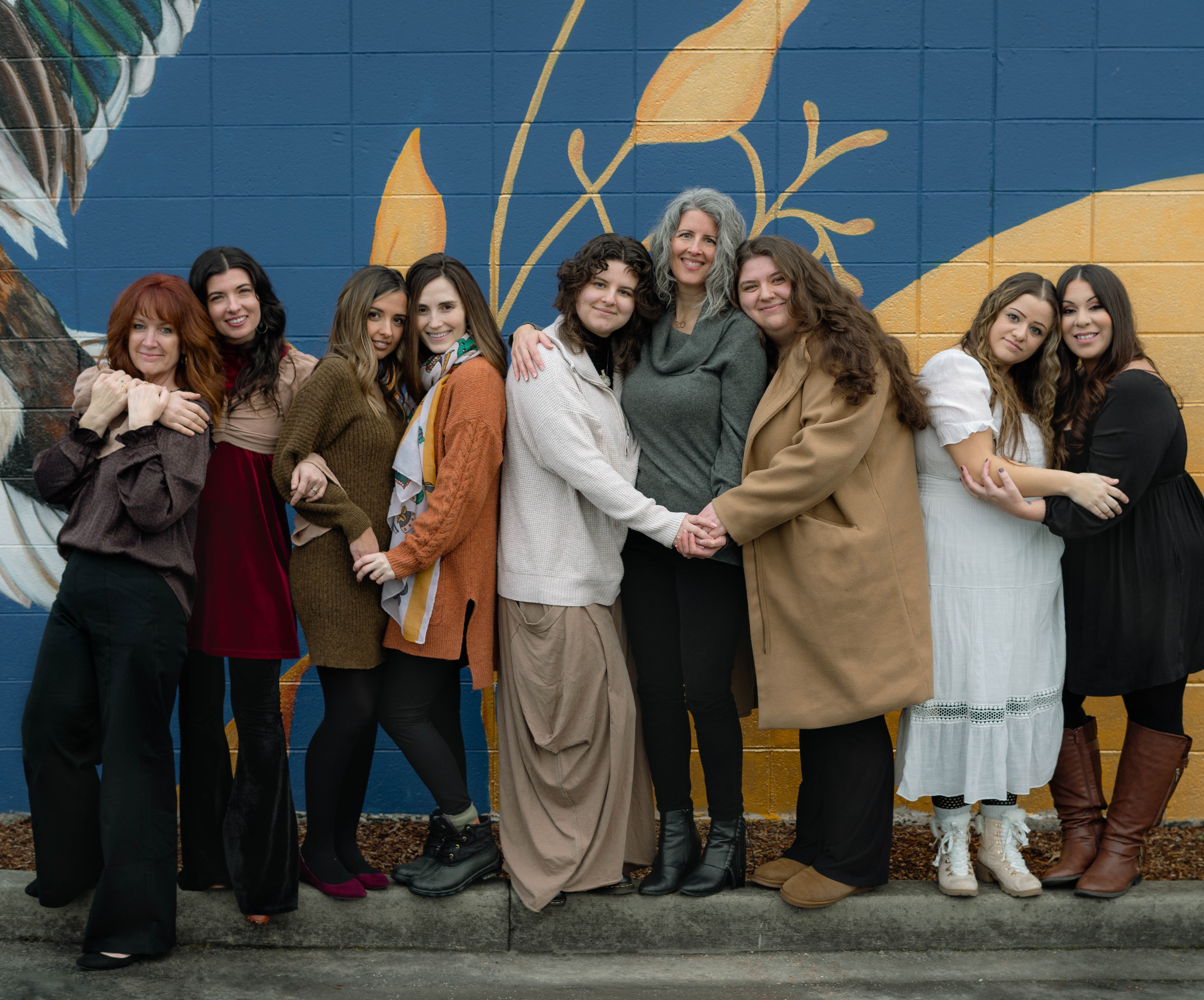
Freeing Our Frozen Songs: Transmuting Pain to Power contributors
Left to right: Mikell, Terah, Crystal, McKenzie, Kaid, Kirsten, Kaya, Meg and Abigail; Not pictured: JC Smith

We did…together! In November, 87 backers pledged a total of $6,201 to support our independently published anthology Freeing Our Frozen Songs: Transmuting Pain to Power. We want to sincerely thank those who contributed to our Kickstarter campaign! Whether it was by pre-ordering your copy of Freeing Our Frozen Songs, donating any amount, sharing, talking about the book, thinking about the book, whatever you did to move this project forward, thank you! We achieved momentum, ultimately exceeding our fundraising goal!

This will allow us to recover our initial investments, fund the printing and shipping of our book, put the finishing touches on our companion workbook’s offerings, including recording guided meditations, and fund our local book release events. 

Thank you so much. Truly. We hope you appreciate all the intention and love we put into this offering!

Mama Bird

Book Reveal! Freeing Our Frozen Songs: Transmuting Pain to Power

Hello faithful readers,

I trust the seasonal changes, wherever you may be, are inspiring you to slow down, go inward, and savor the feeling of autumn’s presence. Those things are certainly true for me. On top of it being a very special time of year, the time of year that my daughter and I both celebrate our birthdays, I am also celebrating another milestone: The upcoming release of our anthology “Freeing Our Frozen Songs: Transmuting Pain to Power.” I, along with nine other artists, collectively and intentionally created a book with the mission of generating more healing and acceptance in a sometimes harsh and apathetic world. Because I have yet to find a better way to reduce the shame and stigma of surviving, well, anything, than through storytelling.

Freeing Our Frozen Songs: Transmuting Pain To Power

Ten Oregon storytellers and visual artists are featured in this anthology. Our curator, Kirsten Fountain, believed in us, valued our individual stories, and honored us as the true experts in our lives. I am so proud to be revealing eighteen poems that I have never before shared. Poems that explore my own personal journey from pain to power.

I believe in not only witnessing, but honoring, celebrating even, the full spectrum of this human experience. That is why I am preordering, in addition to my complimentary contributor’s copy, the book Freeing Our Frozen Songs to place in the library at the Trauma Healing Project in Eugene, Oregon.

I invite you to preorder our collection via Kickstarter and consider sharing it with a loved one in your life, particularly one who has endured trauma of any kind, at any time. Or you might consider donating it to a community library. Or keeping the book just for yourself.

If that feels like too much of a commitment at this time, I completely understand. You instead might consider a “sneak peek” of our anthology on our website https://freeingourfrozensongs.com/. There, you can preview samples of our work, and get to know each contributor more intimately by reading our biographies and artist statements. Of course, you also might consider a simple share on social media or an email forward as a way to show our contributors and curator some love.

Regardless, know that your story is always worthy. Always. And autumn time is a wonderful reminder of the sweet release of letting go of that which no longer serves us. Like the leaves on the tree, we too reach our peak, change colors, and transform into something brand new, sometimes unrecognizable, but always with a thread of the familiar still hanging on.

Please be blessed on your journey, and I will too.

With thanks,

Mama Bird

Killing My Darlings at the Colonyhouse

Late August brought with it my long anticipated road trip north to the historic Oregon Writers Colony Colonyhouse in Rockaway Beach, Oregon. A trip I’d been planning for a year. The time to “kill my darlings” had finally come. I’m quoting William Faulkner there. He was speaking to the act of “letting go of the bits of your writing you are holding onto selfishly.”

Looking down into the dining room where my darlings, or rather, scraps of paper and Post-It notes still needing to be “merged” into my memoir manuscript cover the table. I kept about half the ideas. “Killed” or recycled the rest.

A semi-unexpected surprise was the hominess of the Colonyhouse itself. I knew that the writers’ house (more like a lodge) was established back in 1988, when I was three years old. So I expected the writing desks strewn throughout every room and the impressive collection of coffee mugs hanging in the kitchen. But what caught me by pleasant surprise was how much it smelled like my great aunt’s house and the moment when I stumbled upon a signed copy of my favorite author’s memoir. It was the epitome of homey. Like, I didn’t want to leave.

The Colonyhouse was designed by the same architect who created Oregon’s Timberline Lodge at Mt. Hood. All the little details, down to the doorknobs, were a wonder.

My writing goals for the five day stay at the Colonyhouse were mammoth. I was going to incorporate into my manuscript all the feedback I had received from my critique group, all the changes I had outlined for myself into my manuscript in red pen, all the “notes” you saw earlier, and write an ending. Endings are hard. Writing is hard. Editing is hard! All of it is just plain hard. I had to take deep breaths and remind myself of two things. Number one, Anne Lamott’s well-earned advice: Bird by bird. Number two, it’s all about the journey!

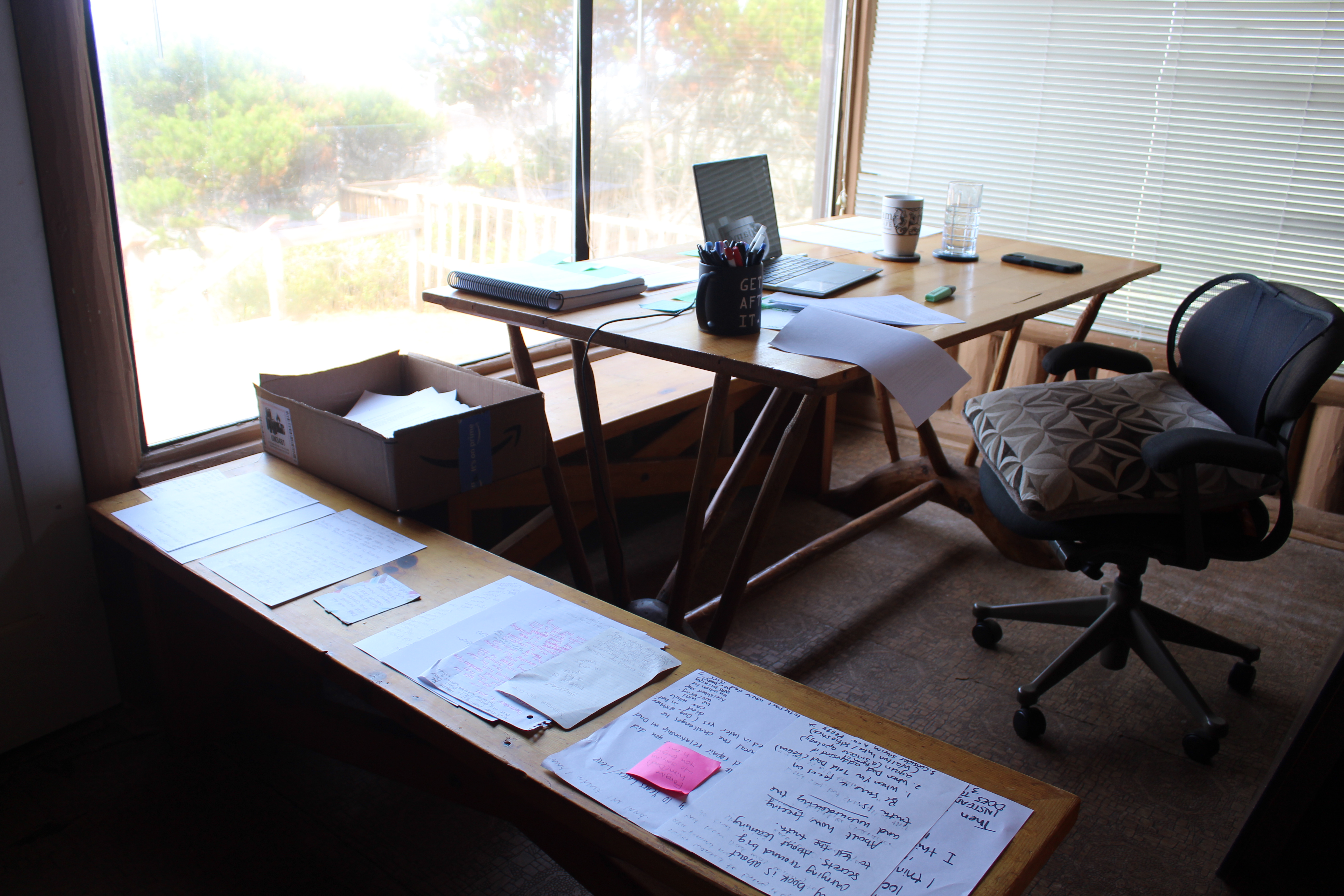
Mid week. Notes. Office supplies. Coffee. Water. And a view of the ocean.

Once I got over the initial shock of all that I was trying to accomplish, I started setting goals. Attainable goals. I incorporated all the feedback needed make my manuscript shine (or rather, stand up on two shaky legs). I wrote an ending and accepted that it will need more work. (First drafts of chapters typically aren’t ready for publication!) I embraced what I would be leaving with: a completed fourth draft. And let go of what I would not be leaving with: a draft that’s ready for querying. Most importantly, I took moments to be grateful, experience joy, and celebrate in my own sacred little ways.

Something else happened, too. Existing inside of my story all day every day for five days was quite emotional. There were tears and reflection and ruminating. I realized that telling my story is a lot like holding up a massively heavy thing for everyone to see. It is deeply emotional work, especially the ground that I delicately try to cover in The Poetry of Place.

I am superstitious when it comes to the craft of writing. I have to have certain objects that invoke inspiration, such as certain books, Dad’s Spirit Path cards, and my satchel of crystals, pictured here.

Wrapping up the five day writing retreat was bittersweet. My writing spells, interspersed with walks on the beach, and sleeping to the sound of ocean waves, would be missed. My only solace was that ever other writer I know would likely have also found the retreat too short to cover the creative distance they wanted. So I leaned on my old, trusted way of thinking, and reminded myself that my manuscript is 100% better than it was.

I also left with the understanding that my story is getting too heavy to lift. And although it is not there yet, it is getting ready to take flight. I can feel it.

Love,

Mama Bird

Sunset at Rockaway Beach, Oregon

Dancing With Daisies

“What makes you so special?”

“Nothing and everything all at once.”

Shasta daisies always bring to mind Spring, 1989, and the kindness of strangers. I was four years old at the time, the same age my daughter is now. I was one of a dozen other mini ballerinas parading across the stage at Crescent Elk Auditorium for our annual dance recital. It was the same stage I would awkwardly walk across a decade later during my eighth-grade graduation. Even more awkward having sipped from a small bottle of Peppermint Schnapps beforehand. (I sure was a special student. At-risk, I think they called it.) That was the first and last certificate of anything I would ever get in my hometown.

The day of the recital my four-year-old brain got tripped up after having walked out onto the stage, looked out to the audience, and noticed my Great Grandma Gladys sitting there. I froze. Usually my Great Grandma Gladys was in her manufactured home by the sea. In her dusty pink recliner. With my “Barrel of Monkeys”–a toy she kept just for me–on her TV stand. Usually she was at home, in her nightgown, smelling like Vix VapoRub and beef minestrone. But on the day of my ballet recital, she was right there in the audience, sitting with my Grandma Peggy, Great Aunt Tina and, of course, Dad. I almost couldn’t believe it, until she raised her hand to wave, palm facing me, wiggling four fingers and smiling. I was transfixed. My face turned pinker than our ballet shoes, and I stood firmly in place for the rest of our number, shyly waving back at Great Grandma Gladys while the other ballerinas did their grand plies and jetes all around me. I didn’t even move when the music stopped. Eventually an older ballerina, dressed head-to-toe in black, picked me up and whisked me backstage. I know because we have a video recording of the whole thing.

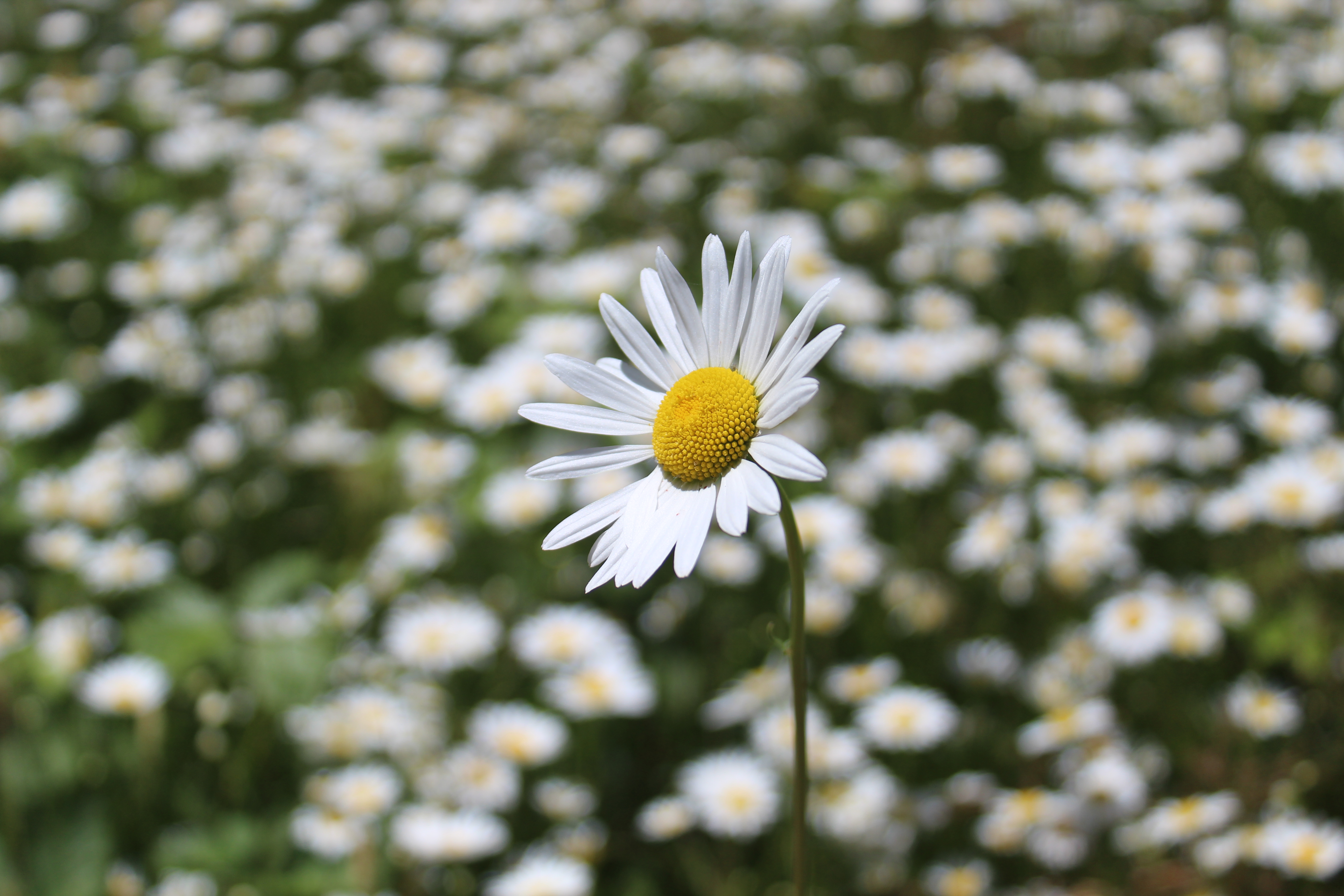
At the end of the recital (this is where the Shasta daisies come in) all the ballerinas from the entire recital went out on stage to take our final bow. The leads got big flower bouquets and rounds of enthusiastic applause. The younger mini ballerinas all got single red roses. And then there was me, the last mini ballerina and no more red roses to go around. Surely it was because I’d goofed up on my part, not even dancing like we’d been practicing for. But before anyone could boo or throw something or–even worse–collect their jackets and leave, a nameless, faceless stranger handed me a single white Shasta daisy on a sturdy green stem. They must have run outside and picked it.

The Shasta daisy set me apart, just as I had set myself apart earlier, as a stage frightened little girl. Not all of us are meant for the spotlight, or even for destined for the things that everyday people take for granted–a mother to look after you, graduations, trophies and certificates, a bedroom to yourself, red roses…That day in the auditorium was the first of many more humbling moments to come. But looking back, it reminds me that no matter how difficult the circumstances are, there is always an angel in the wings. The Shasta daisy is a reminder that I am both special and not special all at once.

Dad and I after my ballet recital. A single Shasta daisy in my hand. Spring, 1989.

Half Sweet

I want to know your antidotes for bitterness
what you hang on the walls of your soul
to help soften all those hard edges
you know the ones
the ones that lol because you thought
after rounding the corner to thirty five
all would be well and fine
and you’d have all you ever wanted
but you don’t
(you have more than all you ever wanted)

I want to know your antidotes for bitterness
how many spoonfuls of something sweet
go into your morning drink
how many shots of something stronger
what you do to take the edge off
your go-to’s:
spirituality, live music,
a sunset every day, something else

I want to know your path to acceptance
what tools you used to climb the hill from thirty to forty five
with such grace and that easy smile
what you did with the pieces that fell out
the bottom of the whole thing
where you air it out, and with who
and what you’re all about
I want to know how you celebrate your little wins
what it looks like when you go big
I want to know your antidotes for bitterness

I want to know how you reimagined the American Dream
and made your own happy ending
stitched together with hand-me-down furniture
and a nice, slow life you can somehow still barely afford
perhaps some flowers, or whatever, planted somewhere
I want to know how you maintained
after having bought everything they sold you
and still coming up half empty
I want to know your antidotes for bitterness

I want to know how you find shimmers of gratitude
every morning in the bubbles in your kitchen sink
what treats you keep in your pocket
sweet one
what you carry through your day
that makes you so unafraid
and keeps you so positively humble and loving
I want to know how the wind and meadow
have both softened you and made you stronger
how the sunrise still feels like a promise
I want to know your antidotes for bitterness


Laughing

You’re no fun,
they told me

I couldn’t help but picture
myself hanging upside down
on a tree branch

laughing

marching
up the hillside
in search of wildflowers
and fungi singing one of my
favorite songs

Dear Prudence

You’re no fun,
they told me

I couldn’t help but picture
Dad’s obituary, which I wrote
a few short months ago,
and likened
him to Christ
and got his age wrong

(I wrote sixty, but Dad
was only fifty-nine)

He never got a Senior Discount
…he would have loved that

You’re no fun,
they told me

I couldn’t help but picture
Dad howling under the fullmoon
just because
or steering our kayak through the
whitewater, kid me in the front,
or us meditating together at sunset
just thankful for the grace of another day

You’re no fun,
they told me

And I laughed

If I Took My Grief Out to Lunch

Dear Reader, Throughout the month of October I, along with a small group of other writers, wrote about loss in “Write Your Grief Out” with Anne and Maria Gudger. Here is one excerpt from that period, based on the prompt “If you took your grief out to lunch, what would you talk about?”

If I took my grief out to lunch, we’d talk about the way things used to be. How the other day I saw a small child sending crab pots off the dock into the ocean with her father. The way we used to do that before you became a vegetarian. Before you quit crabbing in the wintertime and raising rabbits for meat in our backyard. We’d talk about way before the tofu and carob phase, when you ate burgers and drank Budweiser. But that was never you, so I was glad I got to see your next phase too: your altars and spiritual books and how a real live guru came to visit us and stayed in our home and went on long walks with you in the woods.

If I took my grief out to lunch, we’d talk about the way things used to be. How half the pictures from when you were a boy show you at the top of some tree. Or expertly showing your hog for 4-H. Or snug in the middle of three sisters, volleying between tormenting them and being the soft shoulder they could cry on. How you had so much lived life before me, but it took you dying for me to really see that. The boy you’d been–wild as they come. The teenager you’d been–different, but popular and carefree. The man you’d become–a young, single father, your biggest challenge yet.

If I took my grief out to lunch, we’d go up river afterward. We’d blast Johnny Cash through the redwoods, roll down the windows, and stop for a drink of spring water gushing from Carter Falls. I’d take my grief inside the culvert under South Fork Road, where the runoff pours into the river in wintertime. We’d steady ourselves on the rocks, crouching just to watch the water run. Solely for the meditative purpose of it. We’d have no agenda. We’d have no to-do’s. We’d see a bald eagle and raise our hands to our chest in prayer. We’d skip rocks. We’d drive up further and park by Rock Creek. We’d travel up creek on bare feet. We might see a wild animal drinking from the stream; or a fairy ring of mushrooms, undisrupted. We’d awe.

If I took my grief out to lunch, we’d talk about the way things used to be. The time we rode elevators to the tops of the tallest buildings in San Francisco, just to look out the windows. Danced with other Hare Krishna devotees at Golden Gate Park, real ones who lived in the temples year round, not just for a few weeks in the summertime like we did. Venice Beach. Berkeley. Vancouver B.C. All the food and the flowers and the strangers. How we’d come back to Crescent City in September tanned, hair windblown and faces happy, just the two of us. No mom in sight and all the freer for it.

If I took my grief out to lunch we’d talk about the way things used to be–because it’s the best balm to the way things are now. Less colorful. Less natural. Less free. I don’t know many daughters who can claim that the best gift their parents gave them was freedom and exploration–just for the sake of it. Without agenda. But if I took my grief out to lunch, we’d talk about that.

With love,

Mama Bird