Back Home Before You Know It

Driving past the massive redwood peanut carving meant that we were halfway to Eureka, California. The redwood peanut was also a marker of the town where my mother, Moonbeam, lived. Every other weekend, Dad drove me to Orick for our mandatory visit. Mandatory just meant that the law was involved. The law being involved was practically a law of the universe for people like us.

But the law had little to do with why we were driving past the redwood peanut that day. Except that after my scheduled ear surgery, I was mandated to remain with Moonbeam in Orick–in civilization–until my eardrums fully recovered. It would likely take the rest of summer. My earaches had become regular enough that a physician recommended I get tubes put in to help drain out all the gunk. I would also be getting my tonsils and adenoids removed. The plan was that after leaving the hospital in Eureka–the same hospital where I’d been born nine years earlier–Dad would drop me off at Moonbeam’s before heading back upriver to our home off grid. It would be the longest I’d ever stayed with Moonbeam, my stepdad, and my two younger brothers. I stared out the window as we drove past the huge redwood peanut, anticipating the story I knew was coming.

“That peanut,” Dad began, “was trucked all the way to the White House in Washington D.C. as a gift for President Jimmy Carter. But because Carter was an environmentalist, he shipped it back. He saw it as an insult. Here Carter was, trying to save the redwoods—or what was left of them—and some loggers from Orick send him a redwood tree carved into peanut! What a joke. I mean, can you imagine?”

I didn’t say anything in response. Didn’t need to. Sometimes Dad talked to keep himself awake while driving. Despite that it wasn’t nighttime, I knew Dad was probably tired. He’d worked at the road department all week, helped get my belongings together for the trip, then driven from near the border of Oregon in a car we’d borrowed from a friend of his. I didn’t really know why we were in the car, and not in Dad’s pick-up truck. Maybe the truck got a flat tire or needed a repair. Or maybe driving the car had been mandated. For whatever reason, I was riding in the backseat: precious cargo.

The car smelled horrible and was making my stomach turn. I never got car sickness on windy roads, but I suddenly felt queasy. It was as if invisible cigar smoke was emanating from the maroon velvet seats. Dad didn’t smoke, but whoever owned the car sure did. I was getting nauseous. I tried to lie down, the seat belt digging into my waist. I didn’t know what was worse: watching the tops of the redwood trees zoom by out the window, green morphing to white given all the movement, or closing my eyes. Both felt impossible. The pain in my ears faded to the background as my nausea took centerstage. I heard Dad mumble something about the time. My ear surgery was scheduled to start in one hour, so we’d be cutting it close. I gripped the car seat with one hand and held my other hand to my forehead, trying to remain steady. One more hour to go, and then the hard part would begin.

Naturally, I didn’t remember a thing from my first visit to Humboldt General Hospital–the day I’d been born there. This time though, I’d remember every detail. Starting with how enraged Dad was when I finally puked as he whipped the car into the parking lot.

“Couldn’t you have at least waited until I parked?” Dad yelled at me, swinging my door open.

Dad rarely yelled and never hit me, but in that moment, he looked like he wanted to rip my head off. Now that I am a parent myself, I know the look. It was stress. It was fear of failure. It had little to do with me. Fucking up created shame. Dad couldn’t win. We were late and I’d puked in the car he’d borrowed. This would all make him look bad. It would take time that we just didn’t have. Dad quickly shook out the floor mat, tossing the vomit into some nearby bushes, and then we raced into the hospital.

Before long, the hospital staff were preparing me for surgery. Dad may or may not have told them about the vomiting. It was all happening so quickly. They said I wouldn’t feel a thing during the operation, no pain and no nausea, because they planned on putting me to sleep. I was intrigued, then confused. Instead of reading me a bedtime story, a nurse placed a large, rubber mask over my mouth and nose. Because I’d never worn anything like the mask, I was frightened—and then I was out.

I remember a few details from right before they put the mask on. After being wheeled into the room, they positioned me with my feet pointed toward the door we’d entered through. There were three people: one doctor and two nurses. They were all wearing masks too, but a different kind.

Then things changed. The doctor began counting back from ten. By the time he got to four, I did indeed fall asleep. But I also rose up out of my body. Suddenly, my feet were no longer pointing at the door from which we’d entered, but my back was. And instead of laying horizontally, I was standing vertically. I was technically floating and there were two of me: the “me me” and the “hospital bed me.”

Me me observed the doctor and one nurse performing the operation, and a second nurse standing off to my right.

I woke up as I was being wheeled down a short hallway. Never mind that I was getting too old for stuffed animals, I was downright giddy when someone handed me a small teddy bear wearing a white t-shirt with the name of the hospital printed on it. Maybe they’d known they almost killed me back there, and the teddy bear was my consolation prize. I didn’t care. The deal was made even sweeter when I was given a popsicle in the recovery room. I was instructed to eat lots of popsicles in the days to come. Maybe it will be okay after all, I thought.

Driving back to Orick, I sat in the backseat again. I told Dad about the strange occurrence when they’d “put me out” at the hospital.

“Hey, that’ll happen,” Dad said reassuringly, looking at me in the rearview mirror.

Dad was nonchalant. He knew his stuff. This was child’s play. Dad was the one who had spent weeks on the other side after a drowning accident when he was a kid. They’d dubbed him Miracle Boy in the local newspaper. After the accident, our family felt Dad got touched by an angel, because from then on, he was so different. Not just his voice, which had been scarred in the accident, but his whole way-of-being. He was spiritual and special. What I’d experienced was only a blip. I didn’t get so much as a glimpse of heaven. It was practically nothing. I needed to focus on my future, on getting better, on summer.

Today I understand why I didn’t go to the great beyond. Had things ended differently that day, Dad would never have forgiven himself for how he’d left things, for yelling at me like he had in the parking lot. We drove past the redwood peanut again and I sighed audibly.

“You’ll be back home before you know it,” Dad said, empathetically.

I wasn’t entirely sure if Dad meant our cabin by the river, or our home up in the sky.

Killing My Darlings at the Colonyhouse

Late August brought with it my long anticipated road trip north to the historic Oregon Writers Colony Colonyhouse in Rockaway Beach, Oregon. A trip I’d been planning for a year. The time to “kill my darlings” had finally come. I’m quoting William Faulkner there. He was speaking to the act of “letting go of the bits of your writing you are holding onto selfishly.”

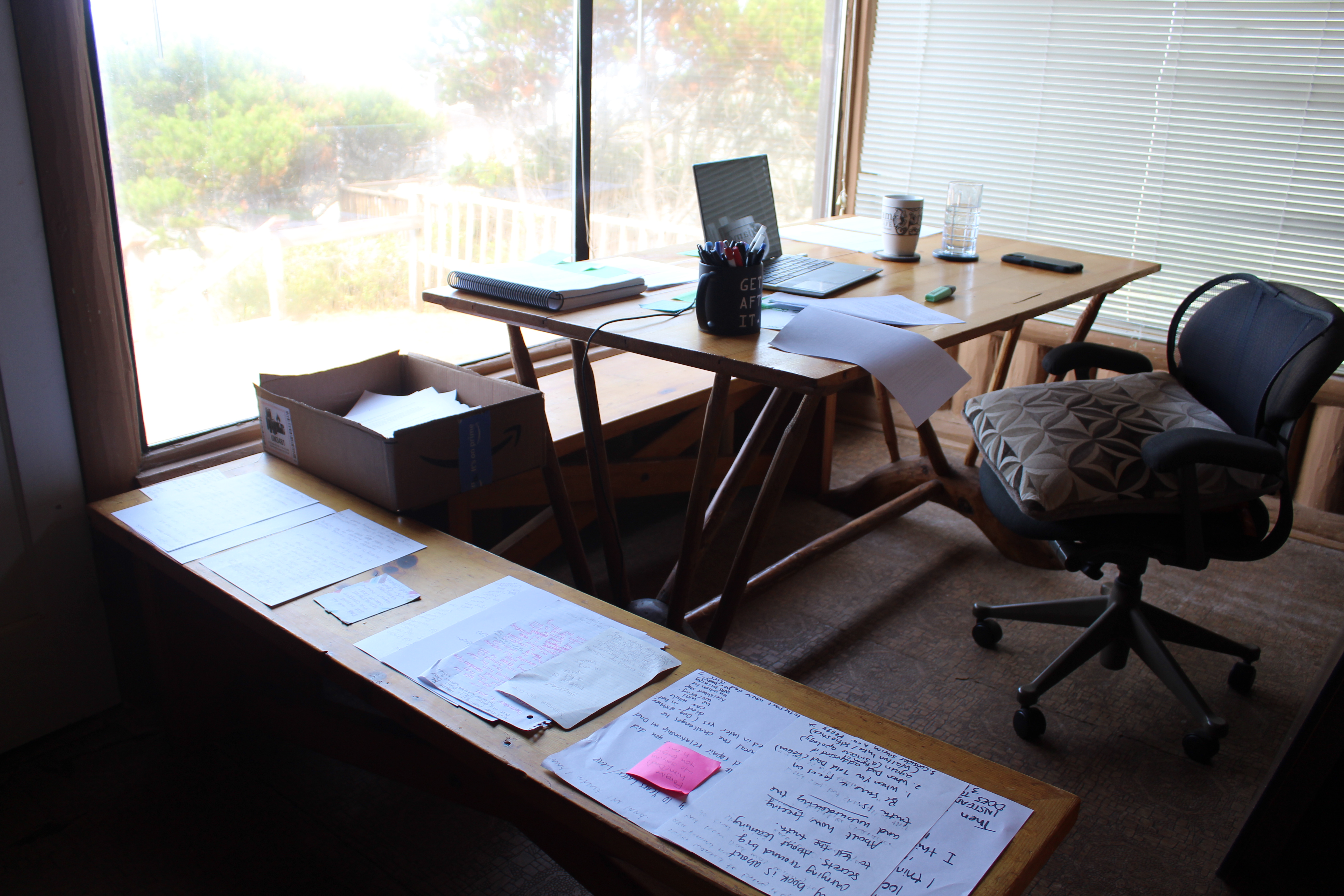
Looking down into the dining room where my darlings, or rather, scraps of paper and Post-It notes still needing to be “merged” into my memoir manuscript cover the table. I kept about half the ideas. “Killed” or recycled the rest.

A semi-unexpected surprise was the hominess of the Colonyhouse itself. I knew that the writers’ house (more like a lodge) was established back in 1988, when I was three years old. So I expected the writing desks strewn throughout every room and the impressive collection of coffee mugs hanging in the kitchen. But what caught me by pleasant surprise was how much it smelled like my great aunt’s house and the moment when I stumbled upon a signed copy of my favorite author’s memoir. It was the epitome of homey. Like, I didn’t want to leave.

The Colonyhouse was designed by the same architect who created Oregon’s Timberline Lodge at Mt. Hood. All the little details, down to the doorknobs, were a wonder.

My writing goals for the five day stay at the Colonyhouse were mammoth. I was going to incorporate into my manuscript all the feedback I had received from my critique group, all the changes I had outlined for myself into my manuscript in red pen, all the “notes” you saw earlier, and write an ending. Endings are hard. Writing is hard. Editing is hard! All of it is just plain hard. I had to take deep breaths and remind myself of two things. Number one, Anne Lamott’s well-earned advice: Bird by bird. Number two, it’s all about the journey!

Mid week. Notes. Office supplies. Coffee. Water. And a view of the ocean.

Once I got over the initial shock of all that I was trying to accomplish, I started setting goals. Attainable goals. I incorporated all the feedback needed make my manuscript shine (or rather, stand up on two shaky legs). I wrote an ending and accepted that it will need more work. (First drafts of chapters typically aren’t ready for publication!) I embraced what I would be leaving with: a completed fourth draft. And let go of what I would not be leaving with: a draft that’s ready for querying. Most importantly, I took moments to be grateful, experience joy, and celebrate in my own sacred little ways.

Something else happened, too. Existing inside of my story all day every day for five days was quite emotional. There were tears and reflection and ruminating. I realized that telling my story is a lot like holding up a massively heavy thing for everyone to see. It is deeply emotional work, especially the ground that I delicately try to cover in The Poetry of Place.

I am superstitious when it comes to the craft of writing. I have to have certain objects that invoke inspiration, such as certain books, Dad’s Spirit Path cards, and my satchel of crystals, pictured here.

Wrapping up the five day writing retreat was bittersweet. My writing spells, interspersed with walks on the beach, and sleeping to the sound of ocean waves, would be missed. My only solace was that ever other writer I know would likely have also found the retreat too short to cover the creative distance they wanted. So I leaned on my old, trusted way of thinking, and reminded myself that my manuscript is 100% better than it was.

I also left with the understanding that my story is getting too heavy to lift. And although it is not there yet, it is getting ready to take flight. I can feel it.

Love,

Mama Bird

Sunset at Rockaway Beach, Oregon

What Matters Most

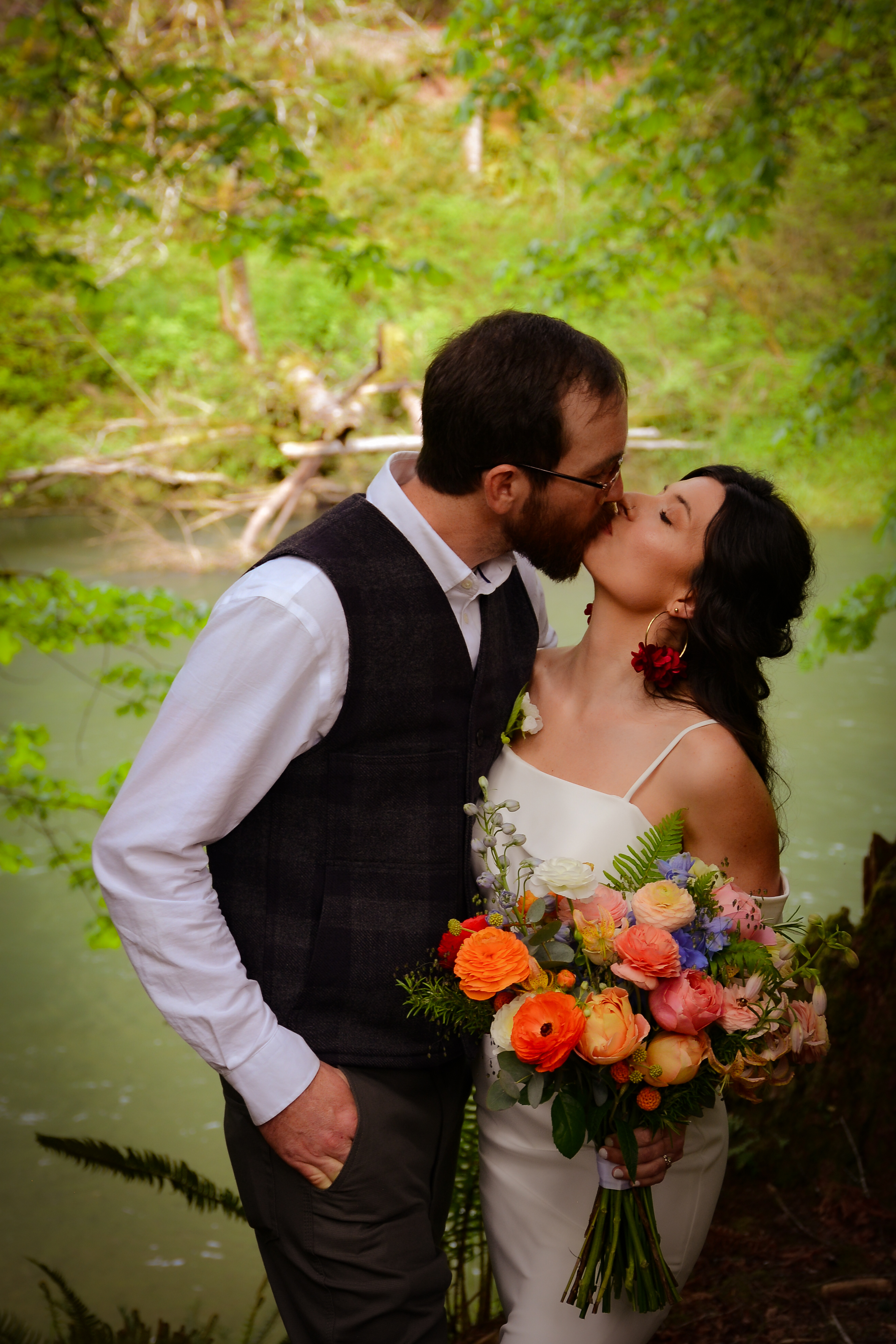
I shouldn’t still be thinking about the earrings I wore on the day of our wedding on Sunday, May 22, 2022, but I am. I’d wanted to convey that, despite Dad’s passing less than three weeks earlier, I was OK. It was all good and everything was fine.

But when I look back at the photos, I see me the day before the wedding, running frantically around the mall alone, bombarded with choices. There were plain gold hoops, bright neon feathers, faux diamond drop earrings, shaped like leaves, and the ones I got: showy gold hoops with crimson silk flowers. The earrings were distracting, and I hadn’t noticed that at the time.

What didn’t help is that until 72 hours before the wedding, I didn’t know which dress I was going to wear, my original choice never having arrived in the mail. It also didn’t help (or maybe it did) that, since Dad died, I decided that nothing superficial mattered anyway. It wasn’t what you wore, it’s what you said. It isn’t how you look, it’s how you see.

So on the one hand when I look at those photos, I think of those earrings as my “fuck it” earrings. The slap it all together and play-it-cool mood of that unique moment in my life. The wishing I could hide in plain sight. But the only statement those earrings seemed to be making was “whatever you do, don’t look at me.

Do I wish, instead, I’d have selected the faux dangly earrings shaped like leaves? Yes, I can too clearly picture how they would have sparkled when catching the sunlight through the trees. But would I take it back and change it? No. Not really, because something else would have been off. As is in life in general. As is when you are having a wedding and you are having a funeral.

In this life, it really, truly isn’t about the perfect look and the photo-worthy setting. And I give myself grace that I knew that going into it, and I placed my priorities elsewhere when I didn’t give myself a lot of time to shop for the earrings, and I didn’t take along a friend. I didn’t really get that “bride moment”…the one that they were selling me. For me that fantasy involved a careful putting on of my high-heeled shoes (I would wind up wearing slip on leather wedges), a cheers with my bridal party, Lorde’s “Royals” blasting in the background, my “Cinderella” moment. What I got instead was a mad dash to the mall for last minute, unplanned accessories, and, in the bridal suite, our children running around underfoot, only the sound of shrieking and chatter in the background. What I got instead was real life, what actually matters, the people, the experiences, and yes, even the innocent fashion mistakes.

Now when I think back on our wedding day, I remember being thankful it didn’t rain. I remember being grateful nobody got hurt. I remember that “My Sweet Lord,” Dad’s song, came on the radio on the drive to the mall and it felt like it was playing just for me. I remember I cried. I remember I was fragile, deep down. I remember I couldn’t afford to crack. I remember writing and practicing my vows. I remember carefully putting out the ceramic dinner plates and silverware, buffing smudges out of the wine glasses in the dining room late into the night before our wedding.

I am trying to forget the sparkly earrings that got away. I want to let go of notion that tells me our wedding needed to be more perfect than it was. That I needed to be a better bride. That I had somehow let something slip. That I should have spent even more money. Then, maybe, things would have really been perfect. Maybe. When the only thing that honestly would have made that day better, is having Dad there for it.

Love and mysterious blessings,

Mama Bird

All The Tattoos I Never Got

Tattoos are expensive. But not the first tattoo I never got. The first tattoo I never got was going to be free, because my friend who was fourteen, had an older brother who was sixteen, and he was doling them out for free. He may or may not have been on something. But the real reason I didn’t get the first tattoo I never got–a flaming heart on the inside of my right hip bone–was because I knew Dad would kill me. Or that he’d want to. Or, at least, he’d say he wanted to. “I could kill you,” I could picture him saying, fists clenched like he wanted to fight, but without a fighting bone in him. All soft on the inside like the bubblegum ice cream he bought me down at CC’s Diner.

Plus I didn’t think my friend’s brother could do color, and I didn’t want a green flaming heart, I wanted a cherry red one with licks of yellow and orange flame coming off of it, like was on the sides of the hot rods down at the annual Sea Cruise.

The second tattoo I never got wasn’t quite as symbolic as my “love equals pain” flaming heart. Like my friend Aimee had done, I was considering a full back tattoo–a landscape. The landscape of home. A redwood tree, and the ocean, and maybe some rhododendron. The plan only got as far as that–a fantasy–before cost prevented me from even considering it. Months later, at 23-years-old, I moved from the high desert where I was living in Arizona, back to the Pacific Northwest. Back to the big trees and the sea. It hadn’t been about having a tattoo at all, but about answering a calling.

The third tattoo I actually got close to getting. It was on a whim which, I was sensing, had to account for at least half of all tattoos out there. It wasn’t even during a break up, or anything. I can’t even put my finger on why I was going to finally get the tattoo I never got. Something about being hip, or the potentiality of appearing as hip as I felt.

I almost went through with it. I thought about it for several days before walking into Cry Baby Tattoos in Eugene. I presented the tattoo artist with an image from my phone: two minimalist looking tattoos, a sun and a moon. Stick drawings for the backs of my arms, placed above my elbows. The sun on my left arm, the moon on my right. I kept thinking of a favorite quote, “Three things cannot be long hidden: the sun, the moon, and the truth.”

The tattoos would be a reminder to always be truthful, to seek truth in all situations. To demand truth. To be truth.

As soon as the tattoo artist stenciled the designs on my arms, a perfect replication, I looked into the mirror and suddenly my elbow wrinkles jumped out at me. I hadn’t noticed them before. And when I bent my arm at the elbow, the sun and moon stretched, misshapen.

When I confessed to the tattoo artist that I felt conflicted, and didn’t think I could go through with it, he responded gracefully, “It’s your body.”

The next tattoo I never got were the coordinates of home:

41.7353923 N -123.9828519 W

It was either that or a fiddlehead fern on the inside of my left wrist, to remember Dad by. Later, I learned that I didn’t need the coordinates of home tattooed on myself anymore. Because now that place would forever be a part of me. I could plant trees in Dad’s yard instead, and spend decades watching them grow. It seemed I had outgrown all of the tattoos I never got, which lead me to thinking that from here on out, maybe I should just let my scars do all the talking.

The Importance of Showing Mercy in Memoir

Like all of us, I’ve always been of the belief that actions speak louder than words. But over the past several months, I’ve been thinking about how loud words do speak, particularly if you are a memoirist.

I’ve had many years of writing and publishing (mostly here on my blog) to teach me that those who are written about will read your words closely and they will take them to heart, naturally. I have also had the luxury–I humbly admit–of those characters showing me extreme grace and forgiveness.

My memoir writing journey began in my very early twenties, and because I knew virtually nothing about memoir, other than having read a couple of them, I approached my writing this way: I wrote everything about everyone and used all their real names.

Now, I look at my pages and I see the truth, yes. But I also look at those pages and see real live people with real live emotions, and I have to honor that. At this juncture, having written the meat of the story, and revised it several times over, I have a choice: Do I change names or soften the story? Do I painstakingly sort through and assign similar sounding names to key characters? Cousins, boyfriends and bosses? Or do I keep their names and speak as if they are there in the room with me: with honesty, integrity, and compassion?

Writers in the genre have all heard the same line, “If they didn’t want to be written about poorly, they shouldn’t have behaved badly.”

It’s a fine starting point, a line to help you get your pen moving across the page. But I am curious to hear from other aspiring memoirists if it’s that same sentiment they think of when crossing over the threshold into querying and publishing.

Because, after all, most books do not become overnight bestsellers. What if we memoirists, in the end, sell our books only to our family members. If your book subject matter, childhood trauma, wouldn’t make for some awkward Thanksgiving dinner conversation, well I don’t know what would.

But here’s the thing, when it comes to me, the majority of those who have purchased the books I have self-published are not my family. I haven’t had a Thanksgiving with my mother, ever, and abandonment, whether comfortable or not, is central to my story. I cannot untangle myself from the truths and tell some other story. But maybe I can tell my story with a balance of both transparency and grace. Maybe. That’s what I hope for.

Back when I first started writing The Poetry of Place, long before it had a title, long before I’d changed my mother’s name to Moonbeam, and long before I started dragging my pages through critique group, it was all about the therapeutic benefits of memoir. I didn’t think of it in those terms back then, but looking back I’d really, really, really needed to exorcise my story. I was always a writer, from elementary school on up. So my story–once I finally realized it’s potential–became viable subject matter. And my intention morphed from the therapeutic benefits of writing to the creative challenge it presented: Writing a book worth reading.

So rather than “If they didn’t want to be written about poorly, they shouldn’t have behaved badly,” how about, “Hurt people hurt people.”

Most people agree with that statement, and I believe the message is being conveyed through my memoir. Therefor I cannot take responsibility, or blame, when expressing, in so many words, something that we all agree is true, that “hurt people hurt people.”

But that’s what it all comes down to, responsibly. Because memoirists aren’t just airing our dirty secrets, but in some cases the secrets of others, too. In turn we have the potential to create a significant portion of someone’s legacy. And that is a responsibility that should not be taken lightly. Ever.

As I cross over the threshold into querying (that’s the long process of landing an agent or a book deal), and as I refine its final pages, imagining its bound version, I weigh my options. I am trying to strike a balance that honors both what I’ve endured, and protects the inherent innocence of those surrounding the story itself. Because none of us are perfect. Not even close. I think the most helpful advice I have heard is to be as hard on myself in the story as I am being on others. I assure you, given my nature, that my flaws will come across strongly in the final story. No matter what version you get.

Love (above all else),

Mama Bird

Surrendering to a Season of Change

We woke up to rain. Big droplets clinging to the rhododendron and sunflowers outside the bedroom window. Every day on the weekend I ask myself the same thing: Should we stay home and clean, or leave and spend money?

It would be a stay home and clean kind of day.

Usually I welcome fall with open arms. If the fact that we named our daughter ‘Autumn’ is any indication…But this year I’m just not as warm to fall. The summer was long, and scorching. One of our farm cats perished in the 108 degree heat. More positively, we managed to get some family time in with loved ones. Long overdue visits and quality connections as we somehow managed to not even get the Coronavirus. Several times, I thought we had. This most recent time impacted A’s experience at preschool — she missed her first whole week. Over a cold. But we rolled with it. Rolling with it is just the way now. Things change all the time. With headlines like, “National Guard Deployed to Drive School Busses in Massachusetts” and “UN is seeking $606 Million in Emergency Aid for Afghanistan After Taliban Takeover,” we’re living in a totally new reality. Disappointments are common place. Ours are minor.

I started gardening this summer. With a lot of cooperation from my fiancé and our neighbors, a plot of food erected itself, now in view from our bedroom window, beyond the rhododendron and sunflowers. My life is layered and rich. We have tomatoes and peppers piling up in the kitchen, and are running out of freezer space. I’m going to miss the days of summer…stretching on and on. Brown shoulders. Blackberries. Golden sunsets.

With the rain, the environment feels to have shifted beyond its allotted amount while we slept. The moon when I last looked was half full — now it appears almost completely full. It is waxing and ready to shine. Last night, a coyote was howling — more like yelping — and it wouldn’t stop. I went outside to make sure it wasn’t down with the chickens, having a feast and tipping us off with its cries. Barefoot on the dry pale grass, it felt like no one was aware of this animal but me. It was ten o’ clock at night and everyone else was sleeping. I shone my cellphone flashlight in the general direction of the coyote — like what was that going to do? When I went back inside and crawled into bed, the yelping suddenly stopped.

Maybe the coyote doesn’t want summer to end, either.

This pandemic, hanging over us like a curse, feels just a little lighter in the summer. We can pretend that things are sunny, even when they’re not.

Then I came across this quote, which I felt echoed the changing season:

Historically, the Waxing Gibbous Moon symbolized the concept of ‘final steps.’ It is a time of the month in which people strive to complete their projects, just as the moon strives to become full. As such, it represents the hardest part of the month for many people. How the Waxing Gibbous Moon behaves is instructional for our lives. For instance, it doesn’t require the hard work of change. Instead, it trusts nature and energies and always transitions to the full moon, without fail. Thus, we should try to do the same.”

The words were an antidote. Meant to counteract the insecurities I am currently feeling about Autumn being in preschool and, more specifically, my routine changing as a result of that. I used to be on the farm all the time, now I will be in town two days per week, minimum. A temporary sacrifice to provide Autumn with her Montessori preschool experience. I don’t want to give up my work-from-home life, but when quotes like the above one jump out at me, I’m sensing that I need to adapt. I need to have some faith that something good can come from being in town. (It just goes against my instincts. Hashtag hillbilly.)

I will leave you with this, “Through the unknown, we find the new.” If you, like me, are feeling negative about the future because you just can’t predict it; then what better time to attract the things–and places–that feel right to us? My life is a blank page, waiting to be filled with all the right things. Finally, at thirty five years old, I feel like I can trust myself to choose wisely what will ground me. No matter where I am.

Love,

Mama Bird

On Doing Things for Myself, Not the ‘Gram

At the beginning of June we went home to visit my roots. We drove the four hours from here to Northern California. I didn’t just see my dad, but I revisited the land that, in some respects, raised me. The waters that taught me how to swim. The trees that taught me how to climb. The land that taught me how to respect it. Or at least, how to see it. How to listen.

Autumn and I spent one sunny morning away from the campsite and on the sandy banks of the Smith River. Usually extremely cold in early June, the water was fine. The deep jade pools were manageable to swim in wetsuit-less, because the snow melt had been so little. I wasn’t expecting it, but I’d worn my blue one-piece Speedo just in case. I also brought along my mask and goggles. Plus one extra pair. The others stayed with the children on the shore, while my friend Alice (we’d worked together at the Oregon Caves) and I swam and snorkeled.

We traversed the widest part of the river. A front-stroke and dive ever so often to catch a glimpse underneath the glasslike water. We took our time. Reaching the other side, sea-lioned atop two slabs of rock, we waved big mama waves to our little ones–who now appeared even smaller–on the sandy shore. They waved back.

We leisurely swam up stream, underneath Second Bridge, and my body pointed–briefly–in the direction of home. My true north. Alice didn’t know it, but a roaring gorge was further up the canyon. An impassable part of the river for most, and certainly for me. A passage that a male cousin of mine rafted down once, and swore he’d never do again. A passage that Dad ran on an inflatable air mattress. So many stories. So many laughs. So many dives this life of mine has taken.

I dove to the bottom of the river and dug my palms into the satiny sand. Eyelids safe inside my airtight mask, I let the sand sift through my fingers, certain that no other person had touched this exact pile of sand before. My feet rested on the bottom. I briefly wondered if Alice might want to play underwater tea-party, like us kids did when we were young, in this very river.

But Alice was floating on her back under the bridge. And in a few short weeks she’d be flying back to Germany.

The river back home, near our farm, was shoulder high and a little murky.

I pushed up from the riverbottom with my right foot, darting toward the surface, light filtering through the water the same way it did in nearby redwood groves. Coming up, I blew hard on the snorkel, and water blasted toward the blue sky. I was a little out-of-practice, but it was coming back already. The snorkeling.

(I was a fish. I’d almost forgotten.)

Back on the shore, Alice and I nursed the little ones, and dug our legs into the almost-hot sand. Satisfied smiles rested on our faces. A man and two women around our age showed up. They shook their towels out on the sand and pulled out their phones.

We had our phones too, of course. We had all snapped a few photos together, snorkel on my head, dry hair. I’d taken a few photos of Autumn exploring the shoreline. The same shoreline I’d first dipped my toes into.

We politely tried not to notice as the two women, probably our age, took off their layers and walked to the edge of the shore. Tip toeing on the river rocks, they held their phones in their hands. “Jump in!” Their companion hollered. “It’s not cold when you get in. It’s cold when you get out.”

I shivered, thinking: he’s totally right.

The women waded into the river carefully, up to their waists. They could have been locals. I’m sure they loved this river. Who was I to judge. Then one of the women tipped back her head just enough to wet her hair up to her hairline. She motioned for her friend to take her photo. They wanted, we all gathered from the shore, to capture that slicked-back, wet “look.”

The background was striking: deep pools of emerald-teal water. But from this vantage point, having just come from that same water, I worried that the women were missing something. Not seeing. Not hearing.

It wasn’t long before they got out of the water and huddled together on their towels, noses in their phones. I’m not saying I don’t relate to them, I do. I do relate to them, and that’s what I’m saying.

Just not on this day.

On this day the snapshot I took was scooping two handfuls of silky sand into my palms, and letting my past filter through my fingertips.

On this day the snapshot I took was my inhale/exhale through the snorkel as my body cut through the surface of the water.

So the contrast of these two things: the realness of that, of what I’d just experienced, and the falseness of a pretty photo, well, it got me thinking. Doing it for the ‘Gram is fine. But doing it for yourself is 100% better. It’s something I’ve always known, and now I feel compelled to share. Whatever it is, I’m in it for the realness of it. A pretty picture is just a bonus.

Love,

Mama Bird

I Needed to Make My World Small Today, and That’s OK

I have this thing where I ask myself: Do I need to make my world big today, or do I need to make my world small today? Big days are off-farm days. Small days are days like today.

I am mostly a small day kind of person. For me, it’s not about adding things, it’s about subtracting them. (Of course I sometimes–maybe even often–forget this and try to fill the void with material things or quick distractions.)

In-between housework and Zoom calls and farming and writing, I have been reading a book titled “Hare Krishna in America.” I am neck-deep in the memoir-writing process now, and I have a three day retreat upcoming at the end of June. Going into that memoir rewriting retreat, I want to better understand what Krishna Consciousness is. What Krishna Consciousness has meant to other Americans. I write about my narrow slice of experience with Krishna Consciousness in my memoir extensively, but I have always lacked a birds-eye view of the religion (or cult; even the label is controversial). The author, E. Burke Rochford, Jr., immersed himself in Krishna Consciousness in the late 1970s. Rochford worked to maintain his position as an un-bias journalist, while experiencing all that one would experience undergoing the transformation–the journey to becoming–a Hare Krishna devotee in America.

The scenes that Rochford describes echo my experiences. They tell me that those memories I have written down are true. In many instances, Rochford is referring to temples whose grounds I have walked on with my own bare feet. And perhaps most astoundingly, he describes Krishna Consciousness as a sect of Hinduism that branched in large part due to beliefs of inclusivity: Hinduism as a religion adhered to the idea that only members of a certain caste could achieve spiritual liberation.

Caitanya preached that all people, regardless of their caste or station in life, could be self-realized through their activities performed in the service of Krishna.” E. Burke Rochford, Jr.

It was no wonder why my twenty-five year old father, who was set apart due to a disability he suffered, in conjunction with a near-death experience, was (and still is) drawn to Krishna Consciousness. Given the background that I am learning about, through this book and other personal stories I am reading about online about Krishna Consciousness in America, it is easy to see how Dad extracted so much meaning, and so much hope, from the Movement. Many Americans, disillusioned with their own culture, did and still do derive meaning from Krishna Consciousness.

In a final act of transparency, my good friend who will also be completing the writing retreat with me in June, is writing about her childhood raised in another counterculture, one that is more commonly perhaps than Krishna Consciousness, referred to as a cult. That group was the Children of God. For fourteen years I have known this friend and we have connected over many things but this, somehow, the shared experience of being raised in very strict religious households or communes, was never at the center of our dialogue. Until now.

~ ~ ~

I have been having a hard time sleeping at night. I just don’t want to sleep or go to bed. I find it boring. Life is so much more interesting right now. My creative and emotional energy is high. I can’t quite put my finger on why. So after I nurse Autumn to sleep, too tired to write, I’ve been watching This is Us, an NBC family drama streamed from Hulu.

In it, the character Randall is reconnecting with his biological father, who disappeared from his life almost as soon as he was born. (If you know anything about my personal journey, it is easy to see why I feel kinship with this character. I, too, lost a biological parent very early on.) Anyway, there is a hilariously embarrassing scene where Randall is trying to express an artistic part of him that he believes is somewhere inside him, because his father was so artistic, he must be too. Randall is clearly trying to win his fathers approval, and bridge the years between them in a very short amount of time. It is painful to watch, because Randall sings a song and plays piano in front of a live audience, and totally bombs it. His intentions were good, but Randall momentarily lost sight of his strengths, of who he is, and how to best express himself. The vulnerability in that scene is heartbreaking, and heartening.

I can relate.

Sometime in 2013 or so, I took my poetry in front of a live audience. I didn’t rehearse like I should have. I think I cried. I think I’ve cried every time I’ve recited my poetry in front of a live audience. People I knew and loved were there. They told me “good job,” but, probably, they felt kind of sorry for me. My performance fell flat.

I should have asked myself that day, “Do I need to make my world big today, or do I need to make my world small today?”

I am a small day kind of person. Recently, someone asked me what my “happiness trigger” was. My answer: peace and quiet. Does that count?

I don’t know if it’s the Hare Krishna in me. The little calm devotee. But I am getting more and more comfortable with who I am, and saying “forget it,” to who I am not. I am not a performer. I am a writer. It is time to edit. To cut. To whisper. To be quiet in my surroundings, and loud and performative on the page.

My mind is poised toward this writing retreat, and my daily happenings are becoming more and more narrowly focused toward this one goal of sharing my story, my memoir, with the world.

So, what’s your story?

Love,

Mama Bird

Water Signs

tumblr_mq8vp9Nqio1synikso1_500

Dad nearly drowned in the mouth of the river in Fort Bragg, California, but that was before I was born. He spent the rest of the summer in the hospital. That didn’t stop him from loving the ocean and water. You can’t trust it, he said. You can’t help but love it either.

Dad was in a coma for most of one month. When he came to he had to learn to talk again. He had to learn to walk again. He was just nine years old at the time. Somehow, though, Dad still knew how to swim. A photo of him and his parents posed alongside the doctor was published in the Fort Bragg newspaper. He was the boy whose life was almost taken by the river at Van Damme State Park. “Miracle Boy” the headline read.

I came thirteen years later. The daughter of Miracle Boy and Moonbeam.

When I was six years old and he was twenty-eight, Dad took us sea-kayaking off the coast of California. If I remember correctly he was trying to impress a woman who wasn’t my mother. We almost got pulled out to sea and I remember being frightened. Or maybe my memory doesn’t serve me right…maybe we did have fun. But the waves, they were so large and I was so little, how could I have? I just remember fearing for my life, I think the girlfriend did too.

I was around one years old when Moonbeam left us (I’m not looking for pity, those are just the facts). Some man I never learned the name of had lured Moonbeam away. I’ll never know the things he promised her. I’ll never know what tempted her. All I know is she took the Ford Pinto when she left. She didn’t go far—just down the road to Eureka. She wasn’t far, no, but she was gone.

Dad took to doing the dishes by hand, very slowly, with hot soapy water. But this wasn’t so strange because Dad did the dishes before she left too. I think he just liked being in the water.

As a toddler, I crawled around on the sticky linoleum floor. I remember looking up at Dad doing my mother’s job. He was in his work clothes and it was after dark. I saw a flash of myself in the kitchen sink before Moonbeam left. I could almost see her standing there washing my body—a dishwater blond with no face, just legs and shoes like the moms in those old cartoons. Comfort just for the fact that they were there. Dish-doers and diaper-changers and dinner-makers and ice-tray-fillers. An essential tool: missing.

Several years later I had my birthday party at the beach. I invited my entire sixth grade class and to my shock everybody showed up. Dad embarrassed me by bannering long streams of white toilet paper from the driftwood poles on the beach, a marker of where the party was. A store-bought stream of purple tissue paper had not been considered.

A couple of the mothers who dropped off their daughters off looked warily around for signs of my mother. But they found none. I just wanted them to go away. I did not even want them to stay because their judgement and misunderstanding was palpable. They finally left, not quite sure what to think. These are the ones who returned first for their daughters.

Dad warmed hot dogs on driftwood sticks over the campfire and we all ran around like we were still kids, which we were, but barely. My peers brought gifts, tons of gifts, each one of them. Dad bought me the expensive black and white Adidas jacket I had wanted so much. The ocean was lapping at the whole scene, father and daughter, fire and friends. The sun went down while we were still out running and playing up and down the beach. And even though I didn’t have a mother…well I thought life was just about perfect.

I had been so excited about my abundance of gifts but was so busy running and playing that I didn’t notice when tide came in and took my birthday booty— piece by piece into the setting sun. It was all gobbled up by the great inhale-exhale of the Pacific Ocean. And there would be no getting any of it back. It wasn’t far, no, but it was gone.

When Dad was a boy that same beach was at least 70 feet under water. The tsunami of 1964 picked up dive bars and fish n’ chip shacks and set them back down, upside down, right on top of Highway 101. To this day Crescent City, California is the only town in the continental United States where a tsunami has killed people. True story. Eleven people died. You can’t trust the ocean, Dad said. You can’t help but love it either.

images (1)

Water Signs is an essay from Earthside and Other Everyday Miracles which I am publishing through Groundwaters this spring. I will keep you updated on all the details here on my blog, and also over on my Instagram page! (See sidebar to follow me there.) Thank you, faithful readers!

Dear Aunt Dorothy,

Dear Aunt Dorothy,

Remember when you lived on that street I can’t remember the name of now—the one way on the outskirts of town, after you moved back to Crescent City for the second time? You were many years sober by then so our conversations happened around mugs of coffee, your second love. 

You had kitschy coffee mugs: Garfield, mugs with quotes about motherhood, one of the lady with the crazy hair, robe, and slippers. You weren’t a grandmother yet, which boggles me now since “Grandma” became your definitive role. Back then your mother-ness extended to me, your niece. 

Remember that night? We were jabbering, catching up. I was visiting from out-of-state and we only had so much time. There were lots of laughs. Cigarettes and ashtrays. If we ever watched television it was just the home videos you’d recorded of our childhood: Your boys reciting Jeff Foxworthy. Me doing cartwheels on the concrete pad outside the trailer on Olive Street. Crystal, who was just a baby then. 

Without having planned it, WHAM, I dropped the bombshell. The bombshell that would blow up your whole world: your present, past, and future. Probably you mentioned his name. My face must have shadowed. And then your openness, your vessel for others pain and suffering, allowed to me tell you—to tell anyone—what had happened to me right there inside our family. It happened in-between recordings, on set, hidden behind the inescapable patriarchy that permeated our culture and society.  

I was seventeen and had never told anyone before. 

I saw the lightbulb go on behind your eyes. This is the moment you that stubbed out your cigarette. Wait, what? 

I saw the quick well of anger and heartbreak rise inside of you. 

Disbelief. 

Guilt. 

Wonder. 

In a dark corner of your mind, I’m sure you were reaching for a gin. 

It was late. Your house was so small. As if turning on my heel, my laughter quickly turned to painful sobs. The burning-apple-in-your-throat-kind of sobs. My racking sobs filled your entire home, probably shook the coffee mugs in your cupboard as you held space for me. 

You didn’t call it that: holding space. Poor, white people don’t have vocabulary for our experiences. But other people do. We live through the tragedies, other people label them. People with food in their bellies and books on their bed stands, free from the everyday challenges we’d faced, free to think things through, I guess. 

Did you know that by now whole fields of study have been dedicated to our resurgence? There are probably university students somewhere right now discussing the phenomenon of the crashing white, rural American class. You would have hated that sentence I know. It made you crawly when I used words like phenomenon because it put you on the spot. You were an Army girl, a farm girl, and to no fault of your own you were never a scholar. We didn’t have the language to get to the bottom of what happened to me–the scary thing that I told you–so we just cussed a lot that night. Fucking sicko. Rot in hell. 

You probably had to go to work at the casino in the morning, but you held space for me. You always did that for others. You always gave more than you had. In the end, I believe, that’s what killed you.  

Cousin John, one year younger than me, must have heard everything that through the thin bedroom wall. In fact I know he did. He told me as much years later. Said he’d pressed his ear up against the wall listening to every word I’d said, welling up with anger, maybe tears. Cousin John is one of those sensitive men—men with single mothers tend to be. Yet another gift that women like you give.

images (1).png

Do you remember the day you died? What was it like? Was it sunny? Cold? Did you argue with people that day? Hold space? Both? Did you start the day out watching FOX news? Looking at old photographs in your albums? How many cups of coffee did you have? Did you eat breakfast? What did you eat? I want to know. I want to hold space for you. Come back from the dead and tell me.

Years later you admitted that my “telling you” had a hand in your decision (if you can even call it that—the swift, perplexing fall from grace) to drink again. It was a single poke that sent you closer to the edge, eventually to fall from maybe ten years sober. At least over five. (I need to get my facts straight with the family.) 

I myself never felt guilty for that. I can’t take that on. I know there were others things, too. Men, maybe, who drank. You thought you could “be around them.” You couldn’t. No one could. You thought you could walk down the wine isle at the grocery store. You couldn’t. No one could. “And what are we drinking with the steak?” A waiter asked you with a wink, mentioning a wine pairing. You couldn’t. No one could. The billboard with a cold, sweaty beer on a hot, Sacramento day. (You didn’t even look at the billboard but your brain saw it and stored the information.) You couldn’t. No one could. A career waitress at a casino, you served drinks day in and day out. You couldn’t. No one could. 

It was your genes, expressing themselves. You couldn’t. No one could. I myself was never a drinker, but I have my “things.” 

Do you remember the day you died? Was it a pleasant day? Did you catch the sunset? Call your boys? It was springtime, I know that. Cousin John called me, it was two, maybe three, a.m. 

It must have been warm in Oregon because I stepped out on the back porch to take the call, having been alerted from sleep and knowing John wasn’t calling to casually chat.

“She’s gone,” he managed to get out. 

“Hello? John? What?” 

One never says the right things in these moments.

images (1).png

We spread your ashes up on the hill above the farm. Your baby sister and her husband handled all the arrangements. Rented the town hall down by the river. Sprinkled photographs of you on the tables and designated a childhood friend to make the centerpieces. They managed to serve one hundred people pulled pork, potato salad and fruit. I don’t know if it was pork. I didn’t eat. I was juggling the newborn baby and rubbing John’s back, trying to be a friend to him. Suddenly he was hard to get through to. 

You meant a lot to a lot of people, so a lot of people were there. Later, in photographs taken above the farm on the hill, someone said the plume of your ashes looked just like an angel when the boys blasted it into the air.

It was the kind of thing you anchor to in times like this.

I didn’t know what to believe. I was reeling—angry—from your fall from grace to death at 61. Alcohol poisoning, the coroners report stated. I was thinking: one little sip—one little slip—then blip, you’re done. You were getting sober again. You were always getting sober. News would travel through the family grapevine: Dort hasn’t been drinking, 3 months now. Dort hasn’t been drinking, 1 ½ weeks now. Dort hasn’t been drinking, 5 months now! Honestly I stopped keeping count. There were so many starts and stops. But that, dear one, is what made you beautiful. Most alcoholics I know don’t even try. 

This was not your legacy. Don’t get me wrong. I am using your lessons to guide my voice. There is a point I we are getting at. I promise. Hang tight. 

You were always transparent about your alcoholism. You were almost curious. You talked to me about AA. How they make you have a sponsor. That they wanted you to pray. You struggled with both of those things. You weren’t vulnerable by nature. Not open with those who you weren’t close to. You just wanted it to be done and dealt with but you lived with a drinker, your second husband, and that, I believe was your biggest downfall…not leaving him to save yourself. 

Vodka in the freezer, you told me. You couldn’t. No one could.

You always gave more of yourself than was even there. Leaving ghosts of yourself behind for others to feed off of. Always wanting to give more, more, more. A pleaser, left thirsty.

I am using your lessons to guide me.

images (1).png

Man. 

I was so distanced from all of this at the memorial. And now that I’ve said that about your second husband everyone’s going to hate me. At the memorial for me it was just this: one foot in front of the other. Don’t slip like she did. Your message to me seemed loud and clear: Keep your head up, don’t look down. But everyone else was crying and carrying on, while I was in some state of blissed out focus. How was I going to explain this? What was going on with me? 

Back in Oregon it took me many months to come around to how I really felt about your death. I saw posts on Facebook, “I think about her every day. I am so sad. It just makes me want to cry every time I think of her.” 

Why didn’t I want to cry? I did think of you. I looked through the scrapbook you sent me, your script written in black Sharpie: Love you always, sweetie niece, it read. 

I thought of how much you had going for you. I thought, don’t slip. I thought, dead at 61. I thought of you, as a girl, going off to Germany with the Army. Your glory days. You went from California to Connecticut to Germany. You made good friends—eased the awkwardness of socializing by drinking. Most of us do. For you it was different.

You had a boyfriend out there in Connecticut. I wonder if he was as different from you as the Connecticut boyfriend I had was from me. We looked the same: white, young, scrawny. We partied together and all of that. They thought we were “pretty.” They could never know the rural swamp from whence we came. We never knew the dollar amount of the steak on our plate. That the cost of that plate amounted to our weekly grocery allowance. 

I remembered that night you held space for me. How when you ran your hand up your forehead—holding the bangs out of your eyes briefly—I saw we had matching widow peaks and dark, thick hair. I saw we had the same oily, pocky skin. I could have been your daughter. 

I did think of you. Fact I walked out on the porch one day and said your name out loud. It was a rough day for me. I was weighing this and that. I was torn between saying “fuck it” and staying on the strait and narrow. I was grappling with my “things” like we all do. 

Exasperated, I asked you for a sign. I toy with spirituality, having given some of it up with I paired up with an atheist. 

“Just, anything,” I told you, in a way I hoped was sincere. 

I held my coffee mug in both hands. The one that reads “Mom is just Wow upside down.” I latched on to the wisdom that you taught me–dare I say telepathically–with your death: Relationships matter. Don’t do what I did. Don’t throw it away for the brief, frequent explosion of addiction and harm. Turn to the light. Every time. Walk away, completely, utterly committed, from the things that threaten you. Physically. Emotionally. Walk away completely. Don’t look back. 

I was open to receiving it. That’s what I was doing at the memorial, when I couldn’t stare down a gin and cry. Actually, I was honoring you. Head up, focused on the future.

It’s what you wanted me–what you want all of us–to do. Perhaps others have experienced this phenomenon. 

Maybe it was because I was looking for a sign so hard that it actually happened, but just then the wind picked up out on the porch. It was a warm wind on an otherwise calm day. I couldn’t fucking believe it, but I wasn’t going to look away as the breeze carried to one single tree out in the yard. Just one tree. Of all of the trees. And it was the tree that was closest to me, a five leaf maple. The wind blew my hair back just a little, and I closed my eyes, gripping my coffee mug in silence. It was late summer, early autumn, and the leaves had turned but were yet to fall from the trees. When I opened my eyes that breeze—your breeze—was whipping around that maple tree like a whirling dervish or Tasmanian devil from the old Looney Tunes cartoon. I mean it was really whipping. 

I even thought to run get my phone to capture the odd, rare event but of course I didn’t. You don’t fuck with something that sacred. You don’t exploit messages from the great beyond.  

I watched as that narrow, focused breeze stripped a previously full tree of most of its orange autumn leaves. It was a clear enough message that I thanked you, looking out to see the one bare tree among the others full of leaves. I breathed in, I breathed out. I felt validated and whole again. 

I didn’t care what anyone thought. I only cared that I was around to see my grandkids, should I have them someday. So I was willing to latch on to anything, even this crystal clear sign from the no-longer-living. I only cared that I was downloading the accurate message that you wanted me to have all along: Do not mourn me outright in the traditional way. Please just walk away completely from the things that threaten your health. Walk away and don’t look back. 

And in-between the lines: Spread the message. Relationships matter. Turn to the light, every time. And this: you are worth it. 

Remember that night? You were many years sober. You lived on the outskirts of town on a street I don’t remember the name of. It was your Demi Moore days: short, cropped dark hair. I was visiting from out-of-state. You were a fulltime mom to two teenage boys. You didn’t want them to come home to an empty house anymore, so you were there waiting with your recipe books and kitschy coffee mugs when they got out of school. Even when drinking though, you were a good mom. Excellent even. Clean sheets on the bed and all of that. You threw Thanksgiving together for the family year after year. I remember the time you had us cousins over to make gingerbread cookies during Christmastime at the house on A Street. You set up your camcorder and had the radio on. Bette Midler sang “Wind Beneath My Wings,” which may have been a new song then:

It must have been cold there in my shadow,
to never have sunlight on your face,
you were content to let me shine, that’s your way,
you always walked a step behind.
Thank you, thank you,
thank god for you the
wind beneath my wings. 


Love, 

Your niece,

Terah