My Greatest Teacher

It’s been going on four years now, Dad. You’d be turning 63 years old in November. Now that I am turning 40 myself, I’m growing wiser (and more disillusioned) with every day. I’ve never been more aware of this stupid human suit I’m wearing. It’s incredible what a difference a few years makes. I wish I could tell you all I’ve learned since you departed. I would ask your forgiveness for the times I articulated your faults on the page, just trying to understand. I would tell you that I understand now. I get it more, Dad.

These are the words rattling around in my mind this afternoon: poverty is a systemic failure, not a personal one. After you died, I discovered that it was a measly ten thousand dollars standing between us and our dreams. I learned that if you hadn’t been literally robbed of your cash, we would have had a home–those sturdy walls and saloon doors we’d sketched out so carefully. Why didn’t you ever tell me that? About the time you got robbed of ten thousand dollars and everything changed?

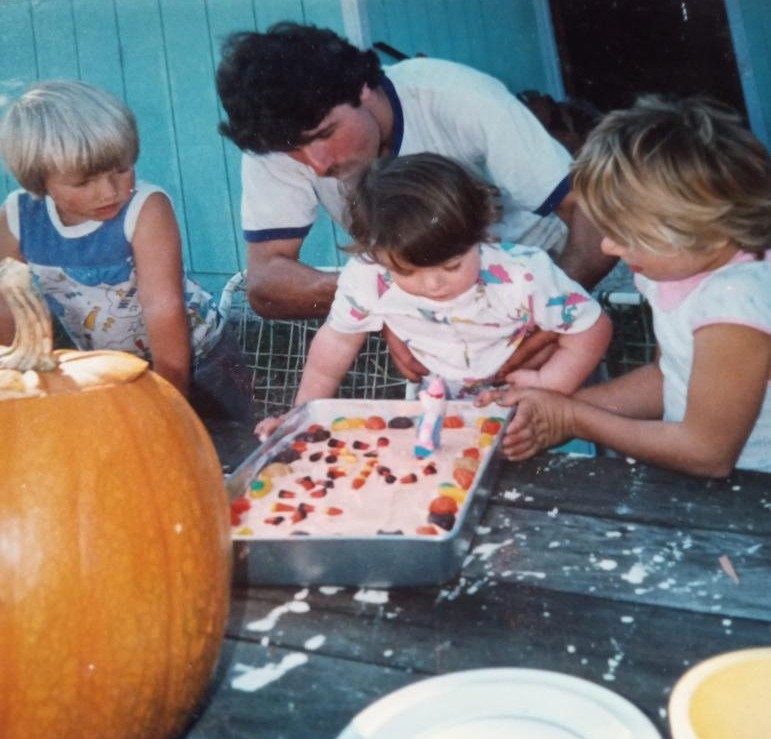
Today, Aunt Julie shared a picture of us that I’d never seen. It was taken on my second birthday, outside the house on Glenn Street. Someone (was it you?) made me a sheet cake and spelled out my name in candy corn. What I love about the picture is that as I am blowing out my birthday candles, so are you. You were ever encouraging, attuned, a gentle wind at my back from day one. God, I look like Autumn in the photo. A few years ago, unwittingly, I also decorated her birthday cake with candy corn. October babies.

You don’t want to be forgotten, do you? I know this because every now and again you pop up. A photo I’ve never seen. Your song playing on the radio. Your initials emblazoned on a barn along the interstate. But most incredible are the thirty-some-odd handwritten pages I recently received from a relative, your descriptions of our early days together. How did it take me all this time to realize that it was you all along? That it was you, legally disabled but spiritually sophisticated, who inspired my love of writing? I wish I could tell you all I’ve learned since you’ve departed, because one thing I know for sure is that you’d be listening.

What I wouldn’t give to scramble up a hillside with you today, sit at the top, overlooking some vista, laughing at the absurdity of it all. Someday I’ll get to reading those pages you sent me from the great beyond. But honestly, it kind of hurts to do so. I opened it once and a line jumped out at me. It read, “I believe in simple living and high thinking.” What more do you have to teach me, Dad? Are you still the wind at my back? What can I do to not be robbed of ten thousand dollars? Anything?

Back Home Before You Know It

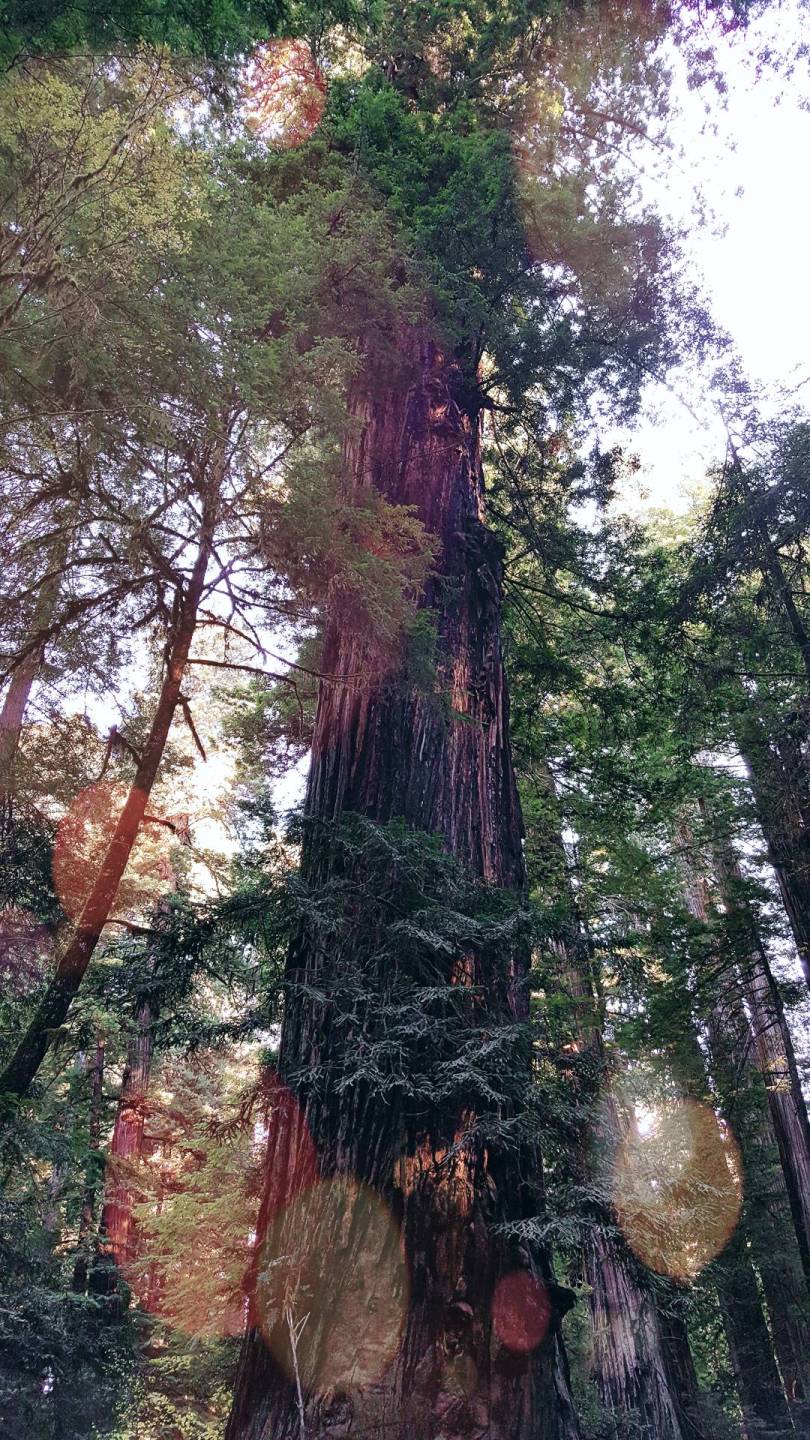
Driving past the massive redwood peanut carving meant that we were halfway to Eureka, California. The redwood peanut was also a marker of the town where my mother, Moonbeam, lived. Every other weekend, Dad drove me to Orick for our mandatory visit. Mandatory just meant that the law was involved. The law being involved was practically a law of the universe for people like us.

But the law had little to do with why we were driving past the redwood peanut that day. Except that after my scheduled ear surgery, I was mandated to remain with Moonbeam in Orick–in civilization–until my eardrums fully recovered. It would likely take the rest of summer. My earaches had become regular enough that a physician recommended I get tubes put in to help drain out all the gunk. I would also be getting my tonsils and adenoids removed. The plan was that after leaving the hospital in Eureka–the same hospital where I’d been born nine years earlier–Dad would drop me off at Moonbeam’s before heading back upriver to our home off grid. It would be the longest I’d ever stayed with Moonbeam, my stepdad, and my two younger brothers. I stared out the window as we drove past the huge redwood peanut, anticipating the story I knew was coming.

“That peanut,” Dad began, “was trucked all the way to the White House in Washington D.C. as a gift for President Jimmy Carter. But because Carter was an environmentalist, he shipped it back. He saw it as an insult. Here Carter was, trying to save the redwoods—or what was left of them—and some loggers from Orick send him a redwood tree carved into peanut! What a joke. I mean, can you imagine?”

I didn’t say anything in response. Didn’t need to. Sometimes Dad talked to keep himself awake while driving. Despite that it wasn’t nighttime, I knew Dad was probably tired. He’d worked at the road department all week, helped get my belongings together for the trip, then driven from near the border of Oregon in a car we’d borrowed from a friend of his. I didn’t really know why we were in the car, and not in Dad’s pick-up truck. Maybe the truck got a flat tire or needed a repair. Or maybe driving the car had been mandated. For whatever reason, I was riding in the backseat: precious cargo.

The car smelled horrible and was making my stomach turn. I never got car sickness on windy roads, but I suddenly felt queasy. It was as if invisible cigar smoke was emanating from the maroon velvet seats. Dad didn’t smoke, but whoever owned the car sure did. I was getting nauseous. I tried to lie down, the seat belt digging into my waist. I didn’t know what was worse: watching the tops of the redwood trees zoom by out the window, green morphing to white given all the movement, or closing my eyes. Both felt impossible. The pain in my ears faded to the background as my nausea took centerstage. I heard Dad mumble something about the time. My ear surgery was scheduled to start in one hour, so we’d be cutting it close. I gripped the car seat with one hand and held my other hand to my forehead, trying to remain steady. One more hour to go, and then the hard part would begin.

Naturally, I didn’t remember a thing from my first visit to Humboldt General Hospital–the day I’d been born there. This time though, I’d remember every detail. Starting with how enraged Dad was when I finally puked as he whipped the car into the parking lot.

“Couldn’t you have at least waited until I parked?” Dad yelled at me, swinging my door open.

Dad rarely yelled and never hit me, but in that moment, he looked like he wanted to rip my head off. Now that I am a parent myself, I know the look. It was stress. It was fear of failure. It had little to do with me. Fucking up created shame. Dad couldn’t win. We were late and I’d puked in the car he’d borrowed. This would all make him look bad. It would take time that we just didn’t have. Dad quickly shook out the floor mat, tossing the vomit into some nearby bushes, and then we raced into the hospital.

Before long, the hospital staff were preparing me for surgery. Dad may or may not have told them about the vomiting. It was all happening so quickly. They said I wouldn’t feel a thing during the operation, no pain and no nausea, because they planned on putting me to sleep. I was intrigued, then confused. Instead of reading me a bedtime story, a nurse placed a large, rubber mask over my mouth and nose. Because I’d never worn anything like the mask, I was frightened—and then I was out.

I remember a few details from right before they put the mask on. After being wheeled into the room, they positioned me with my feet pointed toward the door we’d entered through. There were three people: one doctor and two nurses. They were all wearing masks too, but a different kind.

Then things changed. The doctor began counting back from ten. By the time he got to four, I did indeed fall asleep. But I also rose up out of my body. Suddenly, my feet were no longer pointing at the door from which we’d entered, but my back was. And instead of laying horizontally, I was standing vertically. I was technically floating and there were two of me: the “me me” and the “hospital bed me.”

Me me observed the doctor and one nurse performing the operation, and a second nurse standing off to my right.

I woke up as I was being wheeled down a short hallway. Never mind that I was getting too old for stuffed animals, I was downright giddy when someone handed me a small teddy bear wearing a white t-shirt with the name of the hospital printed on it. Maybe they’d known they almost killed me back there, and the teddy bear was my consolation prize. I didn’t care. The deal was made even sweeter when I was given a popsicle in the recovery room. I was instructed to eat lots of popsicles in the days to come. Maybe it will be okay after all, I thought.

Driving back to Orick, I sat in the backseat again. I told Dad about the strange occurrence when they’d “put me out” at the hospital.

“Hey, that’ll happen,” Dad said reassuringly, looking at me in the rearview mirror.

Dad was nonchalant. He knew his stuff. This was child’s play. Dad was the one who had spent weeks on the other side after a drowning accident when he was a kid. They’d dubbed him Miracle Boy in the local newspaper. After the accident, our family felt Dad got touched by an angel, because from then on, he was so different. Not just his voice, which had been scarred in the accident, but his whole way-of-being. He was spiritual and special. What I’d experienced was only a blip. I didn’t get so much as a glimpse of heaven. It was practically nothing. I needed to focus on my future, on getting better, on summer.

Today I understand why I didn’t go to the great beyond. Had things ended differently that day, Dad would never have forgiven himself for how he’d left things, for yelling at me like he had in the parking lot. We drove past the redwood peanut again and I sighed audibly.

“You’ll be back home before you know it,” Dad said, empathetically.

I wasn’t entirely sure if Dad meant our cabin by the river, or our home up in the sky.

Sign Sign Everywhere a Sign

I spend a lot of time with the dead people in my family. Typing that line, I must pause and stare at the word. Dead. It doesn’t jive with how it really is. With how alive they really are. Right now, for example, seated at my maternal great grandmother Glady’s oak stationary desk, it is her short fingers, not mine, I can imagine reaching out to place a paper clip in a small ceramic dish. The ornate, antique desk came into my life unexpectedly when my great aunt recently moved into assisted living, and it is now the most valuable thing that I own. My mind is blown when I consider that I was just five years old when my great grandmother passed away and, shortly before, said she wanted me to have the desk. That was, of course, long before I was a writer.

I didn’t used to believe in the supernatural or in superstitions. Though I have always accepted that dreams hold significant meaning. But since Dad’s passing, and in the months leading up to it, my previous beliefs were challenged. They softened under the weight of the unexpected. I’d have been a fool not to notice the signs.

In my notebooks, I’ve written down countless instances that point to a storyline larger than us, one just beyond reach. I’ve experienced things that felt more like serendipity than happenstance. Objects arriving in my life like gifts from the universe. A spectacular and rare seashell washed up on Rockaway Beach, during a week away working on my memoir. A brass bell sitting in the rain. An antique desk.

Not long ago, I awoke from a dream along with a message from my late second cousins, Kathy and Carla, who were more like aunts to me. It was one of the few dreams where I’ve been delivered a very specific message. Such dreams are rare. That’s how I know they’re special. In my dream, I stumbled upon heaven. I intuited that I was in heaven by the fact that Kathy and Carla, who had both died of cancer within five years of each other, where there. In dreamland they signaled it was them because they both wore no hair, a reminder of the cancer that had taken them in this form.

I was surprised to find that heaven was less like a place in the sky where you frolic around, and more like Santa’s workshop. Kathy and Carla weren’t idly hanging out on a cloud, sipping earl grey tea, and catching up with Jesus. No, they were both hunched over some sort of creative project. They were working with their hands. They almost seemed annoyed when I interrupted them. I was surprised to see that actual work was being done in heaven. Upon realizing where I was, I wanted to know things. The pressing question that came to mind was, “How can I accomplish my goal of publishing a book?”

They both looked at me, looked at one another, and then communicated these words: Take the actual steps needed to get there.

When I woke, I thought about their words. Take the actual steps needed to get there. I loved that. The actual steps. Not the fake steps. I wrote it down. Carried it with me. Scheduled another writing retreat. Doubled down on my creative writing projects.

There were more serendipities:

Driving to pick up my wedding dress alone on the day before our ceremony the first song that played when I turned on the radio was “My Sweet Lord” by George Harrison. It was the same song I played in the ICU seventeen days earlier when releasing Dad’s spirit back into the wild.

A few weeks after the ceremony, I’d been bawling my eyes out in the kitchen, and my electric teakettle turned itself on, gently. It was as if Dad was saying “I see you” and “It’s all going to be okay.”

One Monday after returning from California with a trunk full of Dad’s belongings, I stumbled upon a piece of a brass altar set, sitting out in the pouring rain, at work near the bench where I always eat lunch. The brass hand bell was identical in color and detail to the rest of Dad’s altar set, which I had just unpacked and polished the night before. I knew the bell belonged with me, though it felt strange putting it in my pocket and carrying it home. I placed the bell on a shelf with the rest of Dad’s set and it was a perfect match.

Months before Dad’s fatal accident, on a dark winter night, I was at home with my daughter. It was just the two of us. My husband (then fiancé) was out. We live a quarter mile from the highway, nine miles from the nearest general store, and we have one neighbor within earshot. We don’t get a lot of visitors. But when we heard three loud knocks on the front door, I still didn’t think much of it. Sometimes a dog gets lost on our stretch of highway and the owner goes knocking on doors asking if you’ve seen them. Or it could have been the UPS or FedEx man. But when I swung open the front door, no one was there. Autumn and I immediately looked at one another, stunned. I locked both doors and put Autumn to bed. I couldn’t quite get the three knocks out of my mind, so I googled “three knocks ghost.” I read reports from different places across the world about a phenomenon called the “three knocks of death” signaling that someone you know has or soon will die. Some believers went far enough to claim that the death will happen in three days, three weeks, or three months.

I spoke with my cousin Crystal the following week. A vehicle had crashed into our lower pasture at dawn, resulting in a fatality. The family affixed a steel cross on a tree trunk on the opposite side of the highway. I ran across the road to study it. It was a young man who’d died. Just nineteen years old. I told my cousin, “I feel like death is all around me.” Only I whispered it, as if by keeping my worst fears quiet enough, they couldn’t possibly come true. By my estimate it was no more than six months later when I got the call about Dad falling off a ladder at a job site.

Autumn, now five years old, recently approached me with a question. She asked if her and Grandpa Rob ever played with toys together on a rocky beach. I told her that they’d played with toys on a sandy beach at the river. She said this wasn’t at the river, it was at the ocean. She reiterated that it was on a rocky, not a sandy beach. She paused for a moment, then said, smiling, “It must’ve been a dream. But wow, it felt so real.”

I smiled knowing Dad had a hand in that. All Autumn ever did was ask me to play with her. So here he was stepping in when I couldn’t. Maybe our ancestors have the birds-eye view. They can be everywhere all at once. They can see into the future. They can understand the past. My ancestors have always known that I need all the help I can get. Today, I am wide open to receiving their signals.

My great grandmother’s desk came into my life in perfect timing. Just when fear managed to unsettle the well of my creativity, doubts churning in the dark waters. Negative self-talk—and just plain laziness—had manifested itself in the form of my stagnant memoir project. There was the penetrating thought that maybe it all doesn’t matter, anyway. My story. My pile of pain. My gift to the world. But now, this desk. Ancient wood capturing afternoon sunlight, illuminating a blank page. Beckoning. Reminding me that there is enough space in this world for one more story. I only need to be willing to take the actual steps needed to get there.   

Love and mysterious blessings,

Mama Bird

If I Took My Grief Out to Lunch

Dear Reader, Throughout the month of October I, along with a small group of other writers, wrote about loss in “Write Your Grief Out” with Anne and Maria Gudger. Here is one excerpt from that period, based on the prompt “If you took your grief out to lunch, what would you talk about?”

If I took my grief out to lunch, we’d talk about the way things used to be. How the other day I saw a small child sending crab pots off the dock into the ocean with her father. The way we used to do that before you became a vegetarian. Before you quit crabbing in the wintertime and raising rabbits for meat in our backyard. We’d talk about way before the tofu and carob phase, when you ate burgers and drank Budweiser. But that was never you, so I was glad I got to see your next phase too: your altars and spiritual books and how a real live guru came to visit us and stayed in our home and went on long walks with you in the woods.

If I took my grief out to lunch, we’d talk about the way things used to be. How half the pictures from when you were a boy show you at the top of some tree. Or expertly showing your hog for 4-H. Or snug in the middle of three sisters, volleying between tormenting them and being the soft shoulder they could cry on. How you had so much lived life before me, but it took you dying for me to really see that. The boy you’d been–wild as they come. The teenager you’d been–different, but popular and carefree. The man you’d become–a young, single father, your biggest challenge yet.

If I took my grief out to lunch, we’d go up river afterward. We’d blast Johnny Cash through the redwoods, roll down the windows, and stop for a drink of spring water gushing from Carter Falls. I’d take my grief inside the culvert under South Fork Road, where the runoff pours into the river in wintertime. We’d steady ourselves on the rocks, crouching just to watch the water run. Solely for the meditative purpose of it. We’d have no agenda. We’d have no to-do’s. We’d see a bald eagle and raise our hands to our chest in prayer. We’d skip rocks. We’d drive up further and park by Rock Creek. We’d travel up creek on bare feet. We might see a wild animal drinking from the stream; or a fairy ring of mushrooms, undisrupted. We’d awe.

If I took my grief out to lunch, we’d talk about the way things used to be. The time we rode elevators to the tops of the tallest buildings in San Francisco, just to look out the windows. Danced with other Hare Krishna devotees at Golden Gate Park, real ones who lived in the temples year round, not just for a few weeks in the summertime like we did. Venice Beach. Berkeley. Vancouver B.C. All the food and the flowers and the strangers. How we’d come back to Crescent City in September tanned, hair windblown and faces happy, just the two of us. No mom in sight and all the freer for it.

If I took my grief out to lunch we’d talk about the way things used to be–because it’s the best balm to the way things are now. Less colorful. Less natural. Less free. I don’t know many daughters who can claim that the best gift their parents gave them was freedom and exploration–just for the sake of it. Without agenda. But if I took my grief out to lunch, we’d talk about that.

With love,

Mama Bird

How to Grieve a Father (Before He’s Even Gone)

After getting the news…

Go stand in the shower to cry, howl instead.

Wail to the heavens, his heavens, the heavens that he believes in enough for the both of you.

Squint your eyes at the crescent moon, the last moon Dad would ever know. Grapple with that for a minute.

Later, meticulously make note of the moon and its aspects: a waxing crescent moon in Gemini.

…Search for meaning. Always search for meaning.

Wonder aloud, tell him, “You were everything to me, Dad. And now you are everything.”

Light a candle, and then another candle, and then another candle. Burn sage and cedar wrapped in string. Sing the Maha Mantra over his dead/dying body. More wailing.

Then silence. Enough silence that someone says, “I think she’s in shock.”

Hold your hands in prayer. Pray for grace, pray for strength, but most of all, pray for his soul to be okay after falling off that ladder.

Notice his body swelling. His hands. His eyes. Listen when the doctors tell you it’s the machines that are keeping his body alive. Write all the dirty details in a notebook, as if that’s going to change anything. Prognosis: impossible.

Instruct them to keep keeping his body alive until all or most of his loved ones have come to see him, to say their goodbyes and their thank you’s.

Host them. Meet them in the waiting room. There are so many and they can only go in in twos.

Notice how his body is swelling. How at first he looked just like Dad, but now, not so much. Notice how he doesn’t open his eyes. Notice the artificial breath. Touch his hair.

Put your hands in prayer again.

Talk like Dad is in the room. Tell him, “So and so is here to see you, Dad.”

Surprise yourself by reciting the Lord’s Prayer verbatim during a too long silence.

After all the visitors, try to sleep next to Dad in a recliner that the hospital provided. Have trouble sleeping. Decline the offer for TV. Walk the halls of the hospital instead.

In the morning, instruct the doctor to unplug him. Play a favorite song. More wailing.

Let your grandpa hold you…something he’s never done before.

Weeks later, let your grandpa walk you down the isle at your wedding.

Ask the mortician to burn him with his tulsi mala beads on, wrapped around his wrist or placed around his neck.

Liken him to Christ in his obituary.

Don’t wash Dad’s laundry, because that means he’ll really be gone.

Place a portrait of him as a baby at your dining room table. His cherub-like smile greeting you every morning.

Place his adult portrait on your dresser, making eye contact every time you pass it.

Decide you don’t need Dad in your bedroom, on your dresser, looking over you. Place the portrait in the common room instead–a reminder to all who enter, “Father Gone But Not Forgotten.”

Search for rainbows. Stitch a quilt of silver linings.

Study Dad’s birth and death dates for meaning: 11/11/62 – 5/5/22

Find none because your mind is too blurry.

Place the jelly in the cupboard and the peanut butter in the fridge.

Finally wash Dad’s laundry, twice to get rid of the ICU smell. But refuse to put the clothes away. Then it’ll really, really mean that Dad’s gone.

Gone. Meditate on the origin of the word. It’s from the Old English “gan” meaning to depart or go away.

Dearly departed. Indeed.

Take a month to go pick up the cremains, which they present to you in a box inside a gift bag.

Tell yourself you’re going to buy little ceramic jars for the family. Then don’t.

Smoke too much pot. It was your and Dad’s “thing.” That and swimming or soaking.

Tell yourself you’re going to take yourself to the water every opportunity you get. Then don’t.

Tell yourself you’re going to send a card to the nurse staff at Sutter Coast Hospital. Then don’t.

Tell yourself you’re going to try not to be so hard on yourself for once. Then don’t.

Have breakfast with his baby picture everyday. Granola and that gummy smile.

Tap into that grief place through music. Play all the emotional ones. Unknown Legend. Eureka. Ripple.

Take a walk in the woods, it’s what he would have wanted.

My Sweet Lord

I am not a destiny person. Or I wasn’t until now anyway. I’m still wary of signing off on that whole concept. But I dare you not to think of God or the afterlife, when staring at a body you once knew, loved, even relied on, hooked up to a life support machine. Questions of what the soul is, where the soul is, and where that soul will end up are likely to swirl around in your consciousness for weeks, if not forever, if you are like me.

So that is where I am now. As I write this, it is seven days after Dad’s passing. I am reflecting on how in those moments of great challenge with Dad, in those hours that I laid by his bedside in the hospital, I surprised myself by curling up in the presence of Something Greater. It didn’t feel good to pray and to surrender—nothing felt good at that time—but it felt completely necessary. The experience with Dad made me question my own faith, or what little there was left of it. This is all to say, you don’t need spirituality…until you do. And you will.

I usually cringe at statements like “It was meant to happen” or “It was all part of God’s plan.” Now there is a small fissure in the wall of my beliefs, where the narrowest slip of light can come in. I didn’t become a believer overnight. Or rather over those 36 hours between Dad’s accident (a fall from a ladder) and when we took him off life support. But my defenses did soften. Where else was there to turn, but to some idea of God? To some idea of an afterlife? I couldn’t just turn on the television and forget about it all, though they did, perplexingly, have a TV in the ICU.

How could all of this, I questioned, from work to play and everything else in-between be orchestrated? It had all been said by others before but, if it were all orchestrated, why would innocent people be imprisoned and tortured, people who love with all they have become broken hearted, and children be born, and die, on the streets? Why is there no justice on this earth?

If there was such a thing as heaven, I hoped there was justice there. The truth is, there is no conflict in heaven. So there needs to be no justice.

According to many, the answer to why there is so much pain and there is so much suffering is that the soul has a need for spiritual evolution. That each has their own lessons to learn in this life, on this earth. Without conflict, our spiritual selves cannot grow or evolve. In the days after Dad’s passing, people started saying things like, “His work here was done.”

Dad used to talk a lot about religion and spirituality. And now that he’s not physically here, I feel I owe him the respect of listening, of leaning into his beliefs, of opening my heart and mind to what he’d been saying all along. His teachings have never been more relevant. In the moments by his bedside, I experienced more than one “ah ha.”

The best I can do for Dad now is to breathe more life into those wisdoms and teachings that he’d had. In his obit, which I wrote, I liken him to Christ. It’s a bold statement, I know. But some people don’t realize the well of compassion that Dad carried within him. Just one example, at the time of his death there was, and still is, a man living on Dad’s property. When we approached him and asked where they’d met, the man said he met Dad at the Mission. He’d just been released from prison, and Dad offered him a place to stay. As a child, there was always one person, usually a convicted felon, living on our land. These are people who had been shunned from society, with no place else on earth to go. And Dad was there for them, as hard as that was for me at times.

“Whoever oppresses a poor man insults his Maker, but he who is generous to the needy honors him.” Proverbs 14:31

I didn’t know that scripture, I don’t know any scriptures, really, but thinking about Dad’s ways, I did a quick Google search. It turns out there are a shit ton of scriptures just like that one.

When the doctor came into the room—Dr. Christie—he asked me, with complete respect, why I had laid a hindi blanket across Dad’s body. I fingered the white cloth with the red Sanskrit lettering and depictions of Krishna and Rhada.

“Dad is a Hare Krishna…and a Christian, and a Buddhist,” I told Dr. Christie.  

He took a sidelong glance at the Bible I’d brought and placed on the table next to Dad’s breathing machine. He worshipped any God that was in front of him, I thought. But I can’t remember if I told Dr. Christie that or not.

A few days later, I was reading a book “Embraced by the Light” by Betty J. Eadie and came across this:

“I wanted to know why there were so many churches in the world. Why didn’t God give us one church, one religion? The answer came to me with the purest of understanding. Each of us is at a different level of spiritual development and understanding. Each person is prepared for a different level of spiritual knowledge. All religions on earth are necessary because there are people who need what they teach.”

It turns out that that book “Embraced by the Light” would help me access my spirituality through a side door: near death experiences or NDEs. I couldn’t come to that spiritual place head on, through the Bible or the Baghavad-Gita. I don’t jive, and never have, with religious stories that read like fiction or with timelines that seem to counter science.

But I could get behind near death experiences themselves, I mean, Dad and I had both had one. His, we all believe, was what made him the way he was. But more on that later. I couldn’t possibly tell this entire story in one sitting. In my journal, where I have been laying down all the letters and words that have been helping me come to some place of understanding at this unimaginable crossroad in my life, my writing now shifts from addressing you, the audience, to addressing Dad himself. This change in style makes it difficult for me to continue the story and round it out in a nice, easy way, so I will share the next segment of what I have written in my journal, before closing this chapter and picking the story up in a different piece. If anything is to render me speechless, or wordless, it is Dad’s passing. So be it. The fact that I cannot finish this essay is a testament to my grief.

My next paragraph is, “I thought of how, since you were a boy, you’d had one foot in this world and one foot in another. You didn’t remember ‘what happened’ when you were in a month-long coma, or what happened to your soul in those moments that you floated lifeless on top of the water, having drowned, but it was clear that you’d met God.”

This is all to say that you don’t need spirituality…until you do. And you will. And also this: some things you just can’t write, or reason, your way out of.

Love and mysterious blessings,

Mama Bird

The Poetry of Place

After waiting a full five minutes for the lodge’s hot water to kick on in the shower, I wash my hair twice with 2-in-1 Shampoo and Conditioner. Autumn sits on the shower floor, folding and unfolding a damp washcloth. We are on a girl’s trip to track down Dad, who lives off-grid in Northern California.

Sometimes I don’t know if my writing frees or pains me, if it liberates me or holds me captive. We tried watching TV but turned it down to hear the creek outside–Patrick Creek–a tributary to the Smith. Now I bounce Autumn on my foot, trying to soothe her toddler boredom, and somehow keep my pen to paper, too. I’d say she can’t sit still, but the same would have to be true for me as well. (Proof: I couldn’t stay put on the farm this weekend. I simply woke with the urge to ramble home.)

I told myself it was justified to see Dad. Steve gave me his blessing, and then tried to suggest routes and game-plans. But I already had it mapped out in my mind; we’d get a hotel room closest to home. Hiouchi Motel or Patrick Creek Lodge.

The rooms at Patrick Creek Lodge have mission-style furniture and vaulted redwood ceilings. In the past I would have camped in the van or a tent or on my best friend’s couch in Crescent City. But motherhood and the pandemic has changed everything. Everything.

Driving south on the I-5, the words “Do whatever you have to do to feel alive” came to mind. So maybe that’s what this is really about, more than seeing Dad. It’s about feeling alive again.

I’d forgotten how when we travel, it upsets Autumn’s natural rhythm. She gets antsy and angsty and now she sits across from me indian-style on the white 70s-style bedspread. “Let’s talk,” she says so we talk about what’s outside the window: bushes, trees, lights, leaves. There are no other cars in the parking lot and I am uncertain if there is an overnight watch person or not. The friendly fellow who checked us in said he was “locking up and heading home for the night.”

A couple and a lady stumbled out of the bar around 7:30 p.m., piled into a full-sized pickup and drove south toward Gasquet (gas-gee). Other than that, crickets (metaphorically of course, because it’s winter in these woods). The temperature registered at 34 degrees but it was sunny and t-shirt weather all day. Of course we only got out at a rest stop somewhere near Riddle, Oregon.

Pacific madrone and redwoods, that’s what I came for. Other than to connect with Dad, the man who raised me. Pacific madrone with its smooth chopstick bark, the redwood groves already shooting up toward the sky, just seven or ten miles into California.

When the sun set we decided it would be best to surprise Dad first thing in the morning, rather than an hour or two after dusk. Dad, like me, is better in the morning. Freshest and sharpest and most optimistic. We both like to have our coffee, too.

As a girl, Dad took me to this very lodge once for breakfast. The waitress seated us by a window where we could watch Patrick Creek flow by. A small porcelain ramekin held strawberry and grape jelly packets. I chose grape jelly to smear on my sourdough toast, not because I liked grape best, but because there were just two choices: grape or strawberry. I knew that a better family, one that would come in next, would have a little girl or boy who would prefer strawberry, and that kids from better families always got what they wanted because of people like us. I knew that my going without kept everything in balance.

The grape jelly kind of tasted like the liquid cough syrup Dad sometimes had to force down my throat. He’d either pin me down on the cabin floor, knees holding down my kid-arms, or convince me that if I plugged my nose I couldn’t taste it, so then I’d just drink it myself. I hoped that kid enjoyed his strawberry jam, whoever he was. I was in heaven just with the butter alone and the creek flowing by.

Dad sometimes liked to elbow his way in to a class above our own–the ski lodge at Mt. Bachelor in Oregon, riding elevators in the business district in San Francisco, the fine dining restaurant in The Wharf where we ordered an appetizer, then sheepishly paid and left. Dad has a penchant for experiences he can’t quite afford, and if I am being honest, so do I. But at least it’s a penchant for experiences, not a penchant for things.

“What are we going to do tomorrow, mama?”

“Well, we are going to get up…”

“Use the restroom?”

“Yes, use the restroom.”

“And then what?”

“And then we are going to make mama some coffee and Autumn some breakfast.”

“Coffee? Brickfest?”

“Yep. And then we’re going to take a walk down to the creek. Patrick Creek.”

In my minds eye I can see the dirt path leading from the lodge, then along Patrick Creek, and under a bridge to where the creek forms a confluence with the middle fork of the Smith River. In a past life, before Autumn, I would make a pit stop here. The middle fork of the river meanders southeast through mossy canyon walls until it intersects with the south fork of the river. You head up the south fork, and that’s where I’m from. I was raised in a single-room cabin that burned down in a fire in the year 2010. Now Dad lives in a fifth-wheel his ex-girlfriend gave him.

“And then?” Autumn asks.

“And then, after our walk, we are going to see Grandpa Rob!”

“See Grandpa Rob?” Autumn repeats, in her high-pitched voice. It’s as if the higher pitched her voice, the more likely she will get an answer she’s satisfied with.

We haven’t seen Grandpa Rob since Father’s Day–five months ago–when we met up with him halfway between his home and ours and ate salmon bagel sandwiches on the bank of the Umpqua River. He didn’t eat much that day, and it worried me. But I am always worried about Dad: worried about him driving distracted, worried about him choosing nutritious over junk food, worried about the steel parts collecting on his property, worried about his future. But mainly, I’m worried that he’s sad, and that I had something to do with that sadness.

Autumn is snoring now. She is laying on her back, mouth slightly open, arms and legs splayed, sleeping off the day. Today was a big day. She said the word “California” and dealt with her mother’s impulsive need to “connect with her roots,” enduring what turned into a 4-hour drive. She kept asking for “Nana” and “Grandpa Norm,” her father’s folks who she is more acquainted with than Grandpa Rob. Dodging fallen granite from rock slides in the road, and manuevering corners I haven’t seen since my Aunt Dorothy’s memorial in March of 2018, I tried to explain, “No, honey, this is mama’s family. Mama has family too.”

“No, I wan’ see Nana.”

I don’t know what to expect in the morning. That’s the thing about mama’s family. It’s the reason we pulled back at dusk, instead of gunning it forward. In the past, I slept on riverbanks or friends couches, desperate to connect with my dad but not willing to endure his lifestyle off-the-grid, which due to his disability and a variety of factors, has degraded some through the years.

But my soft place to land has always been these hills, fog hanging in the treetops like ghosts, white fingers wrapped around the branches of the evergreens. This place hasn’t moved an inch since I left home. Oh, but it has. Things always shift. Even places. Especially river places. I’ll be lucky if I can still recognize myself in the mirrored reflection on the water.

I close my journal, place my writing pen beside it on the nightstand, and open up a new Sun Magazine. Barbara Kingsolver’s essay “The Only Real Story” jumps off the page:

A world is looking over my shoulder as I write these words; my censors are bobcats and mountains. I have a place from which to tell my stories. So do you, I expect. We sing the song of our home because we are animals, and an animal is no better or wiser or safer than its habitat. Among the greatest of all gifts is to know our place.”

I didn’t know what to expect in the morning. I didn’t know that we would arrive just in time for coffee, and that Dad would pour me two steaming cups, before hitting the trails just outside the doorframe.

I didn’t know that Dad would be fine, not sad at all.

I didn’t know that we would hike the land of my youth until noon, with Autumn on his shoulders.

I didn’t know that we would crouch by the rivers and streams and say blessings.

I didn’t know that I would harvest bay laurel and Dad would locate a field of matsutake mushrooms.

I didn’t know that when no one was looking I would press my forehead into the earth, addicted to the feeling of the damp soil crushing into my third eye.

I didn’t know that Dad would go on and on about God, as he always does, and I would just gesture at the nature all around us as if to say, “Yeah, but…this.”

I didn’t know that it would all be intact: the land and the dad, just as I’d left them.

But somewhere deep in my bones, I did know.

Three generations in Rock Creek, California.
Three generations in Rock Creek, California. November 2020.

Love,

Mama Bird

Dear Daughter,

Dear Daughter,

-You will always have more to offer than the shape of your body or the red of your lips. So reach deep within yourself for something substantial to contribute to the world.

-Moments are for living, not for capturing. When you realize that, you hang onto the sacred. The scared is slipping into the darkness of vanity. Don’t let it. Bow, caress, whisper your wishes into the wind. Do things just for the sake of doing them. Not for showing off. For so many centuries, this was how it was done. There is something lacking as we slip into vanity. The sacred is worth hanging onto, I promise.

-There was a time when humans cared about way more than likes and follows. I was there. I remember that time. Laughs were laughed louder then. Breakfasts were enjoyed more fully. When you looked into someone’s eyes, it really meant something. It mattered.  When you looked into the sunset, and really focused, prayers were answered. And if you got to know someone, you really got to know them, not with some device between you.  In junior high, a girlfriend of mine and I sat in a grassy median staring into each others eyes for a full five minutes. Let’s try it sometime. This is called peering in to another’s soul and there’s something to it. Discomfort is a natural part of living. Our addictions try to cover up that discomfort, that natural discord.

-I want you to practice getting up in the morning, making your breakfast, brushing your hair, reading a book, and setting your goals…all without the nagging of your phone and social media. If you watch me, I will show you. I will let my phone get buried in my purse and go dead and I will not worry. I will relish the sound of the natural world buzzing on around me. I will do this for the whole of the weekend until, for work, I must emerge and “connect” with the world again. I will do this and I will fail but I will reset and do it again. Phone dead and buried at the bottom of my purse.

-Take a trip to the sea or mountains or museum…without your device on you. Let’s do it together. Let’s stop and notice what is being offered, what is happening around us. Really noticing this time. Let’s witness some miracle and have it be our little secret.

-Skills like building things and growing things and poetry even and communicating respectfully through eye contact and spontaneous conversation…these things are being lost. I want you to preserve them. I will teach you skills that you will pass down to children, or people older than you or younger than you, it does not matter. Just share them. In real life. Learn to cook. Learn to love to cook.

-If all of your friends jump off bridge, don’t.

-Sparrow recently published a piece in The Sun Magazine stating that meditating is like playing the guitar, except without the guitar. I’d never meditated regularly until I read this, and his bit about meditating four minutes per day, instead of five. Four minutes per day isn’t too torturous in exchange for heightened long-term bliss and contentment, right?

-They call it a feed because it’s taking away our appetite for everything else.

-The people you should be working at impressing are the people around you, through kindness and respect. I vow to do this with you. We will do it together, dear daughter.

Nourishment

I didn’t get published in The Sun Magazine’s “Reader’s Write” section as I had hoped, but I will share my reflection from the January 2020 “Nourishment” prompt below.

“The Sun is an independent, ad-free magazine that for more than forty years has used words and photographs to evoke the splendor and heartache of being human.”

NOURISHMENT:

Dad sat me down and told me two things: one, we were now vegetarians and two, we would sing the Mahamantra morning, noon, and night. That was part of being a Hare Krishna. So that’s what we did. No more Kentucky Fried Chicken. No McDonalds. Hare Krishna, Hare Krishna, Hare Rama, Hare Rama. Morning, noon, and night. Every summer we took our epic road trip to the temple in the Bay Area. At the temple we were surrounded by other Hare Krishnas instead of being the only ones in town. At the temple, we rose at four a.m. to shower, which was required. At the temple, brown-skinned women with large, sagging breasts painted red Bindi dots on my forehead and brushed and braided my hair. I felt comforted by the touch of a woman, even though they didn’t speak to me. It was almost like having a mother. Almost. At the temple, I wore my pea-colored sari with little flowers on it every day. I felt so free as I danced with my father in the ballroom before the deities. At the temple, we were sometimes required to fast all day long but come night there was a massive feast with scrumptious vegetarian food—samosas, curried cauliflower, pineapple chutney—all piled high and sufficiently blessed.

Dear Aunt Dorothy,

Dear Aunt Dorothy,

Remember when you lived on that street I can’t remember the name of now—the one way on the outskirts of town, after you moved back to Crescent City for the second time? You were many years sober by then so our conversations happened around mugs of coffee, your second love. 

You had kitschy coffee mugs: Garfield, mugs with quotes about motherhood, one of the lady with the crazy hair, robe, and slippers. You weren’t a grandmother yet, which boggles me now since “Grandma” became your definitive role. Back then your mother-ness extended to me, your niece. 

Remember that night? We were jabbering, catching up. I was visiting from out-of-state and we only had so much time. There were lots of laughs. Cigarettes and ashtrays. If we ever watched television it was just the home videos you’d recorded of our childhood: Your boys reciting Jeff Foxworthy. Me doing cartwheels on the concrete pad outside the trailer on Olive Street. Crystal, who was just a baby then. 

Without having planned it, WHAM, I dropped the bombshell. The bombshell that would blow up your whole world: your present, past, and future. Probably you mentioned his name. My face must have shadowed. And then your openness, your vessel for others pain and suffering, allowed to me tell you—to tell anyone—what had happened to me right there inside our family. It happened in-between recordings, on set, hidden behind the inescapable patriarchy that permeated our culture and society.  

I was seventeen and had never told anyone before. 

I saw the lightbulb go on behind your eyes. This is the moment you that stubbed out your cigarette. Wait, what? 

I saw the quick well of anger and heartbreak rise inside of you. 

Disbelief. 

Guilt. 

Wonder. 

In a dark corner of your mind, I’m sure you were reaching for a gin. 

It was late. Your house was so small. As if turning on my heel, my laughter quickly turned to painful sobs. The burning-apple-in-your-throat-kind of sobs. My racking sobs filled your entire home, probably shook the coffee mugs in your cupboard as you held space for me. 

You didn’t call it that: holding space. Poor, white people don’t have vocabulary for our experiences. But other people do. We live through the tragedies, other people label them. People with food in their bellies and books on their bed stands, free from the everyday challenges we’d faced, free to think things through, I guess. 

Did you know that by now whole fields of study have been dedicated to our resurgence? There are probably university students somewhere right now discussing the phenomenon of the crashing white, rural American class. You would have hated that sentence I know. It made you crawly when I used words like phenomenon because it put you on the spot. You were an Army girl, a farm girl, and to no fault of your own you were never a scholar. We didn’t have the language to get to the bottom of what happened to me–the scary thing that I told you–so we just cussed a lot that night. Fucking sicko. Rot in hell. 

You probably had to go to work at the casino in the morning, but you held space for me. You always did that for others. You always gave more than you had. In the end, I believe, that’s what killed you.  

Cousin John, one year younger than me, must have heard everything that through the thin bedroom wall. In fact I know he did. He told me as much years later. Said he’d pressed his ear up against the wall listening to every word I’d said, welling up with anger, maybe tears. Cousin John is one of those sensitive men—men with single mothers tend to be. Yet another gift that women like you give.

images (1).png

Do you remember the day you died? What was it like? Was it sunny? Cold? Did you argue with people that day? Hold space? Both? Did you start the day out watching FOX news? Looking at old photographs in your albums? How many cups of coffee did you have? Did you eat breakfast? What did you eat? I want to know. I want to hold space for you. Come back from the dead and tell me.

Years later you admitted that my “telling you” had a hand in your decision (if you can even call it that—the swift, perplexing fall from grace) to drink again. It was a single poke that sent you closer to the edge, eventually to fall from maybe ten years sober. At least over five. (I need to get my facts straight with the family.) 

I myself never felt guilty for that. I can’t take that on. I know there were others things, too. Men, maybe, who drank. You thought you could “be around them.” You couldn’t. No one could. You thought you could walk down the wine isle at the grocery store. You couldn’t. No one could. “And what are we drinking with the steak?” A waiter asked you with a wink, mentioning a wine pairing. You couldn’t. No one could. The billboard with a cold, sweaty beer on a hot, Sacramento day. (You didn’t even look at the billboard but your brain saw it and stored the information.) You couldn’t. No one could. A career waitress at a casino, you served drinks day in and day out. You couldn’t. No one could. 

It was your genes, expressing themselves. You couldn’t. No one could. I myself was never a drinker, but I have my “things.” 

Do you remember the day you died? Was it a pleasant day? Did you catch the sunset? Call your boys? It was springtime, I know that. Cousin John called me, it was two, maybe three, a.m. 

It must have been warm in Oregon because I stepped out on the back porch to take the call, having been alerted from sleep and knowing John wasn’t calling to casually chat.

“She’s gone,” he managed to get out. 

“Hello? John? What?” 

One never says the right things in these moments.

images (1).png

We spread your ashes up on the hill above the farm. Your baby sister and her husband handled all the arrangements. Rented the town hall down by the river. Sprinkled photographs of you on the tables and designated a childhood friend to make the centerpieces. They managed to serve one hundred people pulled pork, potato salad and fruit. I don’t know if it was pork. I didn’t eat. I was juggling the newborn baby and rubbing John’s back, trying to be a friend to him. Suddenly he was hard to get through to. 

You meant a lot to a lot of people, so a lot of people were there. Later, in photographs taken above the farm on the hill, someone said the plume of your ashes looked just like an angel when the boys blasted it into the air.

It was the kind of thing you anchor to in times like this.

I didn’t know what to believe. I was reeling—angry—from your fall from grace to death at 61. Alcohol poisoning, the coroners report stated. I was thinking: one little sip—one little slip—then blip, you’re done. You were getting sober again. You were always getting sober. News would travel through the family grapevine: Dort hasn’t been drinking, 3 months now. Dort hasn’t been drinking, 1 ½ weeks now. Dort hasn’t been drinking, 5 months now! Honestly I stopped keeping count. There were so many starts and stops. But that, dear one, is what made you beautiful. Most alcoholics I know don’t even try. 

This was not your legacy. Don’t get me wrong. I am using your lessons to guide my voice. There is a point I we are getting at. I promise. Hang tight. 

You were always transparent about your alcoholism. You were almost curious. You talked to me about AA. How they make you have a sponsor. That they wanted you to pray. You struggled with both of those things. You weren’t vulnerable by nature. Not open with those who you weren’t close to. You just wanted it to be done and dealt with but you lived with a drinker, your second husband, and that, I believe was your biggest downfall…not leaving him to save yourself. 

Vodka in the freezer, you told me. You couldn’t. No one could.

You always gave more of yourself than was even there. Leaving ghosts of yourself behind for others to feed off of. Always wanting to give more, more, more. A pleaser, left thirsty.

I am using your lessons to guide me.

images (1).png

Man. 

I was so distanced from all of this at the memorial. And now that I’ve said that about your second husband everyone’s going to hate me. At the memorial for me it was just this: one foot in front of the other. Don’t slip like she did. Your message to me seemed loud and clear: Keep your head up, don’t look down. But everyone else was crying and carrying on, while I was in some state of blissed out focus. How was I going to explain this? What was going on with me? 

Back in Oregon it took me many months to come around to how I really felt about your death. I saw posts on Facebook, “I think about her every day. I am so sad. It just makes me want to cry every time I think of her.” 

Why didn’t I want to cry? I did think of you. I looked through the scrapbook you sent me, your script written in black Sharpie: Love you always, sweetie niece, it read. 

I thought of how much you had going for you. I thought, don’t slip. I thought, dead at 61. I thought of you, as a girl, going off to Germany with the Army. Your glory days. You went from California to Connecticut to Germany. You made good friends—eased the awkwardness of socializing by drinking. Most of us do. For you it was different.

You had a boyfriend out there in Connecticut. I wonder if he was as different from you as the Connecticut boyfriend I had was from me. We looked the same: white, young, scrawny. We partied together and all of that. They thought we were “pretty.” They could never know the rural swamp from whence we came. We never knew the dollar amount of the steak on our plate. That the cost of that plate amounted to our weekly grocery allowance. 

I remembered that night you held space for me. How when you ran your hand up your forehead—holding the bangs out of your eyes briefly—I saw we had matching widow peaks and dark, thick hair. I saw we had the same oily, pocky skin. I could have been your daughter. 

I did think of you. Fact I walked out on the porch one day and said your name out loud. It was a rough day for me. I was weighing this and that. I was torn between saying “fuck it” and staying on the strait and narrow. I was grappling with my “things” like we all do. 

Exasperated, I asked you for a sign. I toy with spirituality, having given some of it up with I paired up with an atheist. 

“Just, anything,” I told you, in a way I hoped was sincere. 

I held my coffee mug in both hands. The one that reads “Mom is just Wow upside down.” I latched on to the wisdom that you taught me–dare I say telepathically–with your death: Relationships matter. Don’t do what I did. Don’t throw it away for the brief, frequent explosion of addiction and harm. Turn to the light. Every time. Walk away, completely, utterly committed, from the things that threaten you. Physically. Emotionally. Walk away completely. Don’t look back. 

I was open to receiving it. That’s what I was doing at the memorial, when I couldn’t stare down a gin and cry. Actually, I was honoring you. Head up, focused on the future.

It’s what you wanted me–what you want all of us–to do. Perhaps others have experienced this phenomenon. 

Maybe it was because I was looking for a sign so hard that it actually happened, but just then the wind picked up out on the porch. It was a warm wind on an otherwise calm day. I couldn’t fucking believe it, but I wasn’t going to look away as the breeze carried to one single tree out in the yard. Just one tree. Of all of the trees. And it was the tree that was closest to me, a five leaf maple. The wind blew my hair back just a little, and I closed my eyes, gripping my coffee mug in silence. It was late summer, early autumn, and the leaves had turned but were yet to fall from the trees. When I opened my eyes that breeze—your breeze—was whipping around that maple tree like a whirling dervish or Tasmanian devil from the old Looney Tunes cartoon. I mean it was really whipping. 

I even thought to run get my phone to capture the odd, rare event but of course I didn’t. You don’t fuck with something that sacred. You don’t exploit messages from the great beyond.  

I watched as that narrow, focused breeze stripped a previously full tree of most of its orange autumn leaves. It was a clear enough message that I thanked you, looking out to see the one bare tree among the others full of leaves. I breathed in, I breathed out. I felt validated and whole again. 

I didn’t care what anyone thought. I only cared that I was around to see my grandkids, should I have them someday. So I was willing to latch on to anything, even this crystal clear sign from the no-longer-living. I only cared that I was downloading the accurate message that you wanted me to have all along: Do not mourn me outright in the traditional way. Please just walk away completely from the things that threaten your health. Walk away and don’t look back. 

And in-between the lines: Spread the message. Relationships matter. Turn to the light, every time. And this: you are worth it. 

Remember that night? You were many years sober. You lived on the outskirts of town on a street I don’t remember the name of. It was your Demi Moore days: short, cropped dark hair. I was visiting from out-of-state. You were a fulltime mom to two teenage boys. You didn’t want them to come home to an empty house anymore, so you were there waiting with your recipe books and kitschy coffee mugs when they got out of school. Even when drinking though, you were a good mom. Excellent even. Clean sheets on the bed and all of that. You threw Thanksgiving together for the family year after year. I remember the time you had us cousins over to make gingerbread cookies during Christmastime at the house on A Street. You set up your camcorder and had the radio on. Bette Midler sang “Wind Beneath My Wings,” which may have been a new song then:

It must have been cold there in my shadow,
to never have sunlight on your face,
you were content to let me shine, that’s your way,
you always walked a step behind.
Thank you, thank you,
thank god for you the
wind beneath my wings. 


Love, 

Your niece,

Terah