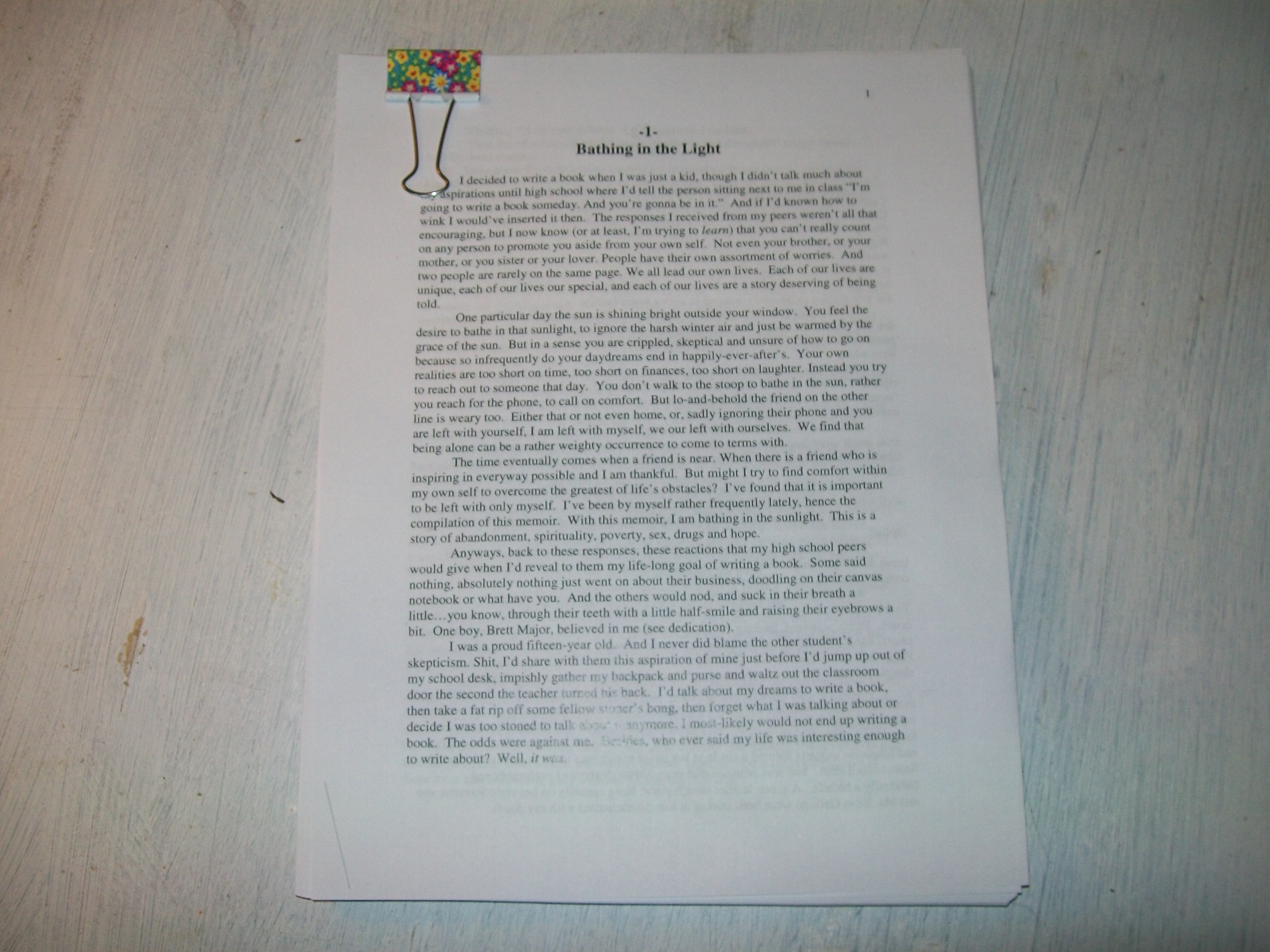
The Fruit of My Labor: A Piece About Writing and the Process

Not finished, but it’s all about the journey, not the destination. I feel good, and thank goodness for digital copies!

Some days something can go wrong but nothing, nothing, can throw you off course.

Today I woke at 4:55 a.m. but went back to sleep knowing the library didn’t open until 10:00. That’s where I needed to be and rather than wait around for the big event I went back to sleep. I woke without an alarm at 10:20 or so on my day off and showered, chugged some water, did a couple of necessary things and headed out the door with my necessities: library books for return, my wallet, and my black binder filled with the rough draft of my memoir and the 20 or so “loose” scenes I needed to merge into it.

This day had been awaiting me and after it was over I would call Nan Phifer, a local memoirist, and tell her how it went. Nan agreed to counsel me as I merged my freshly typed scenes into my first draft which I’ve been writing for, ahem, three years (this shit is not easy). I was nervous about the process of merging, wondering if these scenes even had a place to go and too I am anxious about writing the ending. Yeah, that hasn’t happened yet. Um…what does happen in the end? When does it end? Now? 2 years ago? 4 years ago?

Well aware of what a big day I had ahead of me, I first drove to a coffee shop near my house. I ordered a medium carmel latte and an everything bagel and sat down in a corner with Steven King’s On Writing: A Memoir of the Craft. He’d written it on what he thought was his death-bed and the result is a very honest, in your face account about the life of a writer and what to do and what not to do and when to give up because some people just should, according to him.  So, yeah, it’s good stuff, for sure. Hey, I had to have caffeine, and inspiration, and yeah, I had to eat too.

I burnt my tongue. I still feel it as I write this now. I thought “shit, this is the worst. Nobody should have to burn their tongue this bad on one of the biggest days of their life. Dammit.” The latte was too hot and not sweet enough and I bopped over to the self-serve counter and added some of that natural brown sugar and sat back down. I finished my morning meal and inspirational reading and nodded politely at the staff and headed on my way to library with the remaining gorgeous cup of latte in my hand.

I had to take big, deep breaths all throughout the morning. I will brimming with excitement. After returning my library books, I scanned all three stories looking for the perfect location at which I would work. Like a real writer. All sprawled out and in…the…zone. I didn’t know if this was going to take me 1 or 2 or 3 hours. I took long swings from the water fountain before I sat down at a square, polished pine table. I retrieved my black binder, my pencil-case, and Nan Phifer’s book Memoirs of the Soul, for guidance as needed.

I immediately stood up. It was instinctive. This was not a sitting task. Like Nan suggests in her book, I laid out all the scenes to merge (Nan actually applies this concept to the entire rough draft of your book, where the scenes are actually chapters, with titles, and you arrange according to your liking. I’ve adapted this concept to what I have going) and I set the rough draft off to one side. I am familiar with the scenes to merge, so I arranged them in chronological order (i.e. what happens first in the storyline). I took a good, long look at the titles of the scenes to merge. Then I sat down and started quickly reading, for the most part scanning, the rough draft of my book.

Instantly the places where the scenes needed to go started popping up. I had to dig deep into the material at some points and insure that a scene was going, relatively where it needed to go. If the scene was in the general vicinity of where it needed to go, great. It never had a home anyway, and sloppily throwing it into the book could ultimately make the story more creative and fun and non-chronological (like Lidia Yuknavitch’s memoir!) I felt I was putting these scenes just where they needed to go. I’d move ’em later if I hadn’t.

Thirty minutes later I was done. Done. There was the draft, everything I had written, nice and tidy on the corner of a square pine table in a library, in Eugene, Oregon, in a sunny room, in the best place in the world as far as I was concerned. I still needed to double-check my zip drives for scenes that may not have made it to print, as I didn’t recall seeing Tyson or Dug Out — two very important scenes. A few minutes later, in the computer lab I found that yes, there were still scenes to print and merge. I printed, I merged again, big smile on my face, standing at the square, pine table in the sunny room near a wall of local art that I really enjoyed and took a moment to look at, remembering how in the email my boyfriend’s mother sent me today she said “don’t forget to stop and smell the roses”. Good point.

An hour later and I’m at Office Depot on 11th Ave., one of my favorite places, picking up a copy I had made of my memoir. Of most of my memoir. Of my memoir, minus the ending, as you know. It is fruit. It is the fruit of my labor. It is not ripe, no, but it is there. It is food, it is hope, it is tangible and fucking sexy as hell. It is a joy to be this far. Tomorrow Nan and I will talk about, well, whatever I want to talk about and in another small way, I will have arrived. I said in the beginning that I was writing this book for me. And if that is so, than I have made myself very happy today. I am pleased today, for myself. I say most of the time nowadays that I am writing this book for other people. That is the idea, to share it with other people. Maybe with young girls who are becoming women and are making decisions and need someone to relate with. Maybe for men who like reading memoirs. Maybe with you.

10 Reasons Why I Write

1) People don’t listen to me when I talk (I’m soft-spoken and, you know, people are assholes)

2) I’m an artist

3) There’s verrrrry little overhead cost, a pen, paper? Come on

4) Being able to read and write is a priviledge not everyone has

5)  Ideally I will have a career as a writer, so I need to practice!

6) Because I aspire to publish a memoir and that requires a bunnnnch of writing

7) Because when I read books, I can’t help but think “Hey–I can do that!”

8) Some people earn lots of money writing books, I want to be like those people! I want to break my family tradition–poverty

9) I want to be well-known, small-scale, large-scale, whatever. I want a fan or two or several thousand

10) Because I’m compelled to! Somebody said (help me out here) that you don’t choose writing, writing choses you

The Chronology of Water by Lidia Yuknavitch

When visiting the Eugene Public Library, a bi-monthly event, I sit down at a computer and do a quick search for memoirs. I snatch one of those little square white slips of paper and one of those baby pencils with no erasers and scrawl out the call number and the first four letters of the author’s last name. Usually the memoirs are found in section 921. I write down about 7 books, knowing that I’ll be unable to locate a couple of them, for whatever reason, and that one or two I’ll end up not liking at all, upon seeing the cover, upon reading the first few lines. I’ll leave with four books or so. I’ll get ’em home and read half of those. Right now, for example, I’ve got a book called Patty’s Got A Gun, it’s about Patty Hearst. I read a little bit but it didn’t catch me because, as intriguing as the story is, I already know the gist of it and the author’s writing isn’t making me feel like he’s going to tell me anything new. The author’s writing. The author’s writing.

I used to be a big believer in fate. Not so much in destiny really, but that if I sort of held my hands out in front of me and closed my eyes and slowly walked (figuratively, for the most part) toward the places and people and trees and parks and coffee shops that felt good, that felt right, warm, light, loving, that I would end up where it was appropriate for me to be that if I had mindlessly walked into life that day. That I would end up where I was supposed to be. I used to look for signs everywhere pointing me to these places. I used to keep my eyes wide-open. I used to. I used to. That was a long time ago. Since then I’ve realized that I hold the power, regardless of how spiritually mindful I am being or not, to make things happen in my life, to change things, to get what I want, to make decisions. It’s almost as if it’s entirely up to me, and not depending upon the Universe at all. This took a while to come to terms with, being that I was raised up by such a religious father. My father always told me things like “God will take care of it.” Now, whether it was the Universe leading me to Lidia Yuknavitch’s book or that I just happened upon it: I feel that this was meant to happen. Not predetermined, just meant to happen. At this time. Not one month ago, not one year from now. Now. I’m having one of those: ohmigod, what if I had never come across this book/person/story/insight feelings.

Let me tell you more…when I did that computer search for memoirs roughly a week and a half ago I came across a book description that mentioned something about a drowning. A drowning? Hey–I know about a drowning! My Dad drowned, wait, almost, you know, not quite. Done. I wrote down the call number and the letters YUKN. My boyfriend was with me that day and he and I set out to find my memoirs. If I remember right, he found the first memoir, handed it to me, I mentioned something about it having a beautiful cover, and I tucked it under my arm, almost instinctively. I got that book about Patty Hearst, which had been mistakenly filed under her last name, like it was her book, like it was a memoir. I didn’t look twice at that book, it was like once I had Lidia Yuknavitch’s The Chronology of Water, I was all ready to go home and start reading.

When I began reading the book, I was instantly impressed with Lidia’s poetic writing. I said aloud to my boyfriend in the car, “she just called her still-born baby ‘little dead girlfish’. That’s awesome.” I looked at him and quickly said, “but not, you know, of course, but, I mean, who does that? Nice...” We got home and I put the book away and got busy for a few days with a ballet recital and family visiting and I forgot about the book. Not entirely of course. I picked it back up and got sucked into the story. Some people like to cover things up and ignore them and pretend like they never happened like an unmarked grave. Not Lidia.

I’ve got a lot to learn from Lidia Yuknavitch. Just like she had a lot to learn from Ken Kesey. About one-quarter way through the book, Lidia moves to Eugene. Eugene! That’s where I live! I’ve read other books where people move to Eugene but within a page or two they pick up and move somewhere else, like I’ve sometimes wanted to do. But Lidia, she stayed. Lidia knows that where a person lives does not make or break them. Unlike me, Lidia doesn’t say “I just feel like I’m supposed to be somewhere else” or “It will all come together when I live there and am doing that.” Lidia stays in Eugene for a decade or more and starts off going to creative writing classes at the U of O, classes that she isn’t even paying for, isn’t even signed up for, and she learns that although she feels like she can’t do anything right, she can write. She can write. Lidia stays in Eugene and she learns how to write, amidst a sea of people she feels she is nothing like. She goes to seminars with a flask tucked in her pocket and she fucks the author speaker, man or woman, at the Best Western down the road, the same Best Western where my family just stayed at when they were in town, visiting. She drives the same road I do to get to the coast and she lives in the same neighborhood, just closer to the train tracks.

I google Lidia Yuknavitch and discover that she was recently at the U of O presenting a lecture at the Memoir Fest. I knew about the Memoir Fest but decided not to go because it’s on campus and you know, I’m so above and beyond that and what does campus want with me anyway? I should’ve tucked a flask under my arm and gone. I should’ve, I should’ve.

I read some more and discovered that Lidia Yuknavitch has a Writer’s Workshop! In Portland! In September! It’s not full yet and it’s happening, it really is, on Tuesday’s, at 6:30! (If you can’t tell, I totally plan on going. And if you don’t know me, know that when I say I’m going, I go. I’ll just pretend to hear your “I’m so happy for you!” Dude, it only costs, like 150 bucks.)

I haven’t finished reading the book yet. When I have a good book I like to draw it out like my dad’s loogy. Speaking of dad’s…remember how Lidia’s book description talked about the tragedy around drowning, or almost drowning? That was her dad, her dad almost drown. She still hasn’t gotten back to that. It’s sort of hanging out in the air. I want to know what happened but I wouldn’t imagine most readers do, because nobody cares, because he was a rapist. Lidia’s got a lot of loose ends to tie up in this book, but whether she does or doesn’t, I don’t care. That’s how good this book is. I can dig any book that talks about broken women and lots of sex and S & M and men and women that behave like men and writing and drugs and more drugs and hope and hopE and hoPE and hOPE and more HOPE and VICTORY. I can dig a book that breaks all the rules. I can dig Lidia Yuknavitch.

In Praise Of The Memoir

It wasn’t even a memoir that got me interested in writing a memoir. It was a book that read like a memoir: White Oleander by Janet Fitch. I read White Oleander and I thought “I can do this, only my story will be true, not fiction.” I read it again a few days later and I thought “No, I most likely cannot do this. I cannot write with nearly as much eloquence and skill as Janet Fitch, but who can? Again I told myself, I can do this, to a certain extent. Yes I can.”

That was going on ten years ago. The seed was planted. I was a teenager then, sixteen, and I didn’t feel very comfortable telling people I was planning on writing a book. My wisdom told me that nobody cares if you’re planning on writing a book, that people only care when you are writing a book. I now know that even that is only partially true. Too, I had a feeling that some of the things I was going through at the time…really needed to be in the book. I decided to ride those things out, and planned to write about them later. Plus I was too busy partying and having emotional breakdowns and sleeping off all-night coke binges to do any writing.

My second wave of inspiration came from Jeannette Walls The Glass Castle. My. Favorite. Memoir. By far. And yes, it’s a memoir, it’s not fictional like the Janet Fitch book mentioned prior. It’s embarrassing, but at twenty-three years old or so, I still had very little knowledge about what a memoir was, as opposed to an autobiography, for example. A simple interpretation is that where an autobiography is an author’s life story, often presented chronologically, a memoir can focus on just one main event in a person’s life (such as divorce), or one time period (such as childhood) and does not need to be (nor is it recommended) chronological. However, many memoirs do touch on the author’s childhood even though the story is mainly about her divorce at age forty or will encompass several themes such as divorce, abuse, addiction and manic depression all in one. The Glass Castle, for example, is a story about poverty, alcoholism, sexual abuse, and, ultimately, forgiveness. Forgiveness is the main theme, see, the focus of a memoir isn’t all “poor me, poor me”. In fact, I do believe Jeannette Walls had to literally write this book in order to forgive her parents. Her parent’s are very deserving of forgiveness. Everyone is. See, it all worked out for everyone in the end. When people write about their parents, their grandparents, their siblings and nasty things come up: that’s just life, nasty things come up. The stories are not often intended to target or blame anybody. You can bet your bottom dollar the author is revealing all the nasty things he or she has done too (and then some, if they’re truly conscious). A story without any character’s wouldn’t make it to Chapter 2. And a character without any problems would read like a glass of water in front of a person lookin’ to get real drunk. Remember that before you question memoirists about their airing the family’s dirty laundry. I think for most of us (aspiring memoirists): it just comes naturally.  As naturally as an imperfect parent. Jeannette Wall’s mother was portrayed as a lazy, unrealistic dreamer who condoned physical and sexual abuse against her children and ended up a greasy homeless woman (with a mean mustache) living on the streets of New York City. When Jeanette published the book, her mother’s only comments seemed to be how absolutely proud she was of her daughter. I hope it works out that way for me. My father doesn’t have a computer. I showed him my blog for the first time the other day and he barely lifted a brow. He changed the subject in fact…I don’t think he gets it.

Today, I’m reading The Chronology of Water by Lidia Yuknavitch. So far, it’s a memoir that’s vastly unchronological and very poetically and intriguingly describes scenes of drug-use and sex while a young woman tries to accomplish something, anything, in her life. I ABSOLUTELY love the book at this point and I’m only a sliver deep. I have a feeling it will be right up there with White Oleander and The Glass Castle, books I consider my “model memoirs”, but of course, it’s too early to tell.

Of the twenty plus memoirs I’ve read since The Glass Castle, there are about ten I consider pure gold. I’d like to share that list with you. Perhaps you’ll enjoy the books as much as I did. In addition, please, please, please share with me the titles of your favorite memoirs! (Note: I am particularly interested in the following topics: rural America, womanhood, addiction, poverty, and sexual abuse) In fact, I very strictly do not read material that is too detached from the things I am writing about, which are the topics mentioned above. This may sound ignorant to you, it is not, this is a strategy. I am very focused on writing this memoir right now. I am eating and breathing these things. I’ll read a memoir about English high-society later. I really will.

Okay, here’s the list (sans the books that were already mentioned):

A Piece of Cake by Cupcake Brown
Another Bullshit Night in Suck City by Nick Flynn
Promiscuity by Kerry Cohen
Tweek by Nic Sheff
A Beautiful Boy by David Sheff
Some Girls: My Life in a Harem by Jullian Lauren
Expecting to Fly by Martha Tod Dudman
Running With Scissors by Augusten Burroughs
I’m Down by Mishna Wolfe
Scar Tissue by Anthony Kiedis (technically an autobio, but whatever)